If you've spent any time in the gym, you've probably heard a dozen different opinions on how many sets of bench press you should be doing. Cut through the noise: for most people chasing strength and size, the magic number is somewhere between 8 to 12 working sets per week.
This isn't just a number I pulled out of thin air. Think of it as a solid, evidence-backed starting line for your training.
Why 8 to 12 Sets Is the Gold Standard
That 8-12 set range is the sweet spot for a reason. It's enough of a stimulus to force your muscles to adapt and grow, but not so much that you completely overwhelm your body's ability to recover.
It’s like watering a plant. Too little, and it withers. Too much, and you drown the roots. Your muscles respond to stress in a very similar way—they need just the right amount to get bigger and stronger.
The Data Behind the Numbers
This isn't just bro-science, either. A 2023 analysis of smart gym users actually crunched the numbers and found that lifters doing 8 to 12 sets of chest exercises weekly saw the best strength gains on their bench press.
The folks doing fewer than 8 sets? They left gains on the table. And those who pushed past 12 sets? They often hit a wall, proving that more isn't always better. It’s a classic case of diminishing returns.
Your Sets Should Match Your Goals and Experience
Of course, the "right" number of sets isn't one-size-fits-all. It's going to shift depending on what you're training for and how long you've been lifting.
-
For Strength: You're lifting heavy for low reps (1-5). This is incredibly taxing on your central nervous system, so you'll naturally do fewer total sets to avoid burning out.
-
For Hypertrophy: This is where that 8-12 set range really shines. You're typically working in the 6-12 rep range, which is perfect for maximizing muscle growth.
-
For Endurance: You're using lighter weight for high reps (15+). Since the intensity is lower, you can handle a much higher number of total sets per week without overdoing it.
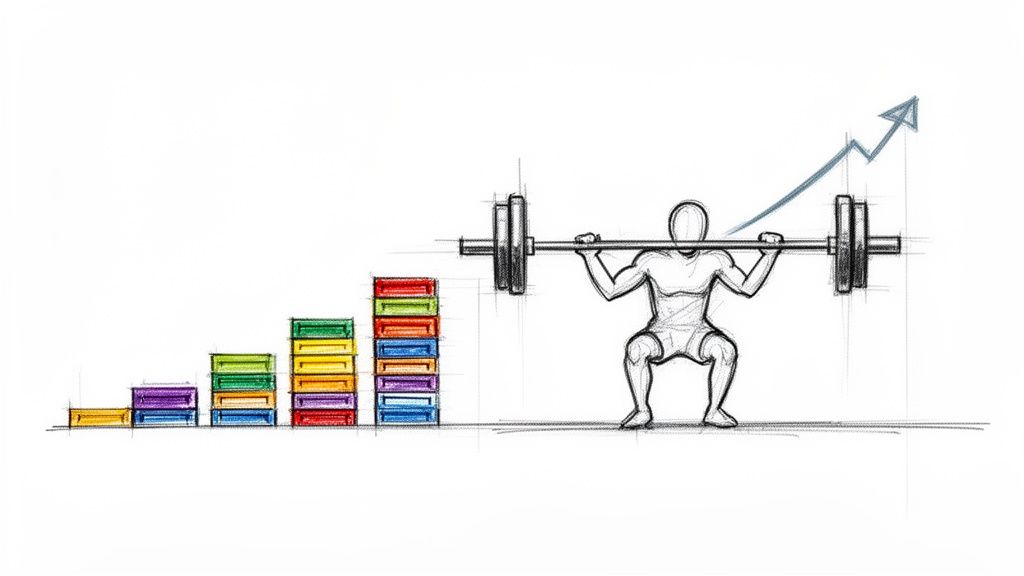
The chart below gives you a good idea of what progress looks like. Moving from a beginner to an intermediate lifter is all about consistently putting in the right amount of work over time.

To make this super practical, here’s a quick-reference table that breaks down how many weekly sets you should aim for based on your experience and primary goal.
Weekly Bench Press Set Recommendations
This table provides a quick reference for the recommended number of total weekly bench press sets based on your primary training goal and current experience level.
| Experience Level | Strength (1-5 Reps) | Hypertrophy (6-12 Reps) | Endurance (15+ Reps) |
|---|---|---|---|
| Beginner | 6-8 sets | 8-10 sets | 10-12 sets |
| Intermediate | 8-10 sets | 10-14 sets | 12-16 sets |
| Advanced | 10-12 sets | 12-18 sets | 16-20+ sets |
Remember, these are starting points. An advanced lifter might be able to handle—and benefit from—the higher end of these ranges, while a beginner should definitely start on the lower end to avoid getting sidelined by poor recovery.
Decoding the Three Pillars of Training Volume
Asking "how many bench press sets?" is a great starting point, but it's a bit like asking a chef how much salt to use without mentioning the dish. The number of sets is just one ingredient in a much bigger recipe for building strength and muscle. To really cook up the results you want, you need to get a handle on the three core components of training volume.
Think of it like mixing a song. You've got three main dials: sets, reps, and intensity. Each one changes the final sound—or in our case, the training stimulus your body receives. They all have to work together.
The Three Pillars Explained
These three pillars are completely intertwined. Tweak one, and you almost always need to adjust the others to keep your training effective and, more importantly, stay injury-free.
-
Sets (How many times you play the track): This is the number of times you perform an exercise after your warm-ups. Each set is a fresh chance to challenge your muscles.
-
Reps (How long the track is): These are the repetitions you complete within a single set. This dictates how long your muscles are under tension.
-
Intensity (The volume knob): This is simply the weight on the bar, usually talked about as a percentage of your one-rep max (1RM). It’s the most straightforward measure of how hard each individual rep is.
Getting this interplay right is everything. You can't just crank all the dials to max and expect a masterpiece; you'd just get distorted noise. In the gym, maxing out sets, reps, and weight all at once is a fast track to burnout, not progress. The real art of programming is finding that sweet spot.
Why Context Is Everything
Let's make this real. Imagine two lifters in the gym. They both do three sets of bench press. On paper, it looks the same. But their workouts are worlds apart, creating completely different results.
Lifter A (Strength Focus):
-
Sets: 3
-
Reps: 3
-
Intensity: 225 lbs (90% of 1RM)
Lifter B (Hypertrophy Focus):
-
Sets: 3
-
Reps: 12
-
Intensity: 155 lbs (65% of 1RM)
Lifter A is grinding through a heavy, low-rep session built for raw strength and teaching the nervous system to fire more efficiently. The high intensity means long rest periods and a serious tax on the central nervous system. The total number of reps is low (just 9 reps), but every single one is a maximal effort.
Meanwhile, Lifter B is chasing muscle growth. Their workout uses lighter weight for more reps, racking up a total of 36 repetitions. This approach creates a ton of metabolic stress and muscle damage—two key drivers for hypertrophy. You can dive deeper into how this works in our guide on effective reps vs volume for hypertrophy.
The key takeaway is that the number of sets doesn't exist in a vacuum. A "set" is just a container; its true impact is defined by the reps and intensity you put inside it.
Understanding this is your ticket to smarter programming. Once you learn to manipulate these three pillars, you can move past generic advice and start building a bench press routine that’s dialed in for your specific goals, whether that’s hitting a new PR or building a bigger chest.
Matching Your Bench Press Sets to Your Goals
Now that we’ve got the basics down—sets, reps, and intensity—let's connect them to what you're actually trying to do in the gym. The number of bench press sets you should do is completely tied to your main goal. What works for building raw strength is worlds apart from what you need to maximize muscle size or endurance.
Think of it like this: your sets are a specific tool for a specific job. You wouldn't use a sledgehammer to hang a picture, right? And you wouldn't use a tiny tack hammer to break up concrete. In the same way, the volume you throw at your bench press has to be dialed in for the result you're chasing. To really nail this, it helps to understand the core principles for smarter resistance training that keep you progressing for the long haul.
Sets for Maximal Strength
When your goal is pure, unadulterated strength, the name of the game is lifting heavy. I'm talking about working with weights that are 80-100% of your one-rep max (1RM), usually for just 1-5 reps per set.
This kind of training is incredibly taxing on your central nervous system (CNS), the command center that fires up your muscle fibers. Because the intensity is sky-high, recovery is everything. Push too many sets in this zone, and you'll quickly hit CNS fatigue, stall out, and burn out.
That's why a lower weekly set count is the way to go. Most strength-focused programs keep the bench press volume in the 6-10 working sets per week range. It's just enough stimulus to drive those neurological adaptations—making you more efficient at lifting heavy—without completely frying your system.
Sets for Building Muscle (Hypertrophy)
If building a bigger, fuller chest is your priority, the whole approach changes. The goal with hypertrophy training is to create a cocktail of muscle damage, metabolic stress, and mechanical tension. This is the signal your body needs to repair and grow bigger.
This is where the classic 8-12 weekly set range really shines. For muscle growth, the sweet spot for reps is generally considered 6-12 reps per set, using a moderate weight of around 60-80% of your 1RM. It’s the perfect blend of intensity and volume to get the job done. Each set pushes the muscle close to failure, racking up the fatigue needed for growth.
The data backs this up, too. A StrengthLog analysis of over 24,000 users found the average intermediate male bench press is 220 lbs. Other industry data shows that consistently hitting 8-12 weekly sets of chest work is a key driver in getting from a novice lift (~176 lb bench) to that intermediate level. It just goes to show how this volume range fuels real progress.
This flowchart below is a great visual for how sets, reps, and intensity all play together to get you different results.

As you can see, when your goal changes, the balance between your sets, reps, and the weight on the bar has to change with it.
Sets for Muscular Endurance
Finally, if you're training for muscular endurance—the ability to keep knocking out reps for a long time—the whole workout structure gets another shake-up. This is a big one for athletes in sports that demand sustained effort, like HYROX competitors.
For endurance, the focus shifts from maximal force production to fatigue resistance. This requires a higher volume of work with significantly less rest between sets.
Here, you'll be working with much lighter weight, often below 60% of your 1RM, for 15 or more repetitions per set. Because the intensity of each rep is low, your body can handle a much higher total number of sets without breaking down.
A typical endurance plan might call for 12-16+ sets per week, often with rest periods as short as 30-60 seconds. This approach trains your muscles to get better at clearing out metabolic gunk like lactic acid, which is what lets you keep pushing for longer.
If this sounds like your kind of training, check out our guide on a Hyrox-focused upper body workout for more ideas. By lining up your set count with your specific goal, you make sure every trip to the gym is a direct step toward the results you want.
How Training Frequency and Experience Impact Your Sets
Thinking about your bench press sets only on a per-workout basis is like planning a road trip by looking at just one town on the map. You're missing the bigger picture. The real secret to making progress isn't just about how many sets you cram into Monday, but how many effective sets you accumulate across the entire week.
When you shift your focus from "sets per workout" to "total weekly volume," you unlock a much smarter way to build your training plan. This is especially true when it comes to training frequency—how often you hit the bench press. It’s the difference between cramming for an exam in one all-nighter versus studying a little bit each day.
For most lifters trying to build muscle and strength, that sweet spot of 8 to 12 working sets per week doesn't have to happen in one marathon session. In fact, for a lot of people, it absolutely shouldn't. Spreading those sets out over multiple days can seriously accelerate your gains.
The Power of Higher Frequency Training
The old-school "bro split" mentality often meant hammering one muscle group once a week with a ton of volume. You can definitely make progress that way, but a growing pile of research shows that hitting a muscle more often with less volume each time is usually a better approach.
One landmark 12-week study on untrained men completely flipped this idea on its head. The group that trained three days a week saw a massive 62% boost in their upper body one-rep max and a 27% strength increase. The group training just once a week? They still got stronger, but with a much smaller 53% and 10% increase, respectively.
Splitting the volume lets you recover better between sessions and gives you more chances to practice your technique. Better technique means better neurological efficiency, which makes you stronger.
This highlights a crucial concept: higher frequency allows for higher quality sets. Instead of grinding through your eighth set when you're already wiped, you're performing fresh, powerful sets more often.
This approach is a game-changer for beginners, but lifters at any level can use frequency as a powerful tool. It's also important to adapt training as you get older; you can learn more about effective strength training principles for older adults.
Tailoring Sets to Your Experience Level
How you spread out your weekly sets depends heavily on how long you've been lifting. Your body's ability to handle and recover from training volume isn't static—it evolves over time.
Beginners (0-1 year of consistent training)
Your number one job is mastering the form. More frequency is your best friend here because it gives you more opportunities to practice the movement pattern correctly each week.
-
Weekly Goal: 6-9 total sets.
-
Strategy: Spread these sets across 2-3 workouts. A simple plan like 3 sets of 5 reps on Monday and Friday is perfect. This keeps you fresh for every single set, lets you focus on perfect technique, and helps you avoid the killer soreness that could derail your consistency.
Intermediates (1-3 years of consistent training)
You've built a solid foundation and can now handle more total work. Your goal is to start pushing the upper end of the recommended volume range to keep the gains coming.
-
Weekly Goal: 10-14 total sets.
-
Strategy: Hitting the bench twice a week often works perfectly. A great way to structure this is with a heavy day and a volume day.
-
Monday (Strength Focus): 5 sets of 3-5 heavy reps.
-
Thursday (Hypertrophy Focus): 5 sets of 8-12 reps with a lighter weight.
-
This split lets you build both raw strength and muscle size at the same time.
-
Advanced Lifters (3+ years of consistent training)
At this stage, gains come much slower. You're walking a fine line between creating enough stimulus to grow and just plain overtraining. Managing your volume and recovery is everything.
-
Weekly Goal: 12-18+ total sets (this will often vary with periodization).
-
Strategy: Advanced lifters might bench three times a week with different intensities. This allows for super high weekly volumes without accumulating too much fatigue in any single workout. They'll also use periodization, cycling through phases of high, medium, and low volume to keep their body guessing and manage recovery.
If you're looking for inspiration on how to structure your training days, you can find some great routines in our library of Strive workout plans.
Troubleshooting Common Bench Press Plateaus
Every single lifter, no matter how dialed in they are, eventually hits a wall. The weight on the bar just stops moving, your motivation takes a nosedive, and you start wondering if you’ve hit your genetic limit. This, my friend, is a bench press plateau, and it’s a completely normal part of the game.
More often than not, the answer is hiding in your training volume—specifically, how many bench press sets you're actually doing.
Plateaus usually pop up for one of two reasons: you're doing too little, or you're doing way too much. Think of it like trying to get a tan. Not enough sun, and you stay pasty. Too much, and you get fried. Your muscles need that perfect dose of stress to adapt and come back stronger.

Are You Doing Too Little?
Under-training is a surprisingly common reason for a stalled bench, especially for lifters who are a bit too cautious about adding more work. If you aren't giving your body enough of a reason to change, well, it won't.
The biggest giveaway is a lack of progress paired with feeling fantastic all the time. You’re never sore, you feel 100% recovered for every session, and the weights feel fine… they just aren't going up. This is your body telling you it has adapted and is basically bored.
The fix here is classic progressive overload. Start gradually increasing your weekly set count. If you’re currently doing 8 sets of bench a week, try bumping it to 10 sets for your next training block and see what happens.
Are You Doing Too Much?
On the flip side, we have overtraining—or more accurately, under-recovering. This is what happens when you push past your body's ability to repair itself between workouts, and your performance starts to go backward.
The classic symptoms of doing too many sets include:
-
Constant fatigue and low energy, even on rest days.
-
Nagging muscle soreness that just won’t quit.
-
A noticeable drop in strength—weights that used to be your warm-up now feel heavy.
-
Feeling irritable, sleeping poorly, and dreading your workouts.
If this sounds like you, the best thing you can do is program a deload week. Just pull back your total sets and intensity by about 40-50% for one week. This gives your muscles and nervous system a much-needed break. After that week, you can ease back into your training, and you’ll often feel stronger than you did before.
A plateau isn't a dead end; it's a crossroads. It's your body's way of telling you that your current approach needs a strategic adjustment. Listening to these signals is what separates good lifters from great ones.
Bench Press Plateau Symptoms and Solutions
Diagnosing the why behind your plateau is the first and most important step. To help you figure it out, I've put together this quick-reference table. It breaks down the common signs of a stalled bench and gives you a clear, actionable game plan to get things moving again. Use it to fine-tune how many sets you’re doing and get back on the path to PRs.
| Symptom | Potential Cause | Actionable Solution |
|---|---|---|
| No soreness, feel great, but weak | Insufficient Volume | Gradually increase your weekly sets by 1-2 and monitor your performance. |
| Constantly tired, sore, and weaker | Excessive Volume | Take a deload week, cutting sets and intensity by half. Then, return to a slightly lower volume. |
| Stuck at a specific rep or weight | Sticking Point Weakness | Maintain your current set count but add accessory exercises like close-grip bench or overhead press to build support. |
| Progress is boring and has stalled | Lack of Variation | Keep your total sets the same but vary your intensity. Try a heavy day (4×5) and a volume day (4×10) each week. |
By paying attention to your body's feedback and making these small, smart adjustments, you can turn that frustrating plateau into a launchpad for your next wave of progress. Don't be afraid to experiment a little—that’s how you find what works best for you.
A Few Common Questions About Bench Press Sets
Once you start getting serious about your bench press, a few practical questions always seem to pop up. Getting the details right can be the difference between spinning your wheels and making consistent progress. Let's clear up some of the usual suspects.
Do Warm-Up Sets Count Toward My Weekly Total?
I see this one all the time, and the answer is a hard no. Your warm-up sets and your working sets are two totally different animals. Think of warm-ups as the rehearsal and your working sets as the main event.
Warm-ups are all about getting the machinery ready. You're using light weight to pump some blood into the muscle, get your joints moving smoothly, and wake up your nervous system for the real work ahead. They're just too light to trigger any real muscle growth.
Your working sets are the only ones that count toward your weekly volume. These are the tough sets, the ones you do after you're fully warmed up, that actually force your muscles to get bigger and stronger.
How Many Sets of Accessory Work Should I Add?
Accessory exercises are the supporting cast for your main lift. For the bench press, we're talking about things like triceps pushdowns, overhead presses, and dumbbell flyes. They build up the smaller muscles that help you bench, smashing through weak points in the process.
A solid rule of thumb is to add 3-6 direct working sets per week for the key supporting muscle groups (mainly your triceps and shoulders). That's enough to spark some growth in those areas without digging you into a recovery hole that messes with your main lift.
For instance, your accessory work for the week might look like this:
-
Triceps: 3 sets of cable pushdowns on Monday.
-
Shoulders: 3 sets of lateral raises on Thursday.
This keeps things targeted and effective. You're building a stronger foundation without overdoing it.
How Do I Know When It’s Time to Add More Sets?
Your body is pretty good at telling you when it’s ready for more. The most obvious signal is a plateau. If your numbers have been stuck for a few weeks and you know your sleep and nutrition are dialed in, your body has probably adapted to what you're throwing at it.
Before you just pile on more sets, double-check that your recovery is genuinely on point. If it is, and you're still stalled out, it’s time to introduce a new challenge. The trick is to do it slowly. If you're currently doing 10 sets of bench a week, don't just jump to 15. Nudge it up to 11 or 12, then hold it there for a few weeks and see how you respond. This is how smart, long-term progressive overload is done.
Ready to stop guessing and start tracking your progress like a pro? The Strive Workout Log is the no-nonsense app built to help you master progressive overload. Log every set, see your volume trend over time with clean charts, and set clear targets for your next session. Download it for free at https://strive-workout.com and take control of your training.
Article created using Outrank
Leave a Reply