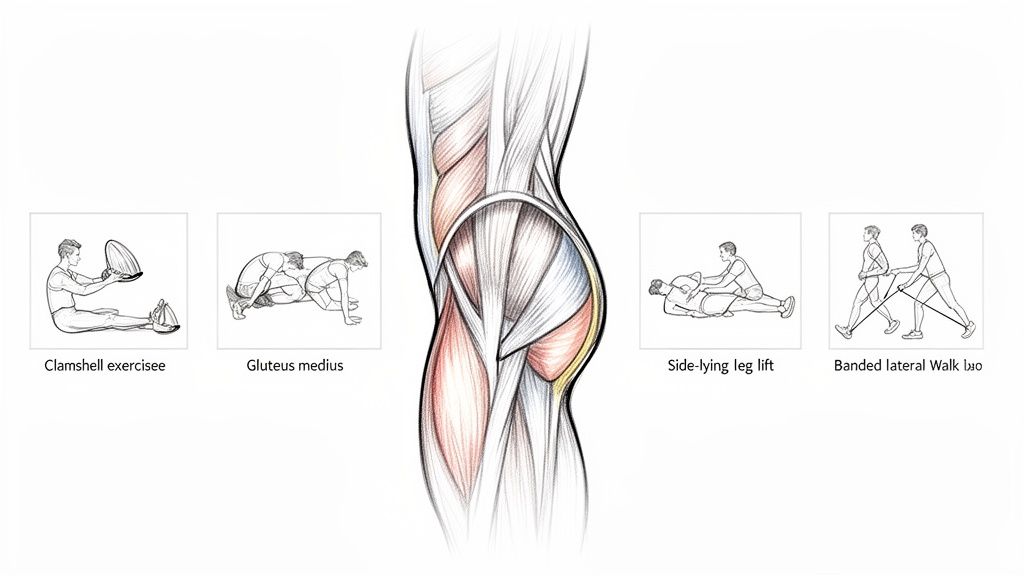
Beyond the Squat: The Science of Lateral Glute Strength
In 2026, the fitness industry has finally moved past the era of the “Instagram booty workout” and returned to biomechanics. We now know that standard squats and lunges, while excellent for the Gluteus Maximus, often fail to adequately stimulate the Gluteus Medius and Gluteus Minimus.
These two muscles are the primary stabilizers of the pelvis. When they are weak, knees cave in (valgus collapse), lower backs ache, and athletic power is leaked.
To build actual mass and strength in these muscles, you need Progressive Overload. Resistance bands often fail here because they provide variable resistance that drops off exactly when you need it most. The following 8 exercises are selected based on Electromyography (EMG) activity and—crucially—their ability to be loaded with real weight.
The Heavy Hitters: Loadable Compound Movements
These first five exercises are your primary strength builders. They allow for significant external loading via dumbbells, barbells, or cable stacks.
1. Single-Leg Box Squat
The Single-Leg Squat is arguably the king of functional glute strength. By removing the stability of the second leg, the Gluteus Medius on the working leg is forced to fire at near-maximal capacity to prevent the hip from dropping (Trendelenburg sign).
-
The Science: High recruitment of the Medius to maintain frontal plane pelvic stability while the Maximus handles the extension.
-
How to Load: Hold dumbbells in both hands or a kettlebell in the goblet position.
-
Execution: Lower yourself slowly to a box or bench. Tap the glutes lightly (do not sit fully) and drive back up.
2. Lateral Step-Up
Unlike the forward step-up, the Lateral Step-Up aligns the movement path with the Gluteus Medius’s primary function: abduction. This subtle shift significantly alters the recruitment pattern.
-
The Science: Studies indicate higher peak EMG activation for the Medius in lateral variations compared to sagittal (forward) variations.
-
How to Load: This is easily overloaded. Hold heavy dumbbells at your sides or use a barbell on your back.
-
Execution: Stand sideways to a bench. Drive the working foot down into the bench to lift the body. Focus on not pushing off the bottom foot.
3. Single-Leg Romanian Deadlift (RDL)
While primarily a hamstring and Glute Maximus builder, the Single-Leg RDL is a stealth killer for the Medius and Minimus.
-
The Science: The exercise creates a massive “anti-rotation” demand. As you hinge forward, the Glute Medius and Minimus must contract isometrically to prevent the pelvis from rotating toward the non-working side.
-
How to Load: Use a barbell, dual dumbbells, or a contralateral (opposite hand) kettlebell to increase the stability demand.
-
Execution: Keep a soft bend in the knee and hinge at the hips. Keep the hips “square” to the floor—do not let the floating hip open up.
4. Standing Cable Hip Abduction
Cables offer a distinct advantage over bands: Constant Tension. A band is slack at the bottom and tight at the top; a cable stack provides uniform resistance throughout the entire range of motion, which is superior for hypertrophy.
-
The Science: Isolates the abduction function of the glutes without the stability constraints of free weights.
-
How to Load: Use the weight stack. This is the easiest isolation exercise to micro-load for progressive overload.
-
Execution: Set the cuff at ankle height. Stand sideways to the machine. Abduct the leg directly to the side, pausing at peak contraction.
5. Angled Cable Kickback (30° Abduction)
Many lifters kick straight back (extension) or straight out (abduction). However, the posterior fibers of the Gluteus Medius are best targeted at a hybrid angle.
-
The Science: The fibers of the Glute Medius run diagonally. Kicking back at a 30-45 degree angle aligns the line of pull with the muscle fibers, targeting the “shelf” of the upper glute.
-
How to Load: Heavy cable stack.
-
Execution: Lean forward slightly holding the machine. Kick the leg back and out diagonally.
The High-Activation Finishers: Isolation & Stability
These final three exercises score incredibly high on EMG activation studies. However, they are mechanically difficult to overload with heavy weight. Place these at the end of your workout as “finishers” to exhaust the muscle fibers completely.
6. Side-Lying Hip Abduction
In clinical EMG studies, this exercise consistently ranks in the top two for peak Glute Medius activation, often beating heavy compound lifts.
-
The Limitation: It is difficult to load heavily because of the leverage. Holding a 50lb dumbbell on your thigh is awkward.
-
The Solution: Use this for metabolic stress (high reps). You can apply moderate load by holding a plate against your outer thigh or using heavy ankle weights.
-
Execution: Lie on your side. Keep the top leg straight and slightly extended behind you (to inhibit the TFL muscle). Lift comfortably high without crunching your waist.
7. Side Plank with Hip Abduction (“Star Plank”)
This is a brutal isometric and concentric hybrid. The bottom leg works isometrically to keep the hips off the floor, while the top leg works concentrically to lift.
-
The Limitation: Your core or shoulder stability will likely fail before your glute strength allows for extra weight.
-
The Solution: Do not worry about adding weight. Focus on time under tension and perfect rigid body mechanics.
-
Execution: Get into a side plank. Lift the top leg toward the ceiling. Hold for a count of two at the top.
8. Hip Hitch (Pelvic Drop)
This short-range movement is one of the few that specifically targets the deep Gluteus Minimus along with the Medius. It is subtle but effective for hip health.
-
The Limitation: The range of motion is only a few inches. Heavy loading can feel compressive on the spine if not done perfectly.
-
The Solution: Hold a moderate dumbbell in the opposite hand or stand on a box to allow the free leg to hang. Focus on the mind-muscle connection rather than moving heavy iron.
-
Execution: Stand on a step with one leg, letting the other hang off. Drop the free hip down, then “hitch” it up using only the side glute of the standing leg. Keep the knee locked.
How to Program This (2026 Update)
For optimal Gluteus Medius and Minimus development, you do not need to do all 8 exercises in one session.
The “2+1” Strategy: In every lower-body workout, include:
-
One Heavy Hitter: (e.g., Single Leg Squats or Lateral Step-Ups) performed for 3-4 sets of 6-10 reps.
-
One Finisher: (e.g., Cable Abductions or Side-Lying Abductions) performed for 3 sets of 12-20 reps to failure.
This ensures you get the mechanical tension required for strength and the metabolic stress required for muscle growth.
Leave a Reply