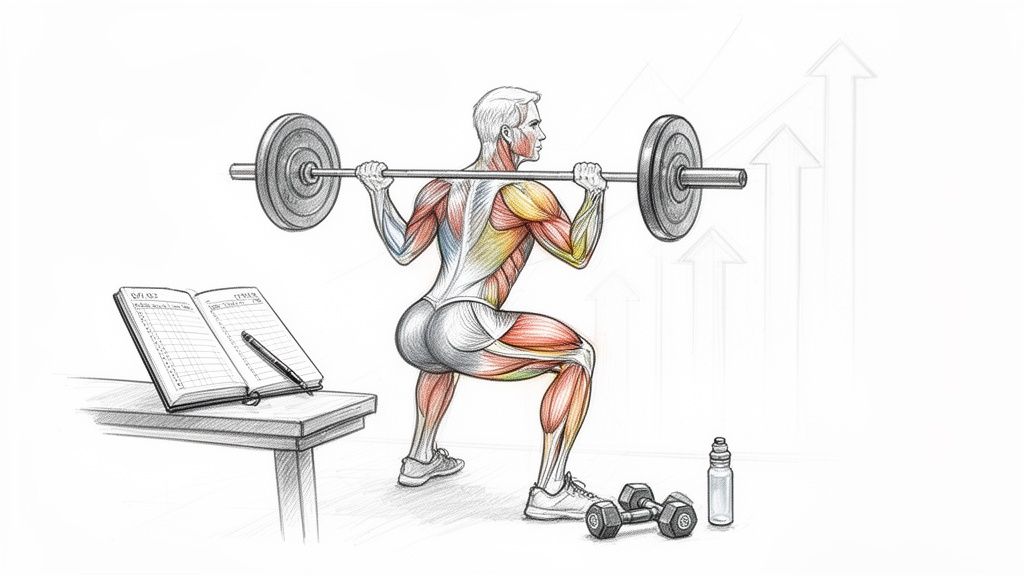
Starting bodybuilding can feel like trying to drink from a firehose of information. Everywhere you look, there’s a new “secret” or a complicated routine.
Let’s cut through the noise. Getting started really boils down to three things: consistent resistance training, eating enough to fuel muscle growth, and getting proper rest. Nail these, and you’re already ahead of the game.
Your Bodybuilding Foundation And What To Expect
As a beginner, you have a massive advantage. Your body is incredibly receptive to training, a period often called “newbie gains.” This isn’t just gym bro-science; it’s a real biological window where you’ll see some of the fastest progress of your entire lifting journey.
Understanding Newbie Gains
Since your muscles aren’t used to the stress of structured lifting, they respond like crazy. This is why the first few months are so magical—you get stronger and see changes faster than an experienced lifter ever could.
The science backs this up. It’s not uncommon for untrained people to pack on 4 to 7 pounds of muscle in their first three months of serious training. This is thanks to a massively spiked rate of muscle protein synthesis (MPS), which can be up to five times higher than in seasoned lifters. If you want to dive deeper into the science, honehealth.com has a great breakdown.
The Core Principles of Progress
Newbie gains are fantastic, but they don’t last forever. To keep the progress train rolling, you need to lock in a few foundational principles. Think of them as the operating system for building muscle.
Here’s a quick look at the core principles that will drive your long-term success.
Beginner Bodybuilding Core Principles
| Principle | What It Means | Why It’s Critical for Beginners |
|---|---|---|
| Progressive Overload | Gradually making your workouts harder over time—more weight, more reps, more sets. | This is the single most important trigger for muscle growth. Without it, your body has no reason to adapt. |
| Consistency | Showing up and doing the work, week in and week out, even when you don’t feel like it. | Sporadic workouts won’t cut it. A consistent schedule is the signal your body needs to start building muscle. |
| Nutrition & Recovery | Eating enough quality food (especially protein) and getting enough sleep. | You don’t build muscle in the gym; you build it when you rest and refuel. Training is just the stimulus. |
These aren’t just suggestions; they’re the non-negotiables. Nail these three, and you are guaranteed to make progress.
For a deeper dive into staying on track, check out our guide on how to stay consistent working out.
The gym is where you stimulate muscle growth. The kitchen and the bedroom are where you actually build it.
Setting Realistic Expectations for Your First 3 Months
So, what should you actually aim for? Forget about lifting giant weights right away. Your first three to six months are all about building a solid base.
Focus on mastering the form for big, fundamental exercises like squats, bench presses, and rows. Building a strong mind-muscle connection and learning to move the weight correctly is far more important than how much is on the bar.
Here’s a practical roadmap for your first few months:
- Month 1: Your only goals are technique and consistency. Learn the movements, don’t miss a workout, and get comfortable in the gym.
- Month 2: Start applying progressive overload. Track your lifts and try to add a little weight or an extra rep to your main exercises each week.
- Month 3: You should feel noticeably stronger. You might even start seeing some real changes in the mirror. This is where it gets addictive—when you see tangible proof that your hard work is paying off.
Crafting Your First Training Program
Wandering into the gym without a game plan is probably the fastest way to kill your progress before it even starts. A solid, structured program is your roadmap—it makes sure every single session builds on the last one.
For anyone just starting out, the best approach is always the one that focuses on efficiency and mastering the absolute fundamentals.
The core of any good beginner program is built around compound exercises. These are the big, multi-joint lifts that hit several muscle groups all at once. I’m talking about squats, deadlifts, bench presses, and overhead presses. They’re the meat and potatoes of building a strong physique.
On the flip side, you have isolation exercises like bicep curls or leg extensions, which zero in on a single muscle. They have their place, for sure, but your main focus should be on the compound lifts. They just give you way more bang for your buck by stimulating more muscle and building more overall strength.
The Power Of A Full-Body Split
As a newcomer to lifting, you really don’t need some complex, five-day split that hits a different body part each day. Your body is primed for growth right now, and hitting your muscles frequently is the secret sauce. This is exactly why a full-body routine performed three times a week is the gold standard for beginners.
This setup lets you train every major muscle group multiple times each week, which is perfect for learning the movements and cashing in on those “newbie gains.” Just train on non-consecutive days—like Monday, Wednesday, and Friday—to give your body plenty of time to recover and come back stronger.
Your goal isn’t to obliterate one muscle group and then wait a week to hit it again. It’s about consistent stimulation across the board to encourage growth, and a 3-day full-body split is the perfect tool for that job.
The principles behind a great starting program are pretty universal, although the specific exercises can be tailored. The fundamentals we’re talking about here work just as well for women as they do for men. You can see these concepts in action in this well-structured beginner gym routine for women.
Demystifying Sets, Reps, and How Much to Lift
Alright, let’s break down the language you’ll see in workout programs. If you see something like “3×8-12,” it can look a little cryptic at first, but it’s super simple.
- Sets: This is how many rounds you’ll do of an exercise. So, for 3x8-12, you’re doing 3 total sets.
- Reps (Repetitions): This is the number of times you perform the movement in one set. For 3x8-12, you’re aiming to complete between 8 and 12 reps in each set.
For building muscle (hypertrophy), the 8-12 rep range is a fantastic place to start. It’s the sweet spot that blends the mechanical tension and metabolic stress needed to make muscles grow.
Choosing your starting weight is more about feel than it is about ego. You’ve found the right weight when you can finish all your target reps with good form, but those last couple of reps feel like a real challenge. If you’re easily cranking out 12 reps, the weight is too light. If you can’t even get 8 without your form falling apart, it’s too heavy. Simple as that. For an extra kick in focus and energy, some people find success by incorporating pre-workout aids like energy gum before they hit the weights.
Your First Full-Body Workout Template
Putting it all together, here’s a simple but brutally effective full-body workout. Just run this routine three times a week on your training days.
Workout A (e.g., Monday)
- Barbell Squats: 3 sets of 8-10 reps
- Bench Press: 3 sets of 8-10 reps
- Barbell Rows: 3 sets of 8-10 reps
- Overhead Press: 3 sets of 10-12 reps
- Bicep Curls: 2 sets of 10-12 reps
Workout B (e.g., Wednesday)
- Deadlifts: 3 sets of 5-6 reps
- Lat Pulldowns: 3 sets of 8-10 reps
- Dumbbell Incline Press: 3 sets of 10-12 reps
- Leg Press: 3 sets of 10-12 reps
- Tricep Pushdowns: 2 sets of 10-12 reps
Workout C (e.g., Friday)
- Barbell Squats: 3 sets of 8-10 reps
- Dumbbell Rows: 3 sets of 8-10 reps
- Bench Press: 3 sets of 8-10 reps
- Lateral Raises: 3 sets of 12-15 reps
- Face Pulls: 2 sets of 15-20 reps
This program covers all your bases. It’s built on a foundation of the most important compound lifts and sprinkles in just enough isolation work to hit specific muscles. The real key here is to nail your form before you even think about chasing heavy numbers. Get that right, and you’ll have a rock-solid foundation for the rest of your bodybuilding journey.
How To Master Progressive Overload For Continuous Growth
If you only take one single concept away from this entire guide, make it this one. Progressive overload is the non-negotiable, fundamental law of building muscle. Plain and simple, it just means you have to constantly make your workouts harder over time. This is what forces your muscles to adapt by growing bigger and stronger.
Your body is a ridiculously efficient machine. It has zero interest in changing unless it absolutely has to. If you lift the same weights for the same reps week in and week out, you’re giving your body no new reason to grow. You have to introduce a stimulus that’s greater than what it’s used to. That’s the signal that tells your body, “Hey, we need to build more muscle to handle this workload.”
This principle is the real engine behind all long-term gains, whether you’re a total beginner or a seasoned pro. Without it, you’re just exercising—not actually training for growth.
More Than Just Adding Weight
When most people hear “progressive overload,” they immediately picture slapping more plates on the barbell. And while adding weight is a fantastic way to progress, it’s just one tool in the toolbox. If you rely on it exclusively, you’ll hit a wall fast, or worse, your form will go down the drain.
The truth is, you can challenge your muscles in a bunch of different ways. Learning these methods gives you more ammo to keep the gains coming, especially when piling on more weight just isn’t happening.
- Increase Your Reps: If you benched 135 lbs for 8 reps last week, your goal this week is to hit 9 or 10 with the same weight. This is one of the safest and most reliable ways to progress.
- Add More Sets: Finished 3 sets of squats last session? Try adding a fourth set this time. This bumps up your total workout volume, which is another huge driver for muscle growth.
- Improve Your Form: This is a sneaky one. Try slowing down the negative (eccentric) part of the lift or pausing for a second at the point of peak contraction. This increases the time your muscles are under tension, making the same weight feel way harder.
The goal isn’t just to lift heavier; it’s to consistently demand more from your body than you did before. Whether that demand comes from more weight, more reps, or better technique, the principle remains the same.
A Real-World Example of Progression
Let’s see how this plays out in the real world. Imagine your goal is to get stronger on the bench press, and you’re currently working with 135 lbs for 3 sets in the 8-10 rep range.
Here’s what a simple 4-week progression could look like:
- Week 1: You hit your target: 3 sets of 8 reps (3×8) with 135 lbs. It felt tough, but your form was solid.
- Week 2: Instead of jumping up in weight, you focus on adding reps. This week, you manage 3 sets of 9 reps (3×9) with 135 lbs. Nice.
- Week 3: You push again and hit your top-end goal of 3 sets of 10 reps (3×10). Now that you’ve maxed out your rep range, it’s time to level up.
- Week 4: You increase the weight to 140 lbs and bring the reps back down to 8. Your new mission is to work your way back up to 10 reps with this heavier weight.
This methodical approach is everything. It ensures you’re always making measurable progress. To really dig into how reps and volume fuel muscle growth, check out our in-depth guide on effective reps vs. volume for hypertrophy.
By logging every workout, you create a clear roadmap for yourself. You’ll walk into the gym knowing exactly what you need to do to keep moving the needle forward.
Fueling Your Muscles: Nutrition and Recovery Fundamentals
Here’s the honest truth: the hard work you put in at the gym is only half the battle. Think of your training sessions as flipping the switch that tells your body it’s time to build muscle. What you do in the other 23 hours of the day determines if that growth actually happens.
You simply can’t out-train a bad diet. The most perfectly designed workout plan will fall completely flat without the right fuel. Proper nutrition and recovery are the raw materials and the construction crew that get the job done. For anyone just starting out, getting this right is just as crucial as learning to squat correctly.
Your Simple Nutrition Blueprint
Forget about complicated diets for now. As a beginner, your only focus should be building consistent habits around a few key nutritional pillars. It’s all about giving your body what it needs to recover and grow stronger, day in and day out.
First up is calories. To build muscle, you need to be in a slight caloric surplus, meaning you eat a bit more energy than you burn. You don’t need to stuff yourself, though—an extra 250-500 calories above your daily maintenance is the sweet spot. This encourages muscle gain while keeping fat storage to a minimum.
Next, let’s talk macros: the protein, carbs, and fats that make up those calories.
- Protein The Builder: This is the absolute cornerstone of muscle repair and growth. Aim for 1.2 to 2.0 grams of protein per kilogram of body weight each day. So, for a 180 lb (82 kg) person, that’s about 98-164 grams daily.
- Carbohydrates The Fuel: Carbs are your body’s go-to energy source, powering you through those tough workouts. Don’t be afraid of them; they are essential for performance.
- Fats The Regulator: Healthy fats play a huge role in hormone production, including testosterone, which is a key player in building muscle.
Don’t get bogged down weighing every single piece of food from day one. Just focus on hitting your daily protein target and filling in the rest with quality carbs and healthy fats. Consistency over perfection is the name of the game.
If you need some practical ideas that make hitting your macros simple, you can easily fuel your fitness with muscle building meal prep ideas.
Recovery: The Secret Growth Phase
This might come as a surprise, but your muscles don’t actually grow while you’re lifting. They grow while you’re resting. Prioritizing recovery is completely non-negotiable if you want to see real results from your training. This boils down to two main things: hydration and sleep.
Being properly hydrated is crucial for everything from nutrient transport to joint health. Even slight dehydration can totally tank your strength and energy in the gym. My advice? Carry a water bottle everywhere and sip on it all day.
Sleep, however, is the ultimate recovery tool. It’s during deep sleep that your body releases human growth hormone (HGH), which is vital for repairing damaged muscle tissue. Skimping on sleep will sabotage your efforts, guaranteed. Make 7-9 hours of quality sleep a non-negotiable part of your routine.
The Role of Supplements
While your focus should always be on whole foods first, a few supplements can be a convenient way to support your nutrition. It’s not a surprise that 70% of bodybuilders use supplements daily. The sports nutrition market is exploding and expected to hit $35 billion by 2027, which just shows how common they’ve become. Creatine, for example, has been shown to boost strength by around 20%—a huge advantage when you’re pushing for progress.
A good protein powder can make it much easier to hit your daily protein goals, especially right after a workout when your body is ready to soak up nutrients. Creatine monohydrate is also one of the most researched and effective supplements out there for improving strength and power.
Just remember, these aren’t magic pills. They’re tools to supplement an already solid diet and training plan.
Your First 8-Week Bodybuilding Workout Plan
Alright, let’s put all that theory into practice. Below is a complete, structured 8-week full-body workout plan built from the ground up for beginners. The mission here is simple: forge a rock-solid foundation of strength and muscle by hammering away at proven compound movements and staying consistent.
We’re going with a 3-day-a-week training schedule. This means you’ll hit the gym on non-consecutive days—think Monday, Wednesday, and Friday—to give your body plenty of time to recover, which is when the real growth happens. Each workout blasts your entire body, the single most effective way to milk those early “newbie gains” for all they’re worth.
How The Program Works
For the next eight weeks, you’ll stick to a consistent routine, making small, calculated jumps in difficulty. The first couple of weeks are all about one thing: mastering your form. Seriously, don’t rush this. Flawless technique is the bedrock of long-term, injury-free progress.
Once you’re comfortable with the movements, the focus shifts to progressive overload. You’ll be aiming to add a tiny bit of weight or squeeze out an extra rep on your big lifts each week. It’s this constant, gentle push that signals your muscles to adapt and get bigger and stronger.
The best workout plan is the one you actually stick with. Don’t get down on yourself if you have an off day. Just show up for the next session and keep chipping away.
Your 8-Week Roadmap
Here’s the full plan, broken down week-by-week. Make sure every single session starts with a good warm-up and ends with a cool-down.
Warm-Up (Before Every Workout):
- 5-10 minutes of light cardio: A brisk walk on the treadmill, a spin on the bike, or some time on the elliptical will get your heart rate up and blood flowing.
- Dynamic stretches: Think leg swings, arm circles, and torso twists. You want to get your joints prepped for what’s coming.
- 1-2 light warm-up sets of the first exercise on the list for that day.
The Workouts: A & B
You’re going to alternate between two different full-body workouts, labeled A and B. It’ll look something like this:
- Week 1: Monday (A), Wednesday (B), Friday (A)
- Week 2: Monday (B), Wednesday (A), Friday (B)
…and so on.
Here’s a simple table to visualize how you could lay out your week.
Sample Weekly Training Split (Full Body)
| Day 1 (e.g., Monday) | Day 2 (e.g., Wednesday) | Day 3 (e.g., Friday) |
|---|---|---|
| Workout A | Workout B | Workout A |
This A/B rotation ensures you hit every muscle group frequently while still allowing for that crucial recovery time on your off days.
Workout A
- Barbell Squats: 3 sets of 8-10 reps
- Bench Press: 3 sets of 8-10 reps
- Barbell Rows: 3 sets of 8-10 reps
- Dumbbell Shoulder Press: 3 sets of 10-12 reps
- Dumbbell Bicep Curls: 2 sets of 10-12 reps
Workout B
- Deadlifts: 3 sets of 5-6 reps (Form is EVERYTHING here. Be a stickler.)
- Lat Pulldowns: 3 sets of 8-10 reps
- Leg Press: 3 sets of 10-12 reps
- Dumbbell Flys: 2 sets of 12-15 reps
- Tricep Pushdowns: 2 sets of 10-12 reps
Pushing Forward: Weekly Milestones
This is your playbook for applying progressive overload over the next 8 weeks. You absolutely have to log your workouts to make this work—an app like the Strive Workout Log is perfect for tracking every set and rep so you know exactly what you need to beat next time.
| Week | Focus & Progression Plan |
|---|---|
| Weeks 1-2 | Technique Mastery: Go light. I mean it. Your only job is to learn the movements with perfect form. Don’t even think about adding weight yet. |
| Weeks 3-4 | Rep Progression: Keep the weight from Week 2. The goal is to add 1-2 reps to each set of your main compound lifts (Squats, Bench, Rows, Deadlifts). |
| Weeks 5-6 | Weight Increase: If you successfully hit your target reps in Week 4, it’s time for a small jump. Add 5 lbs (2.5 kg) to your main lifts. Drop your reps back down to the start of the range (e.g., 8 reps) and work your way up again. |
| Weeks 7-8 | Consolidate & Push: Keep fighting for more reps with that new, heavier weight. For the smaller isolation moves, really focus on the mind-muscle connection and squeezing the target muscle on every single rep. |
Cool-Down (After Every Workout):
- 5-10 minutes of static stretching: Hold stretches for your chest, back, hamstrings, and quads for 20-30 seconds each. This helps with flexibility and can take the edge off post-workout soreness.
Once you’ve conquered this 8-week plan, you’ll have built an incredible foundation of strength and discipline. You’ll be more than ready to graduate to more advanced training, knowing you’ve laid the groundwork for your entire bodybuilding journey.
Common Bodybuilding Questions From Beginners
When you first step into the gym, it feels like you’re learning a new language. Suddenly, you’re swimming in a sea of terms like “hypertrophy,” “progressive overload,” and “macros.” It’s totally normal to have a million questions. Let’s tackle some of the most common ones I hear from people just starting out.
How Long Until I See Results?
This is the big one, isn’t it? Everyone wants to know when the hard work will start to show. The good news is you’ll feel a difference way sooner than you think, often within the first 2-4 weeks. This initial buzz is mostly your nervous system getting its act together—your brain and muscles are just getting better at talking to each other.
As for seeing actual muscle growth in the mirror, that usually starts to become noticeable around the 6-8 week mark, assuming your training and nutrition are on point. They call this phase “newbie gains” for a reason. It’s the fastest progress you’ll ever make, which is why it’s so motivating to stay consistent early on.
Do I Need Supplements To Start?
Let me be crystal clear: no. You absolutely do not need a cabinet full of powders and pills to build a fantastic physique, especially at the beginning. Your first, second, and third priority should be getting your food right.
Before you even think about supplements, focus on building a solid diet with whole foods. We’re talking quality protein, complex carbs, and healthy fats. Once you’ve got that dialed in and you’ve been training consistently for a few months, then you can think about adding a couple of things for a small boost or convenience.
- Protein Powder: A simple way to help you hit your daily protein target if you’re struggling to get enough from food alone.
- Creatine: One of the few supplements with tons of research backing it up. It’s proven to help with strength and performance.
They’re called supplements for a reason—they add to an already solid foundation. They don’t build it for you.
You cannot out-supplement a bad diet or a lazy training schedule. Get the fundamentals right first. Always.
How Do I Know If I Am Lifting Heavy Enough?
This is a constant balancing act. You want to push yourself, but not so hard that your form goes out the window. A good rule of thumb is to pick a weight where the last one or two reps of your set are a real struggle, but you can still finish them without turning the exercise into a total mess.
You should feel the burn in the muscle you’re trying to work, not a sharp pain in your joints or your lower back taking over. If you finish a set and feel like you could have cranked out five more reps easily, the weight is too light. On the flip side, if you can’t even hit the minimum number of reps in your target range, it’s too heavy.
What Is More Important: Diet Or Exercise?
Ah, the classic fitness debate. It’s like asking what’s more important, the left wheel or the right wheel on a car. You need both. They’re two sides of the same muscle-building coin, and you can’t have one without the other if you want real results.
Here’s how I think about it:
- Exercise is the signal. Lifting weights tells your body it needs to get stronger and build muscle to handle the stress.
- Diet is the construction crew. Protein, carbs, and fats are the raw materials your body uses to repair the damage and build new muscle tissue.
If you ignore one, you completely sabotage the other. The best diet in the world won’t build muscle if you don’t give it a reason to, and the most brutal workouts are useless if you don’t give your body the fuel it needs to recover and grow.
Ready to stop guessing and start building? Strive Workout Log is the straightforward app I built to help you master progressive overload and track your progress without any fluff. Log your lifts, plan your next session, and see your strength skyrocket with our simple charts. It’s completely free. Grab it today at https://strive-workout.com.
Leave a Reply