
Most split advice gets one thing wrong. It treats training structure like a personality test.
You're told to pick Push Pull Legs if you're “serious,” or Upper Lower if you're “busy,” and then stay loyal to that choice as if the split itself drives progress. It doesn't. The split is just a way to organize hard sets, recovery, and repeatable weeks.
That's why the PPL upper lower split matters. It stops forcing a false choice. Instead of asking whether PPL beats Upper Lower, the better question is simpler: what setup lets you keep training productively when your week is clean, messy, or somewhere in between?
For most lifters, that's the main problem. Not theory. Scheduling. Fatigue. Missed days. Knowing whether to push volume, trim it, or rotate the next session forward without turning the whole week into chaos.
Beyond PPL vs Upper Lower
The usual debate is too rigid. PPL and Upper Lower both work, but they solve different problems.
A standard PPL setup gives you tighter muscle grouping and more room for focused work inside each session. A standard Upper Lower split gives you fewer weekly gym visits and usually better control over recovery when life gets crowded. If you read enough split comparisons, you start to think you must choose one camp forever.
That's the wrong frame.
The useful comparison isn't “which split wins?” It's “which structure still works when your training week isn't perfect?” That's where a hybrid earns its place. Instead of locking you into either a pure 4-day Upper Lower or a pure 6-day PPL, you use the logic of both.
A PPL upper lower split usually means push, pull, legs, then upper and lower. In practice, that gives you focused early-week sessions and broad catch-up sessions later in the cycle. If you miss a day, you don't have to guess whether the week is ruined. You just continue the sequence.
That flexibility matters more than internet arguments about “optimal” organization. If you want a broader look at how split choice affects hypertrophy planning, this breakdown of the best split for hypertrophy is worth reading. The main takeaway is the same one experienced lifters keep relearning. The winning split is the one you can recover from, progress on, and successfully complete.
The hybrid works because it treats training as a rolling system, not a perfect calendar.
Understanding the Hybrid Structure
A PPL upper lower split isn't a random mashup. It's a structured weekly flow that borrows the best logic from each parent split.
What each split is doing
Push Pull Legs organizes training by movement pattern and muscle function:
- Push covers chest, front delts, side delts, and triceps
- Pull covers back, rear delts, and biceps
- Legs covers quads, glutes, hamstrings, and calves
This setup keeps sessions focused. You can push hard on fewer patterns without cramming everything into one workout.
Upper Lower organizes training by body region:
- Upper combines pressing and pulling in the same workout
- Lower combines knee-dominant and hip-dominant lower-body work
That structure is efficient. It also has solid support for hitting each muscle group with useful frequency. A randomized trial in non-resistance-trained women found that a 4-day upper/lower split produced muscle mass increases of 1.9% versus 2.2% in a full-body group, with similar strength gains, and the authors concluded that distributing training across four upper/lower sessions was just as effective as two longer full-body sessions when each muscle group was trained twice per week, establishing its high-frequency effectiveness (randomized upper lower trial).
How the hybrid fits together
The common hybrid is a 5-day cycle:
- Push
- Pull
- Legs
- Rest
- Upper
- Lower
- Rest or repeat based on schedule
That sequence works because the first half gives you focused sessions, and the second half lets you hit broad movement patterns again without needing a full second PPL rotation.
Here's the practical effect:
| Day type | Main benefit |
|---|---|
| Push | Focused chest, shoulder, triceps work |
| Pull | Focused back and biceps work |
| Legs | Dedicated lower-body volume |
| Upper | Extra upper-body frequency and catch-up work |
| Lower | Second lower-body exposure with different emphasis |
Why it works in the gym
Most lifters grow well when muscle groups are trained regularly enough to keep progression moving, but not so often that performance tanks. The hybrid lands in a useful middle ground.
It also solves a common programming problem. A pure 6-day PPL gives you plenty of room for volume, but many people don't need that much weekly structure. A pure 4-day Upper Lower is easier to run, but sessions can get crowded if you want more specialization. The hybrid lets you keep session quality high while still revisiting major muscle groups frequently.
Practical rule: If a split looks perfect on paper but collapses every time your schedule shifts, the split isn't practical for you.
Is a PPL Upper Lower Split Right for You
This split is a strong fit for lifters who want more structure than Upper Lower but less weekly pressure than a full 6-day PPL.
That middle ground is where many individuals train best. Not because it looks fancy, but because it leaves room for hard training without demanding a flawless week.
Who usually does well on it
The hybrid tends to work best for:
- Intermediate lifters who've outgrown very basic full-body or minimalist templates
- Busy lifters who can usually train 4 to 5 days, but not always on fixed weekdays
- People who want extra upper-body exposure without dropping lower-body work
- Lifters who like exercise variety but still want repeatable progression
It's also a good fit for anyone who hates the all-or-nothing feel of 6-day PPL. Miss one day in a strict PPL week and many people start rearranging everything. Miss one day in a hybrid and the fix is usually simple. Continue the rotation.
Where the trade-offs show up
The biggest advantage of a hybrid isn't magic volume distribution. It's adherence.
A data analysis comparing the two common anchors on either side of this hybrid reported that a 6-day PPL setup produced 12% faster strength gains, but a 4-day Upper/Lower split had 31% better 12-week adherence, with users averaging 4.1 completed sessions per week versus 3.1 for PPL. When adherence was controlled, the strength advantage of PPL shrank to 3 to 4% and was statistically insignificant, which suggests schedule sustainability can matter more than theoretical split design (PPL vs Upper Lower adherence analysis).
That doesn't mean “more days are bad.” It means extra training only helps if you keep doing it.
Who should think twice
This split isn't automatically right for everyone.
A beginner who's still learning exercise execution may do better on something simpler. An advanced bodybuilder with clear specialization demands may need a more customized setup. And a lifter with poor recovery habits can still bury themselves on a hybrid if every day becomes a max-effort day.
A few honest drawbacks:
- Five-day versions can still feel demanding
- Session overlap needs planning, especially for shoulders, lower back, and elbows
- Leg emphasis varies by design, and some versions underdeliver for lower body if you program them lazily
- Missed days still need rules, otherwise the flexibility turns into guesswork
If you can train hard but inconsistently, a hybrid often beats a more “optimal” split you rarely finish.
Designing Your 4 5 and 6-Day Split
The best version of a PPL upper lower split depends on how many days you can realistically train, not how many days you wish you could train.
Most guides miss that point. They tell you to choose a template. They don't tell you how to keep progression intact when a work trip, bad sleep, or family stuff knocks a day out of place. One guide on the PPLUL format highlights that exact gap: the key challenge isn't picking a template, but preserving progression when the schedule gets interrupted (PPLUL scheduling gap).
Use the split as a rotation, not a fixed Monday-to-Sunday prison.
The 4-day version
If you only get four sessions most weeks, don't pretend you're running a five-day hybrid. Run a compressed one.
A strong 4-day sequence is:
| Day | Workout |
|---|---|
| 1 | Push |
| 2 | Pull |
| 3 | Lower |
| 4 | Upper |
This works well when you want a bit more upper-body segmentation than a classic Upper Lower split, but still need tight weekly control.
Sample structure:
Day 1 Push
- Incline dumbbell press
- Flat machine or barbell press
- Cable lateral raise
- Overhead triceps extension
- Triceps pressdown
Day 2 Pull
- Chest-supported row
- Lat pulldown or pull-up
- Single-arm cable row
- Reverse pec deck or rear-delt row
- Dumbbell curl
Day 3 Lower
- Hack squat or leg press
- Romanian deadlift
- Leg extension
- Seated leg curl
- Standing or seated calf raise
Day 4 Upper
- Flat or incline press variation
- Row variation
- Vertical pull variation
- Lateral raise
- Curl
- Triceps isolation
Exercise selection matters here. In practice, lifts with a strong stimulus-to-fatigue ratio are easier to progress on for longer. That often means choosing hack squats, leg presses, chest-supported rows, cable laterals, and machine presses when they let you train the target muscle harder with less systemic cost. Barbell lifts still have a place, but they shouldn't be there just because they look serious.
If you need another reference point for higher-frequency weekly layouts, this 6-day workout split guide is useful for seeing how volume expands when you have more training time.
The 5-day version
This is the classic hybrid.
A reliable weekly flow is:
- Push
- Pull
- Legs
- Rest
- Upper
- Lower
- Rest
The point of this structure isn't novelty. It's distribution. Your push and pull days stay focused. Your upper day lets you add another round of chest, back, shoulders, and arms without needing a full second PPL loop.
A practical setup:
Push
- Incline press
- Flat press
- Seated dumbbell shoulder press
- Cable lateral raise
- Overhead triceps extension
Pull
- Pull-up or pulldown
- Chest-supported row
- Cable row
- Rear-delt fly
- EZ-bar curl
Legs
- Hack squat
- Romanian deadlift
- Leg press or split squat
- Leg curl
- Calves
Upper
- Flat press
- Row
- Pulldown
- Machine shoulder press or lateral raise
- Curl
- Triceps pressdown
Lower
- Squat pattern
- Hip hinge pattern
- Unilateral leg work
- Hamstring curl
- Calves
The easiest way to keep this productive is to avoid repeating the exact same stressor. If your first lower session is quad-heavy, make the second one more hinge-heavy. If your push day includes heavy pressing, your upper day can use more stable pressing and more arm or delt work.
For lifters who want another example of a structured fitness plan for muscle gain, it helps to compare how different templates distribute fatigue across the week. The useful lesson isn't the exact exercise list. It's how each day protects performance on the next one.
After you've seen one implementation, this coaching walkthrough is also helpful for visualizing how the hybrid can be organized in practice:
The 6-day version
A 6-day hybrid only makes sense if your recovery and schedule are stable. When it works, it gives you more room for specialization without fully committing to a strict repeated PPL cycle.
A clean option looks like this:
- Push
- Pull
- Legs
- Upper
- Lower
- Specialization day or repeat the weak link
- Rest
That sixth day shouldn't be random. Use it for one of three jobs:
- Upper specialization if chest, delts, arms, or back lag
- Lower specialization if quads, hamstrings, or glutes need more work
- Technique and lower-fatigue work if you want extra practice without crushing recovery
What to do when you miss a day
The hybrid is often where most lifters mess up.
Don't skip ahead to “stay on the calendar.” Follow the sequence. If you miss Pull, your next session is still Pull. That preserves exercise order, weekly exposure, and progression history.
Use these simple rules:
- Miss one day: continue the rotation
- Miss two days: continue the rotation, but trim one or two isolation slots from the first session back
- Have a chaotic week: prioritize Lower, Upper, then whichever of Push or Pull is furthest behind in your current rotation
The split should serve your training. Your calendar shouldn't control your exercise logic.
Programming Progression and Recovery
A hybrid split only works long term if progression is built into it. Otherwise you're just rotating workouts and hoping effort alone carries results.
For most lifters, progression should start simple. Add reps within a target range. When you reach the top of the range with solid form, add load next time. Keep the exercise stable long enough to earn progress from it.
The basic progression model
A clean hypertrophy setup looks like this:
- Use a rep range such as 5 to 8, 8 to 12, or 12 to 15
- Keep the same core lifts in place long enough to compare performance
- Add reps before load when technique is still improving
- Add load when you can repeat the top of the range reliably
That's boring. It's also what works.
For example, if incline dumbbell press is programmed for 3 working sets of 8 to 10 reps, your job is to push those sets upward over time. Once all 3 sets are solid at the top end, raise the weight and start lower in the range again.
How advanced lifters should modify it
Basic templates stop being enough once you need specialization or fatigue management by body part. That's where more advanced programming inside the split matters.
Recent coaching content around hybrid structures points in that direction. The useful shift isn't the split name. It's the use of periodized volume, intensity, and exercise variation inside the split, including heavy top sets, back-off sets, myo-rep work, and rep-range changes across repeated movements (advanced hybrid programming discussion).
That matters because advanced lifters usually don't need more random exercises. They need cleaner intent.
A few useful modifications:
- Top set plus back-off work for compound lifts that benefit from both load and volume
- Higher-rep isolation work for joints that don't love constant heavy loading
- Exercise rotation by block, not by mood
- Extra volume only for lagging muscle groups, not for everything

Advanced programming isn't about making the split look clever. It's about allocating effort where adaptation is still available.
Managing fatigue before it manages you
Recovery problems don't always show up as soreness. More often, they show up as stagnant reps, flat pumps, falling motivation, nagging elbows, or lower-back irritation that never quite clears.
That's when you need to reduce fatigue, not prove toughness.
Deloads don't need drama. Keep the exercise order similar, reduce effort and total hard work, then return when performance feels normal again. Lifters dealing with pain limits or return-to-training issues may also benefit from a qualified strength and rehab setting, and resources like Shawnee KS non-surgical pain relief can be useful when movement quality and loading tolerance need to be rebuilt alongside regular training.
A split is only productive if you can keep repeating it.
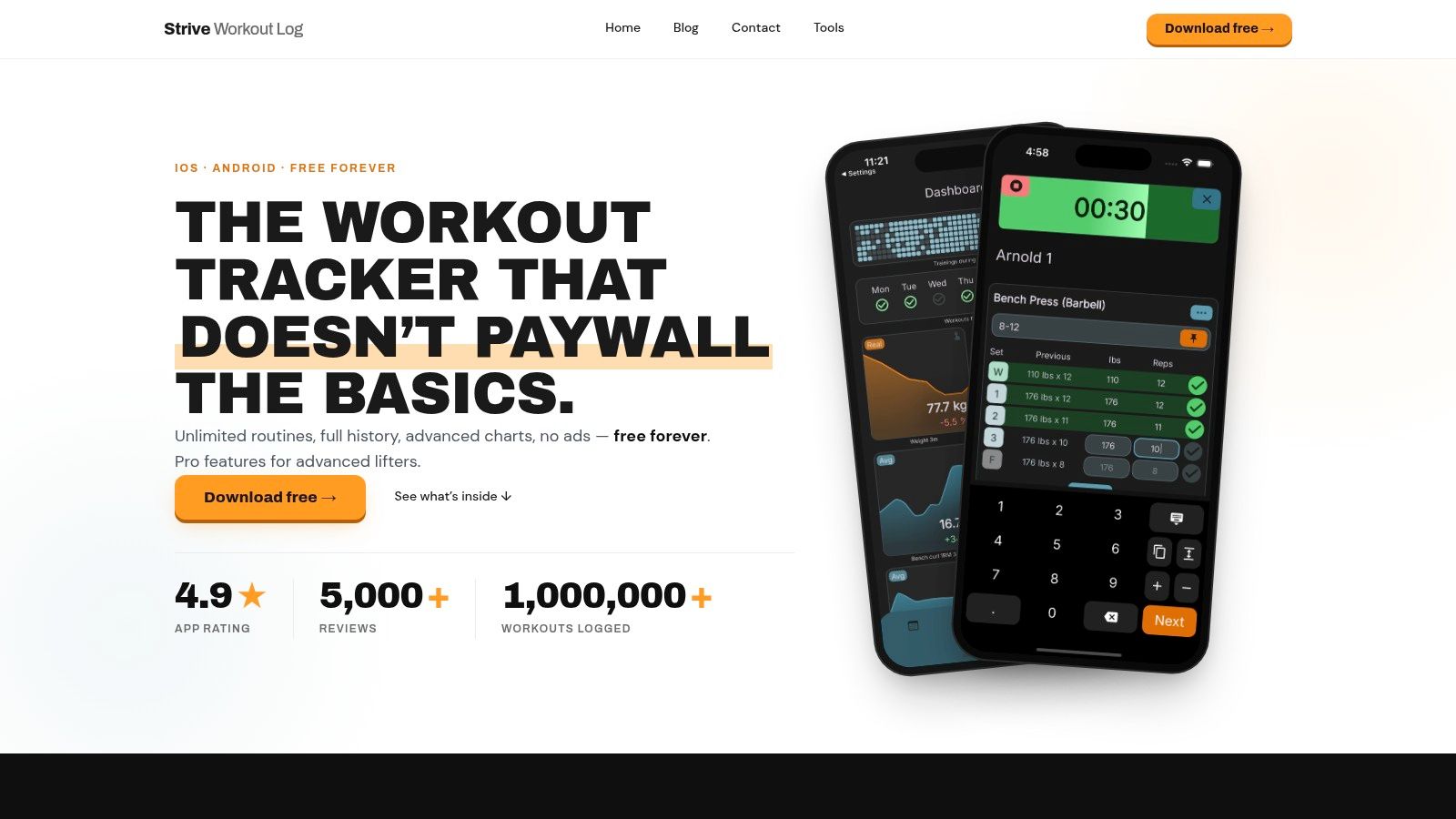
Tracking Your Hybrid Split with Strive Workout Log
A hybrid split breaks down fast if you treat the calendar as the program. The program itself is the rotation, your exercise history, and the next target on each lift. That matters even more when you train 4, 5, or 6 days depending on the week.
Strive Workout Log works best here when you set it up around session order, not weekday names.
Build the split as a rotation
Create five routines:
- Push
- Pull
- Legs
- Upper
- Lower
Then run them in sequence. If work runs late and Thursday disappears, you do not need to reshuffle the whole week. You log the next session in line and keep progressing. That is the main advantage of the PPL and Upper/Lower hybrid. It bends with your schedule without turning random.
If you want a practical breakdown of good logging habits, this guide on keeping a workout log covers the basics.

Set targets before the session starts
Guessing loads on the gym floor usually leads to repeated weeks that only feel hard.
Set a clear target for each main movement before training starts. For example:
- Incline press aims to beat last session by one rep
- Hack squat aims to match reps and add load
- Pulldown aims to match output with cleaner execution
That keeps overload objective. It also helps on weeks where recovery is mixed, because you can see whether the right call is to push load, hold steady, or keep the weight and improve rep quality.
Use rest timers and mark deloads
Rest periods change performance more than many lifters admit. If one pull day is done with short rests and the next with long rests, the log becomes harder to interpret.
Use rest timers so your comparisons stay useful. Mark deload weeks too. Later, when performance dips or volume drops, you want to know whether that was planned fatigue management or simple inconsistency.
I built the tracker with this in mind because hybrid splits create more moving parts than a fixed Monday-to-Friday plan. If the app cannot show what happened and why, it is not helping much.
Watch trends, then adjust the split
Single sessions are noisy. Bad sleep, poor meal timing, and stress can flatten a workout that says nothing about the program.
The better check is the trend across repeated exposures:
- Exercise performance: are your repeated lifts improving over time?
- Volume: are priority muscle groups getting the amount of work you planned?
- Estimated strength trend: are the main patterns moving up across blocks?
- Bodyweight and measurements: does the physical result match the goal?
That is how you keep the hybrid flexible without losing structure. You are not choosing between rigid programming and chaos. You are using a rotating system, then tracking it closely enough to make smart adjustments when real life interferes.
If you want a simple way to run a PPL upper lower split without losing track of progression, Strive Workout Log lets you build custom routines, set next-session targets, track deloads, and review exercise and volume trends over time. That makes it easier to keep the split flexible without letting it become random.
Leave a Reply