Why do so many lifters treat dumbbell step ups like a warm-up exercise, then wonder why their glutes and quads never get much out of them?
That's usually a programming problem, not an exercise problem. Common errors include using a box that's too low, allowing the back leg to do the work, or turning the movement into a sloppy conditioning drill that's hard to overload and easy to fake.
Done properly, dumbbell step ups are one of the best lower-body accessories for hypertrophy, unilateral strength, and low systemic fatigue. They train a big range of motion, expose side-to-side deficits quickly, and let you hammer the glutes and quads without the recovery cost of another heavy barbell lift. That combination matters if your goal is to build muscle with movements you can keep progressing for months, not just survive for a few hard sessions.
Why Dumbbell Step Ups Are a Top-Tier Movement
Forward dumbbell step ups deserve more respect than they usually get. They're not just a “functional” leg exercise. They're a serious hypertrophy tool when you program them with intent.
A key reason is mechanical output. During forward step-ups, the movement produces significantly greater peak hip power (P < 0.05) and total work (P < 0.001) than lateral step-up variations, which makes the forward version the better choice when the goal is unilateral strength and lower-body loading capacity, as shown in this biomechanical analysis of step-up variations. In practice, more total work from the same basic set-and-rep structure means the exercise can deliver a stronger hypertrophy stimulus to the glutes and quads than many people assume.
That matters because good hypertrophy work isn't about novelty. It's about choosing exercises that meet four standards:
- They load useful tissue well: The glutes and quads do real work instead of sharing it with momentum.
- They train a meaningful range of motion: You're not cutting the rep short to stay comfortable.
- They're easy to standardize: Setup and execution can stay consistent across training blocks.
- They don't bury recovery: You can add them after bigger lifts without wrecking the rest of the week.
Why they work so well in real training
The best accessory lifts solve problems. Dumbbell step ups solve several at once.
First, they force each leg to produce force on its own. If one side is weaker, less stable, or less coordinated, the set exposes it immediately. Second, they train hip and knee extension together, which is exactly what you want for building legs with movements that transfer well to athletic patterns and compound lifting. Third, dumbbells keep the setup simple. You can push effort hard without needing a rack, spotter, or the full-body fatigue that comes with another barbell pattern.
Practical rule: If an exercise lets you train hard, recover fast, and clearly see whether the left and right sides are doing the same work, it belongs in a hypertrophy program.
There's also a strong argument for using step ups when your squat pattern is already covered. If your main lift handles the bilateral strength work, step ups become a clean way to add unilateral volume without turning the session into a grind. That's part of why they fit so well alongside other lower body compound exercises.
What step ups do better than many alternatives
Here's the trade-off in simple terms:
| Exercise quality | Dumbbell step ups |
|---|---|
| Unilateral loading | Excellent |
| Range of motion | Strong when box height is chosen well |
| Balance demand | Moderate to high |
| Systemic fatigue | Lower than major barbell lifts |
| Progression potential | Good, if setup is standardized |
Step ups aren't automatically superior to every lower-body movement. They won't replace heavy squats or hinges for maximal loading. But if your goal is muscle growth with cleaner unilateral work and less overall fatigue, they're one of the smartest options you can put into a modern program.
Perfecting Your Form for Maximum Gains
Most bad step ups look hard but train the wrong thing. The set feels tiring, yet the working leg never gets the full stimulus because the setup leaks force everywhere.
The biggest form decision is box height. Proper execution calls for the platform to sit at or just below knee height, and the thigh shouldn't go past perpendicular to the ground, according to the coaching guidance in this step-up form breakdown. That setup gives you enough range of motion to load the glutes and quads without turning the start position into a mobility test.

The setup that actually works
Stand close enough to the box that you can place the whole working foot on the platform. Don't hang the heel off. Hold the dumbbells at your sides and lock your ribcage over your pelvis so you're not starting in an overextended position.
From there:
- Plant the entire foot on the box before you drive up.
- Lean slightly forward from the torso if needed, but keep the spine neutral.
- Brace the trunk so the pelvis stays level instead of dumping to one side.
- Keep your eyes fixed ahead to reduce wobbling and unnecessary head movement.
A lot of lifters underestimate how much trunk control matters here. If your torso shifts all over the place, the step up stops being a leg exercise and becomes a balance rescue.
That's why better core control usually cleans up step ups fast. If you need extra work there, Yuve's holistic core fitness guide is a useful companion resource because it emphasizes trunk stability in a way that carries over well to single-leg patterns.
The two cues that change everything
The first cue is simple. Drive through the working leg only. The second is a frequently overlooked point. Lift the heel of the non-working foot so you don't push off from the floor. That same coaching source above stresses the back-foot heel-up position because it removes assistance and makes the lead leg produce the force.
If the trailing foot is helping you leave the floor, the exercise is easier than the dumbbells say it is.
At the top, stand tall under control. You don't need to slam the back foot onto the box or snap into an exaggerated lockout. Then reverse the movement with the same control you used on the way up. The lowering phase is where you prove you own the rep.
A practical form checklist
Use this quick audit during your sets:
- Box height is right: Working thigh reaches about parallel, not crammed into excessive hip flexion.
- Foot placement is solid: Whole foot stays planted on the box.
- Back leg stays honest: Heel is up, and there's no obvious push-off.
- Torso stays organized: Neutral spine, no collapsing forward.
- Knee tracks cleanly: It follows the foot instead of diving inward.
- Descent is controlled: You lower yourself, not drop yourself.
If you want another lower-body pattern that teaches bracing and upright positioning well, the goblet squat muscles worked guide is worth pairing with step-up work. The carryover is especially useful for beginners who still lose position when unilateral movements get challenging.
Common Mistakes That Kill Your Progress
Most step-up mistakes don't just make the set uglier. They change the training effect. You think you're hammering the glutes and quads, but the actual limiting factor becomes momentum, balance, or whatever compensation your body can get away with.
The mistakes that matter most
Here are the ones I see most often in real programs:
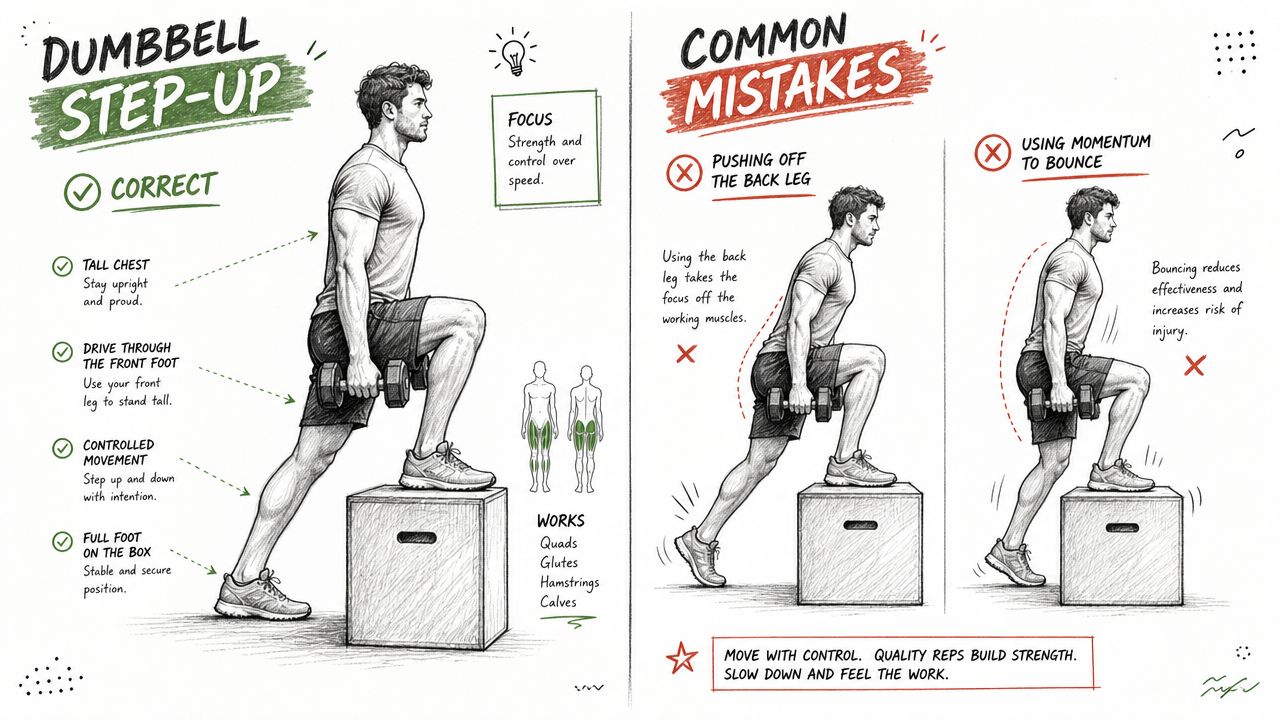
- Pushing off the back foot: This turns the rep into a split jump with dumbbells. The lead leg loses tension and your progression data becomes meaningless.
- Bouncing off the box: Some lifters rush the turnaround and let momentum carry them through the rep. That shortens the useful work.
- Letting the knee cave in: Valgus collapse usually shows up when the load is too heavy, the box is poorly chosen, or the athlete can't control the pelvis.
- Rounding or collapsing through the trunk: Once the torso folds, force production gets messy and the rep becomes less stable.
- Using a box that's too high for current control: The movement stops looking like a loaded step and starts looking like a grindy climb.
Why these errors stall muscle growth
The step up only shines when the target muscles stay loaded through a controlled path. If you cheat with the trailing leg, the glutes and quads of the working side don't have to finish the hardest part. If you bounce or rush, tension leaves the muscles at the exact point you want them working.
Knee collapse is a different problem. It usually tells you the hip isn't controlling the movement well, and that often means the glute medius and trunk aren't doing their stabilizing job. Even if the set doesn't hurt, that kind of rep quality tends to cap load and cut useful volume.
Clean reps beat heavier dumbbells on step ups almost every time.
How to fix each one quickly
Use simple corrections instead of overthinking it:
| Problem | What to do |
|---|---|
| Back foot pushing off | Pause before initiating each rep and consciously unweight the rear foot |
| Momentum on the ascent | Start each rep from a dead stop instead of rebounding |
| Dropping on the way down | Count the descent and keep the dumbbells quiet |
| Knee caving inward | Reduce load, slow the rep, and focus on pressing the foot firmly through the platform |
| Trunk folding forward | Brace harder and reduce the box height if position falls apart |
If someone can't stop cheating, I usually strip load first, not range. A lighter, stricter step up teaches more than a heavier fake one.
A fast self-test
Film one set from the front and one from the side. Ask three questions:
- Does the trailing foot visibly launch the rep?
- Does the knee stay aligned with the foot?
- Does the descent look controlled, or does it look like a fall?
If any answer is bad, don't add weight. Clean the pattern first. Step ups reward discipline and expose ego lifting faster than almost any other dumbbell lower-body movement.
Advanced Variations for Targeted Hypertrophy
Once standard step ups are stable and repeatable, the next question isn't “How do I make them harder?” It's “How do I make them more specific?” That's where advanced variations become useful.
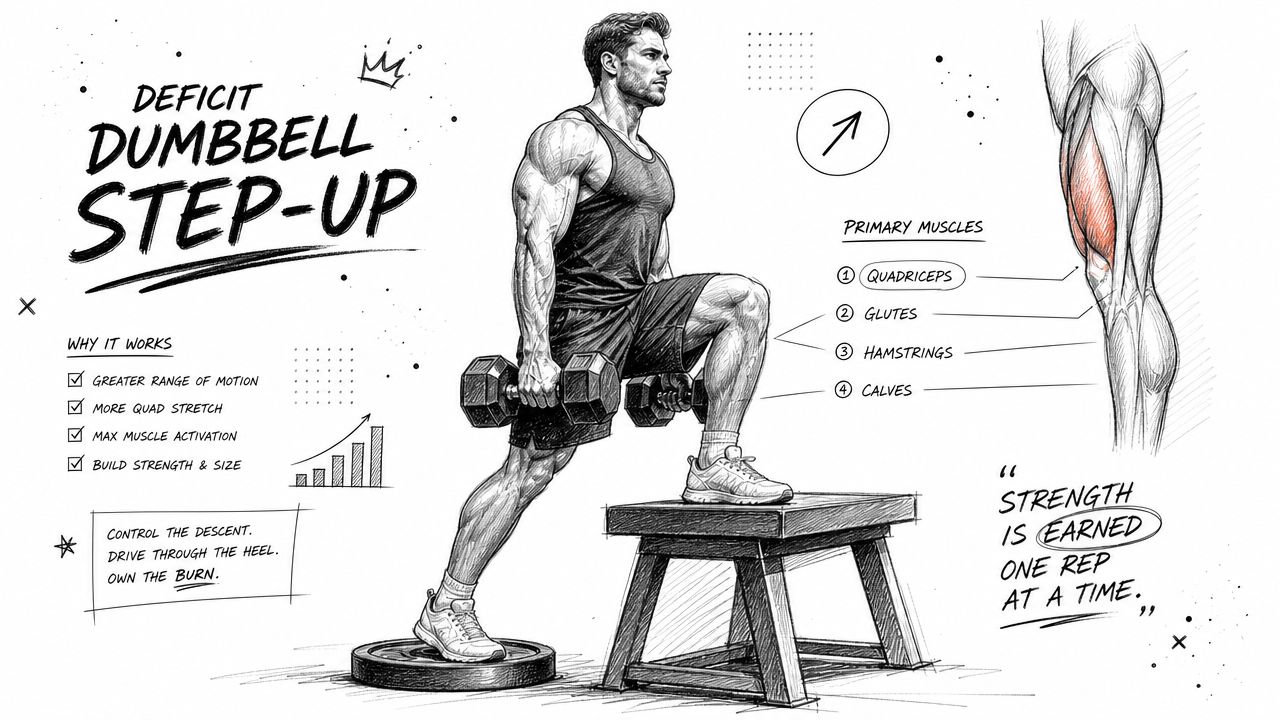
The smartest changes are the ones that improve muscle stimulus without forcing sloppy loading. For glute-focused training, step ups can be performed on a higher platform of 12–16 inches, or high enough that the thigh reaches parallel or above, to maximize gluteus maximus hypertrophy. Two other useful hypertrophy tools are contralateral loading and a slow 3–5 second eccentric descent, both of which raise stability demands and time under tension without requiring more weight, based on this glute-focused step-up guidance.
The glute-focused step up
This is the variation I use when the goal is to bias hip extension more strongly. Raise the platform enough that the working thigh reaches parallel or slightly above, then keep the rep controlled instead of turning it into a climb.
A slight forward torso lean is often helpful here, not because cheating is good, but because it lets the hips contribute more naturally. The key is that the spine stays neutral and the working foot stays fully planted. If the higher box forces you to twist, push off, or yank yourself up with momentum, it's too high for productive hypertrophy work.
Use this version when:
- Glute growth is the main goal
- You want hard local muscular work without another heavy bilateral lift
- You recover better from controlled unilateral volume than from more barbell work
Contralateral loading changes the feel fast
Holding the dumbbell in the hand opposite the working leg adds a stability demand that many lifters haven't felt before. The body has to resist being pulled off line, which usually makes the glute medius and trunk work much harder to keep the pelvis organized.
This variation isn't automatically “better” for everyone. It's better when your standard bilateral dumbbell hold has become too easy from a coordination standpoint, or when you want more glute and frontal-plane stability work without increasing total load. For some lifters, that trade-off is ideal. For others, it just exposes that their current balance is still the limiting factor.
Coaching note: If contralateral loading makes you wobble so much that the working leg never gets a hard set, go back to two dumbbells and earn the variation.
A visual demo helps here because the balance demand is easier to understand when you see it in motion.
Slow eccentrics are a real hypertrophy tool
A 3–5 second lowering phase is one of the best ways to make dumbbell step ups harder without chasing heavier loads that ruin stability. This is especially useful when grip, setup confidence, or gym equipment limits how much weight you can add.
Try this sequence:
- Step up under control.
- Stand tall briefly without relaxing.
- Lower over a deliberate 3–5 second count.
- Reset fully before the next rep.
That slower descent gives you more time under tension and usually exposes whether you own the bottom half of the movement. If you can't control the eccentric, you probably don't own the concentric either.
Which variation fits which goal
| Goal | Best variation |
|---|---|
| More glute max emphasis | Higher platform step up |
| More pelvic stability demand | Contralateral loaded step up |
| More hypertrophy without more load | Slow-eccentric step up |
| More general unilateral leg work | Standard forward dumbbell step up |
The mistake advanced lifters make is stacking every intensity technique at once. Don't. Pick one lever. Box height, loading position, or tempo. When you change all three at the same time, progression gets muddy and rep quality usually drops.
Programming Step Ups for Strength and Size
A good exercise still needs a good slot in the program. Dumbbell step ups work best when you stop treating them like random accessory filler and start assigning them a clear job.
For hypertrophy, the best target is 10–12 reps per set performed slowly and with control. For strength, use 6–10 reps with heavier loads. They should also be placed after squats so you don't pre-fatigue the hip extensors needed for the heaviest bilateral work, based on this step-up programming recommendation.
The easiest way to place them in a session
If squats, front squats, or another main lower-body compound lift are in the workout, step ups usually belong after that primary movement. That order keeps your highest-output lift first, then uses step ups to add unilateral volume where it counts.
A simple lower-body sequence often works well:
- Main bilateral lift first: Squat pattern or hinge pattern
- Dumbbell step ups second or third: Based on your goal
- Smaller accessory work after: Curls, calves, or direct glute work
That ordering keeps quality high. If you put step ups first and push them hard, many lifters find their squats feel flat because the glutes and quads are already taxed.
How to progress them without turning them into chaos
The cleanest progression model is double progression. Keep the setup fixed, own the rep quality, add reps within the target range, then increase load once all sets are solid. That works especially well for unilateral lifts because it respects stability and technique instead of forcing weekly jumps.
Here's a practical framework:
| Goal | Rep target | Priority |
|---|---|---|
| Hypertrophy | 10–12 | Controlled reps and consistent depth |
| Strength | 6–10 | Heavier loading with clean force production |
Use the same box, the same loading style, and the same execution standard across a block. If any of those change, the progression isn't apples to apples anymore.
Sample use cases
For a size-focused lower day:
- Main squat variation
- Dumbbell step ups for controlled moderate reps
- Hamstring or glute isolation work
For a strength-focused lower day:
- Main squat or deadlift variation
- Dumbbell step ups in the lower rep range
- Secondary posterior-chain work
If your training is built around athletic performance, essential athletic strength training is a useful reference for understanding how accessory lower-body work fits around primary strength development without stealing from the main lifts.
Don't judge step ups by how smoked you feel. Judge them by whether load, rep quality, and consistency improve over time.
What works and what doesn't
What works:
- Standardized setup
- Controlled reps
- Progression based on execution, not ego
- Placement after major bilateral lifts
What doesn't:
- Random box heights
- Turning every set into a balance challenge
- Chasing load when the descent is uncontrolled
- Mixing glute-focused, tempo, and standard versions in the same progression line
Dumbbell step ups are simple, but they reward structure. The lifters who grow from them are usually the ones who treat them like a main accessory, not an afterthought.
Tracking Progress for Unstoppable Gains with Strive
Most articles tell you to “progressively overload” dumbbell step ups and leave it there. That isn't enough. This movement has a unique problem. Sometimes the limiter is leg strength, but sometimes it's grip, trunk stability, setup confidence, or balance. That's why many lifters struggle to log it consistently in the first place, which mirrors the point raised in this discussion of progressive overload for dumbbell step-ups.

What to record so the data means something
If you want useful progression data, log more than weight and reps. Dumbbell step ups need a stable identity.
Record:
- Variation used: Standard, glute-focused, or contralateral
- Box height: Keep it consistent within a block
- Load placement: Two dumbbells or one contralateral dumbbell
- Tempo notes: Especially if you're using a slow eccentric
- Execution limits: Whether grip, balance, or leg strength ended the set
That last point matters a lot. If the set stopped because your trunk was wobbling, that's not the same as true local leg failure. Treating those as identical makes progression harder to interpret.
How to use Strive properly for step ups
In Strive Workout Log, create separate entries for each step-up variation instead of dumping everything under one generic exercise name. “Dumbbell Step Up,” “Glute-Focused Step Up,” and “Contralateral Step Up” should each have their own line if you rotate them.
Then use notes to standardize the details that usually get forgotten:
- box height
- tempo
- whether the back foot stayed honest
- which side felt less stable
The app becomes more useful than memory. You can set manual targets for the next session, or use auto-progression rules if your setup is repeatable enough. If you want a deeper framework for that process, the guide on how to track progressive overload pairs well with unilateral work like this.
A simple progression decision tree
Use a rule set like this when reviewing your last workout:
- If technique was clean and all sets landed at the top of the target range, increase load next time.
- If load was stable but reps were short of target, keep the load and add reps first.
- If grip or balance failed before the legs got enough work, keep load fixed and improve control before progressing.
- If setup changed, don't count it as a direct performance comparison.
That approach keeps your log honest. And honesty matters more on dumbbell step ups than on many bilateral lifts because it's so easy to hide bad reps inside “hard work.”
If you want a clean way to log dumbbell step ups, standardize variations, set next-session targets, and see whether your unilateral work is progressing, Strive Workout Log is one of the best tools for it. It's simple, ad-free, and built for lifters who care about progressive overload instead of fluff.
Leave a Reply