
A seated leg curl machine can build more hamstring muscle than a prone leg curl, even when both exercises bend the knee through a similar path. In a controlled 12-week intervention, seated training increased total hamstring size by 14.1%, compared with 9.3% for prone training, according to the published study in Medicine and Science in Sports and Exercise.
That result doesn't mean every seated machine is automatically superior, or that every set on a leg curl machine is productive. Hip angle, machine geometry, resistance design, range of motion, and progressive overload determine whether the exercise creates a useful hypertrophy stimulus or merely produces a temporary burn. The practical question isn't “Which machine feels hardest?” It's “Which setup lets me load the hamstrings consistently, through a large usable range, without wasting recovery on compensation?”
What a Leg Curl Machine Actually Does
A leg curl machine is an isolation exercise station that trains knee flexion. You anchor the thigh or hips against a pad, place the lower leg behind a roller, and pull the heel toward the body against resistance. The primary target is the hamstring group, which includes the biceps femoris, semitendinosus, and semimembranosus.
The movement matters because it lets you train the hamstrings without asking the entire body to stabilize a squat, deadlift, or lunge. Electromyography research found that the machine leg curl strongly activates the hamstrings while producing very low gluteus maximus activity, supporting its role as a high-target, low-systemic-fatigue exercise in this comparative exercise study.
Practical rule: If your hips, lower back, or shoulders are doing most of the work, the machine isn't isolating the hamstrings as effectively as it should.
Four decisions control the result of nearly every leg curl session:
- Machine type: A seated, prone, standing, Nordic, rehabilitation, or flywheel unit creates a different loading environment.
- Hip angle: Flexing the hips places the hamstrings under a longer starting length before the knee bends.
- Loading method: A weight stack, plate-loaded lever, cam, band, or flywheel changes how resistance feels across the repetition.
- Progressive overload: If you can't track and gradually improve reps, load, range, tempo, or control, the exercise becomes difficult to evaluate.
The machine isn't a recent gimmick. Historical accounts place one of the earliest rudimentary leg curl devices in the early 1900s and credit physical culture innovator Sigmund Klein with developing a machine intended to isolate and fully develop the posterior thigh, as described in this account of Klein's leg curl invention.
For hypertrophy-focused lifters, that history is less important than the principle behind it. The leg curl exists to make hamstring loading repeatable. For someone returning from injury, that repeatability can also make it easier to select a manageable range and build strength gradually, although pain, surgical restrictions, and return-to-sport decisions belong with a qualified clinician.
Types of Leg Curl Machines Compared
Every leg curl machine belongs to the same broad family, but the user experience and training effect can differ sharply. The main categories are prone, seated, standing, and Nordic machines, with additional variation from selectorized stacks, rehabilitation units, plate-loaded designs, and flywheel systems.
Lying and prone machines
The prone leg curl places the hips closer to extension while the torso lies against a bench. It usually feels straightforward and gives a strong contraction near the top of the curl. The limitation is that the hamstrings begin at a shorter length than they do on a seated unit, and some lifters find the prone position uncomfortable around the neck or lower back.
Seated machines
The seated leg curl holds the hips in flexion. That position lengthens the hamstrings at the hip before knee flexion begins, which makes it the most compelling default for lifters prioritizing hamstring hypertrophy. A good unit also provides firm thigh and torso support, although poorly designed pads can feel restrictive for very short or very tall users.
Standing machines
A standing leg curl trains one leg at a time and generally uses a shorter, more compact frame. It can be useful when a gym has limited floor space or when you want to compare left-to-right performance. The trade-off is reduced bracing and less total loading capacity than a well-fitted seated or prone machine.
Nordic hamstring machines
A Nordic station anchors the ankles while you lower the torso under bodyweight resistance. It emphasizes eccentric knee-flexion strength and demands more control from the trunk and hips. It fits athletes who need high-level eccentric work, but beginners often need assistance, reduced range, or band support before they can perform clean repetitions.
| Machine type | Hip angle | Best for | Main limitation |
|---|---|---|---|
| Prone leg curl | Hips near extension | Simple hamstring isolation and familiar machine work | Shorter starting muscle length and possible torso discomfort |
| Seated leg curl | Hips flexed | Hamstring hypertrophy and stable progressive loading | Fit varies considerably between machines |
| Standing leg curl | Usually near neutral, one leg at a time | Unilateral work and compact setups | Less bracing and usually lower loading capacity |
| Nordic machine | Hips extended while kneeling | Eccentric strength and bodyweight control | Harder to scale precisely for beginners |
A fixed-stack commercial machine is convenient because the pin changes resistance quickly. Selectorized rehabilitation units can prioritize fine adjustment and controlled movement, while heavy-duty commercial units emphasize structural stability and high loading. Available equipment ranges from rehabilitation machines offering 20 resistance levels and a maximum selectable load of 100 kg to large selectorized kneeling systems with dual 150-pound stacks and a machine mass of 746 pounds, or 339 kg, as shown by this commercial equipment specification.
The right machine also depends on how you use other equipment. A thoughtful comparison of machines and free weights helps, but for direct hamstring isolation, stability and fit usually matter more than whether the machine looks advanced.
Muscles Worked and Why Hip Angle Matters
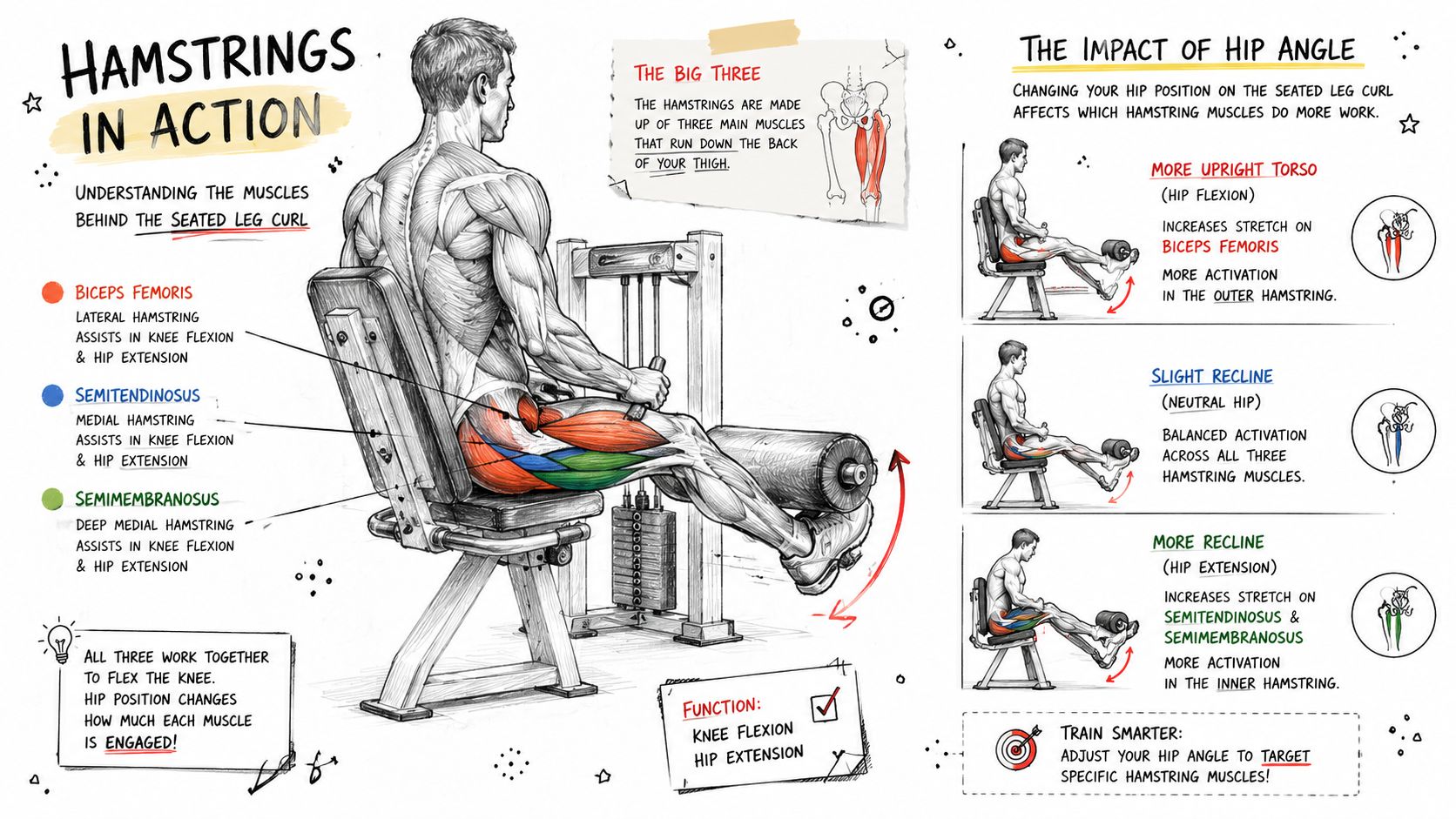
The leg curl primarily trains the hamstrings, not the glutes. The group includes the biceps femoris long head, biceps femoris short head, semitendinosus, and semimembranosus. All contribute to knee flexion, while the biarticular hamstrings also cross the hip and respond to the position of both joints.
That second-joint position is the important detail. A seated leg curl places the hips in flexion while the knees bend, lengthening the hamstrings at the hip and loading them at a longer overall muscle length. A prone curl doesn't create the same combination because the hips remain closer to extension.
What the hypertrophy data says
The controlled seated-versus-prone intervention found larger increases in several hamstring regions with seated training. Total hamstring volume increased 14.1% versus 9.3%, while the biceps femoris long head increased 14.4% versus 6.5%, the semitendinosus increased 23.6% versus 19.3%, and the semimembranosus increased 8.2% versus 3.6%, as reported in the full peer-reviewed study.
The useful conclusion isn't that prone curls are worthless. They clearly train the hamstrings. The better conclusion is that exercise selection changes which muscle lengths and regions receive the most growth stimulus. If hamstring size is the priority, seated curls deserve a prominent place in the program, especially when the machine allows a deep, controlled knee-flexion range without forcing the pelvis to move.
Why low glute activity helps
A machine curl doesn't need to compete with hip-dominant exercises for the same fatigue budget. Because glute involvement is low, you can place it after Romanian deadlifts, good mornings, squats, or hip hinges and continue training the hamstrings directly without adding another demanding full-body movement.
That doesn't make the exercise complete hamstring training by itself. The hamstrings perform both knee flexion and hip extension, so a well-rounded program may include a hinge as well as a curl. The machine's advantage is precision, not universality.
How to Set Up and Perform the Leg Curl
A good repetition starts before you select the weight. Poor alignment shifts tension toward the hips, reduces the usable range, and encourages the exact compensations the machine was designed to prevent.
Seated leg curl setup
- Adjust the seat and back pad. Set the hips firmly against the backrest, with the thigh pad pressing securely across the thighs without blocking knee movement.
- Align the knee. The side of your knee should line up with the machine's pivot or axis of rotation. This is the most important adjustment because it keeps the movement centered on knee flexion.
- Set the lower-leg roller. Position it against the lower calf, above the ankle rather than directly on the Achilles tendon. Start with the knee comfortably extended, not forced into an aggressive lockout.
- Brace the torso. Hold the handles and keep the pelvis and ribs connected to the pads. Don't let the hips slide forward as the set becomes difficult.
- Curl smoothly. Pull the roller down and back as far as your individual mobility allows, pause briefly when the hamstrings are shortened, then return under control.
Prone leg curl setup
Lie face down with the knee joint lined up with the pivot. Place the roller against the lower calf, set the thigh and hip pads so your pelvis stays down, and grip the handles before beginning. Keep the hips pressed into the bench rather than lifting them to create momentum.
Use a two-to-three-second eccentric on most working repetitions. That tempo gives you time to notice whether the pelvis is moving, whether the roller is losing contact, and whether the final portion of the range is controlled.
Before adding weight, ask: Can I keep the knee aligned, the hips supported, and the lowering phase quiet?
Start with a light warm-up set that lets you rehearse the path. Add resistance gradually until the working load challenges the target rep range while preserving full, comfortable movement. End the set when you can no longer control the eccentric, maintain pad contact, or reach the intended range. A heavier stack with shortened repetitions is not a better hamstring stimulus than a lighter load performed cleanly.
Breathing should stay simple. Inhale during the lowering phase, brace as you begin the curl, and exhale as you complete the effort. If the machine's geometry forces your knee into discomfort, adjust the seat, roller, or range rather than trying to tolerate a poor fit.
Programming for Hypertrophy Without Excess Fatigue
The leg curl works well as a hypertrophy accessory because it concentrates work on the hamstrings without demanding the systemic recovery of another heavy compound lift. The low glute activity observed in EMG research supports that role, but activation alone doesn't guarantee growth. You still need enough challenging work, a meaningful range of motion, and a progression method you can repeat.
A practical starting framework is:
- Working sets: Use roughly 3 to 5 sets.
- Repetitions: Stay around 6 to 12 reps when the machine allows stable loading and controlled technique.
- Tempo: Use a 2-1-2 or 3-0-1 tempo, with the longer portion assigned to the eccentric.
- Effort: Finish close to failure, while stopping before technique changes the exercise.
- Placement: Put the curl after demanding compound work if hamstring strength or total lower-body performance matters earlier in the session.
These are programming ranges, not laws. A machine with a coarse resistance stack may work better with higher repetitions, while a smooth plate-loaded or flywheel unit can provide a strong stimulus with slower, harder eccentric work.
A simple progression model
Use double progression. Keep the load constant until you can complete the upper end of the rep range across your planned sets with the same range, tempo, and effort. Then make the smallest available load increase and build the repetitions again.
Log more than the number on the pin. Record the machine type, seat setting, load, repetitions, tempo, and perceived effort. A change from one seated machine to another can make the same displayed load feel completely different because pulley ratios, cams, pad geometry, and resistance curves aren't standardized.
Variable-resistance cams may reduce loading in weaker portions of the curl and increase it near peak contraction. That can make the machine feel smoother and better match hamstring force across the movement, as described in this equipment and resistance analysis.
Where flywheel work belongs
Flywheel leg curls add an eccentric-overload option rather than just providing another fixed-load stack. A flywheel machine was specifically developed to overload the eccentric phase of hamstring training, as documented in the original flywheel leg-curl research.
A 2025 randomized trial involving athletes with prior hamstring strain found greater eccentric-strength improvement with flywheel leg curls, 19 ± 19% versus 6 ± 9% with conventional curls, and also reported greater fascicle-length improvement in the flywheel group, according to the published trial. That makes flywheel work interesting for eccentric-strength goals, but it doesn't make a standard seated machine obsolete. Use the loading method that matches the adaptation you want and the fatigue you can recover from.
For a broader lower-body setup, this leg workout for mass can help you place curls around compound work without turning every exercise into a maximal-effort event.
Common Leg Curl Mistakes and How to Fix Them
Most stalled leg curl progress doesn't come from a lack of exercise variety. It comes from subtly changing the movement whenever the load becomes difficult.
The hips lift off the pad
If your pelvis rises during the curl, you're trying to gain an advantage and changing the exercise. The hamstrings may still work, but the machine no longer keeps the load centered on knee flexion.
Fix: Reduce the load, tighten your grip, and press the hips into the pad before each repetition. If the machine's pads don't fit your body, adjust them before blaming your technique.
The range becomes partial
Short repetitions often produce a strong burn, which tricks lifters into assuming they're productive. A partial range can be useful in a deliberate progression, but accidental shortening usually means the load is too heavy or fatigue has exceeded your current capacity.
Fix: Choose a range you can repeat without pelvic movement. Keep the starting position consistent and record it with the machine setting.
Momentum takes over
Yanking the roller from the bottom creates speed instead of tension. The hamstrings then lose control exactly where you need them to produce force.
Fix: Pause briefly before the curl and use a controlled eccentric. If you can't lower the load smoothly, the set is over.
Ego-loading hides failure
A heavy stack isn't evidence of a successful set. Machine lever lengths, pulley ratios, cams, and pad positions vary, so displayed load only has meaning on that specific unit.
Fix: Track repetitions, range, tempo, and machine settings together. Progress the exercise when the whole performance improves, not just when the pin moves.
The eccentric is treated as rest
Dropping the weight back to the starting position wastes the lengthening portion of the repetition. That matters particularly when you select seated curls for their longer-length loading or use a flywheel variant for eccentric emphasis.
Fix: Make every lowering phase intentional. Longer muscle length may support hypertrophy, but it doesn't automatically guarantee injury protection. A review-style summary reported no significant difference in hamstring-damage protection between seated and prone training, as discussed in this review of the seated and prone comparison. Treat seated curls as a hypertrophy choice first, not as a guaranteed injury-prevention solution.
Equipment-Free and At-Home Alternatives
A machine is convenient because it makes resistance easy to measure, but it isn't the only way to train knee flexion. At home or in a crowded gym, the best substitute is the exercise that lets you create challenging hamstring tension and progress it without turning every repetition into a survival test.
Nordic curls
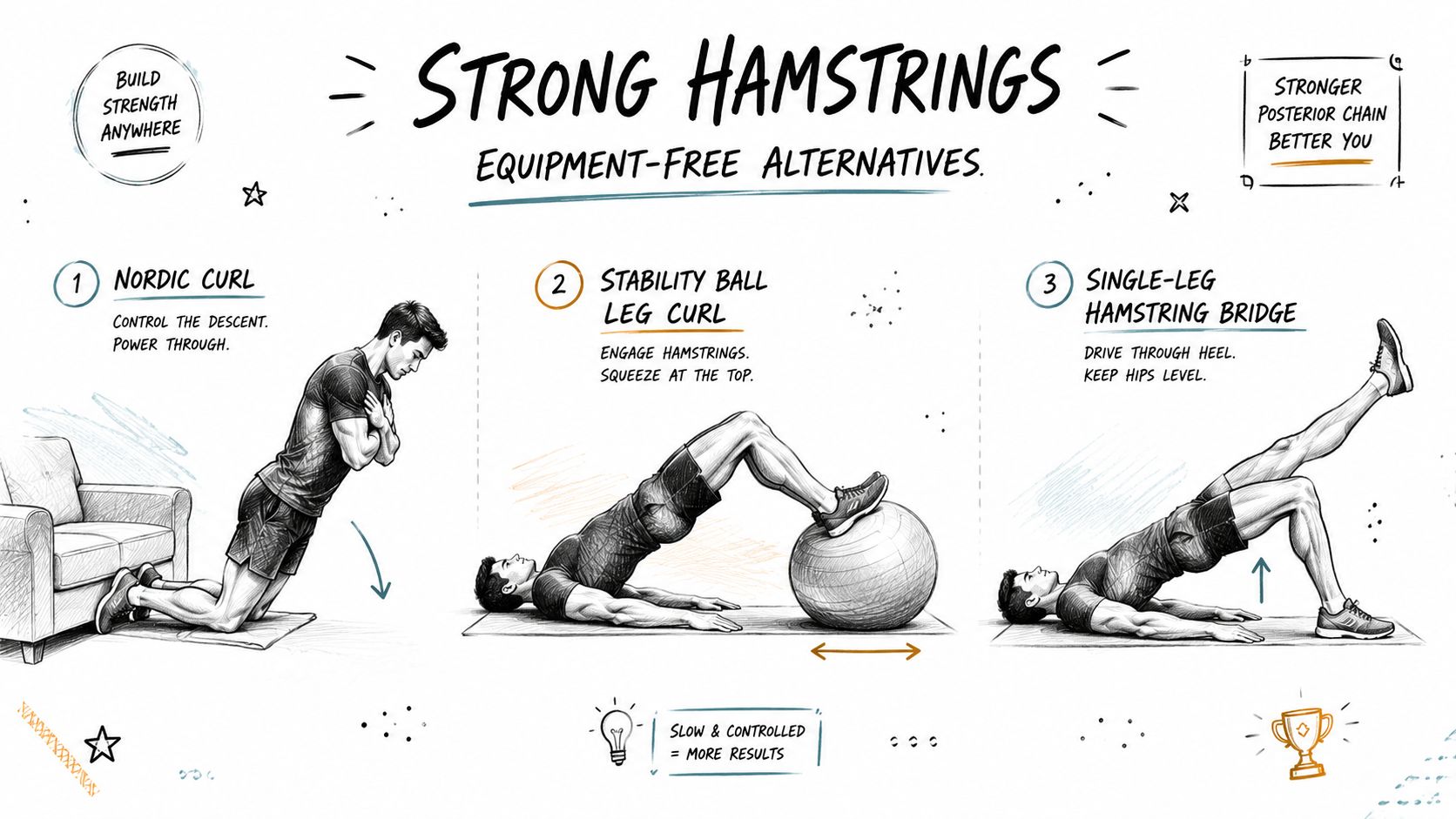
Nordics are the strongest at-home substitute for demanding eccentric knee-flexion work. Anchor the ankles, lower under control, and use your hands or a band for assistance when the full descent is beyond your current strength. Progress by reducing assistance, extending the range, slowing the descent, or adding external load.
They don't replicate the precise concentric loading of a selectorized leg curl, and they can create substantial soreness. Use them strategically rather than forcing high volumes before your hamstrings have adapted.
Sliders and stability-ball curls
Slider curls and stability-ball curls train knee flexion while the hips remain raised. That hip-extension demand adds glute work and trunk control, which can be useful, but it also makes the exercise less isolated than a seated or prone machine.
Sliders are easy to progress by extending the legs farther, slowing the eccentric, or using one leg. A stability ball changes the balance demand and may be less practical for heavy progressive overload.
Bands and single-leg RDLs
Banded knee flexion is portable and easy to set up, though the resistance curve depends heavily on how far the band stretches. It can maintain hamstring work while traveling, but it usually lacks the loading precision of a machine.
Single-leg Romanian deadlifts train the hamstrings through hip extension rather than knee flexion. They're valuable posterior-chain work, not a direct replacement for a leg curl. If your only goal is hamstring hypertrophy through knee-flexion isolation, prioritize Nordics, sliders, or a banded curl over treating every hip hinge as an equivalent substitute.
A short visual demonstration can help you check the basic movement options before training.
Tracking Progress and Building Overload Into Every Session
Use a repeatable checklist before you worry about advanced variations:
- Pick the machine that matches your goal, with seated work generally favored when hamstring hypertrophy is the priority.
- Align the knee with the machine's axis and secure the thigh or hips.
- Perform roughly 3 to 5 sets of 6 to 12 repetitions at a controlled tempo.
- Record the load, reps, range, tempo, and effort.
- Increase the challenge only when technique remains stable.
A workout log turns that process into evidence. In Strive Workout Log, create the exact exercise you use, then record weight, reps, tempo, and RIR or RPE for each set. You can manually set the next-session target before training, or use auto-progression rules such as linear progression, double progression, or a custom sentence rule like “add 2.5 kg if the top set exceeds 8 reps.”
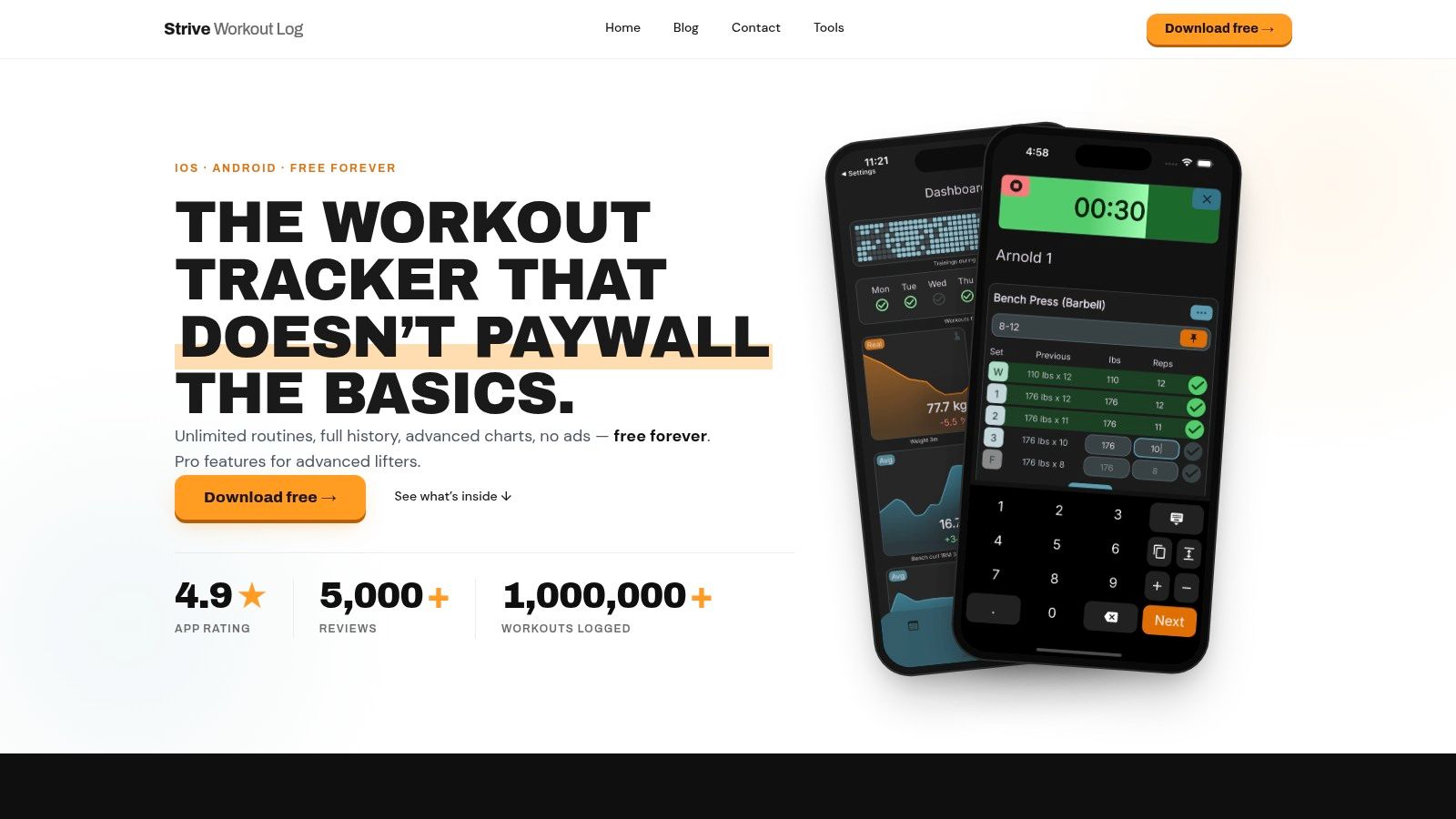
The charts help you separate real progress from random good days by showing trends in volume and estimated one-repetition maximum. If performance drops while fatigue rises, mark a deload rather than forcing another load increase. The broader principle is covered in this guide to tracking progressive overload.
Strive Workout Log lets you record leg curl variations, sets, reps, weights, effort, and progression targets in one place, with charts that make hamstring training trends easier to evaluate. Visit Strive Workout Log to build a repeatable leg curl progression instead of relying on memory or guesswork.
Leave a Reply