
The most popular progressive-overload advice is also the easiest to misuse: add weight every session. That rule works only while your technique, recovery, and adaptation all move in the same direction. Once one of them stalls, forcing heavier numbers can turn productive training into shortened range of motion, failed reps, and fatigue that makes the rest of the week worse.
A useful workout log for progressive overload treats training like a feedback system. It records load, reps, effort, set quality, range of motion, fatigue, and weekly volume, then uses those signals to decide whether the next step should be more weight, more reps, more work, or no change at all. The evidence supports that broader view. Load progression and repetition progression can produce similar short- to medium-term hypertrophy outcomes, so the barbell isn't the only place progress appears. The controlled resistance-training study also supports tracking proximity to failure and the intended rep range instead of treating added tonnage as the sole definition of improvement.
Why Adding Weight Every Session Is Not Real Progressive Overload
Adding weight every workout measures one type of change, not progressive overload itself. Progressive overload means gradually increasing training demand in a way the target muscle can recover from and adapt to. Load is one option. Reps, set quality, range of motion, density, and controlled volume can raise the challenge without forcing heavier plates onto every session.
A heavier set is not automatically better if depth, control, or proximity to failure deteriorates. Keeping the load fixed while completing more clean reps inside the planned range can represent genuine progress. An 8-week comparison of fixed-rep load progression and fixed-load repetition progression found similar lower-body muscle-size gains, with the authors concluding that either approach can support hypertrophy in the short to medium term. The full study is available through PubMed Central.
The overload signals worth recording
Configure a serious log to separate external progress from training-quality progress:
- Load: tracks strength exposure and performance for a specific exercise.
- Reps: matters for double progression and whenever available load jumps are too large.
- Set quality: shows whether the target muscle performed the work, rather than momentum or altered technique taking over.
- Range of motion: keeps comparisons between sessions meaningful.
- Proximity to failure: explains whether a lighter set still provided enough challenge.
- Density: records whether the same work was completed with less rest, while preserving enough recovery for quality performance.
- Fatigue: gives context for a performance change and discourages reckless progression.
Practical rule: If the number rises while the rep standard falls, mark it as a different outcome. Do not let the app count it as an automatic personal record.
Volume needs the same scrutiny. Increases in total training volume are not a reliable standalone proxy for hypertrophy, so a log that displays only tonnage misses whether those sets were productive. Track effort, set quality, and fatigue alongside volume, as supported by the resistance-training discussion cited earlier.
Recovery determines which progression option makes sense. Persistent soreness, pain, or declining performance may justify holding the load steady rather than adding work. A practical 2026 guide to muscle recovery can help you review recovery habits alongside the training data. The useful log does not pressure you to add weight. It identifies the most productive next demand.
What to Log in Every Set for Maximum Training Insight
Adding weight is only one progression lever. A useful workout log must show whether progress came from more load, more reps, more hard sets, or shorter rest. Record the exercise and variation, load, completed reps, target range, set type, rest, and proximity to failure immediately after each set. Delayed entry turns missed reps and improvised changes into unreliable data.
Exercise diaries also have a measurable reliability problem. A 12-week validation study found that self-reported diaries overestimated adherence by almost 20% on average and had only moderate correlation with accelerometer-measured completion. The validation study in JOSPT supports treating your log as a measurement system, not a memory aid.
The minimum fields for each set
- Exercise and variation: “Chest-supported row” gives a stronger comparison than “row,” because setup changes can alter performance.
- Load and reps completed: enter the result, not the prescription.
- Target rep range: lets the app determine whether the next progression step involves reps or load.
- Set type: separate warm-up, normal, backoff, drop set, myo-rep, and failure work.
- RIR or RPE: effort changes the meaning of a rep count. Eight easy reps and eight difficult reps are different training stimuli. Use the definitions in this RIR versus RPE guide consistently.
- Range of motion and technique notes: short tags such as “full depth,” “paused,” or “shortened” keep comparisons honest.
- Rest and fatigue: record unusually long rests, grip failure, pain, or a performance drop.
Marking warm-up sets separately, for instance, prevents them from inflating your volume numbers. At the weekly level, compare scheduled sets, reps, and load with what you completed. Repeated shortfalls may indicate an unrealistic plan rather than poor discipline.
Configure the log around the goal of the phase. For hypertrophy, prioritize repeatable execution, target-muscle effort, and productive hard sets. For strength, emphasize load, successful heavy exposures, and estimated-strength trends, while keeping the phase goal visible. Volume alone cannot explain the result, so retain effort and quality fields alongside tonnage. Research from PubMed Central supports this broader view of resistance-training outcomes.
Make deloads explicit. Label the reduced-training period so a temporary drop in volume is not misread as program failure. A structured fitness log compilation for dieters may offer organizational ideas, but lifters need entries tied directly to training decisions. The log should show whether the next useful change is another rep, an added set, a heavier load, or recovery before more work.
Progression Models You Can Automate in Your Workout Log
A heavier bar is only one possible progression signal. Your log should choose between more load, more reps, more sets, or recovery based on the phase goal and the quality of the completed work.
Linear progression adds load on a planned schedule after the session standard is met. It suits early-stage lifters and stable exercises, where performance changes are relatively easy to interpret. Its weakness appears when recovery fluctuates or the smallest available weight jump exceeds what you can perform cleanly.
Double progression keeps the load fixed while reps move through a defined range. Once every prescribed set reaches the upper boundary with acceptable technique and effort, the log suggests a load increase and returns the rep target toward the lower boundary. With an 8 to 12 rep target, for example, add 2.5 kg after all sets reach 12 clean reps, then work back from 8 reps. The setup is outlined in the double-progression guide.
Percentage-based systems, including 5/3/1, schedule work from a training max and planned intensity exposures. They reduce daily decisions during strength-focused phases, although the log still needs notes for sleep, joint discomfort, missed reps, and technical breakdown. A percentage cannot adjust for those conditions by itself.
In one line: linear progression schedules load, double progression advances reps before load, and percentage-based programming controls intensity through planned exposures. Each model needs a clear failure rule and a recovery rule, not just a next-weight calculation.
A 2024 review found that increasing load or reps can both support strength and hypertrophy gains in early-stage trainees, while earlier controlled work reported similar muscle-size increases from repetition progression. The 2024 review supports giving the app several valid next actions instead of forcing a heavier load every week.
Rules your log should understand
Separate targets for strength and hypertrophy. A muscle-building phase can prioritize high-quality reps within a chosen range, whereas a strength phase may prioritize heavier loads and successful lower-repetition exposures. Estimated one-rep-max changes should not be the only score during a hypertrophy block.
Add a “hold steady” outcome. If reps fall below target, RIR drops sharply, technique changes, or pain appears, the next recommendation might repeat the load, reduce the prescription, or trigger a planned deload. Store the reason, because repeating a weight after poor sleep is different from repeating it after repeated technical failure.
Deload timing also needs model-specific rules. Linear progression may call for a reset after repeated missed sessions. Double progression can keep the same load while reducing sets or reps, then resume the range after fatigue falls. Percentage-based work can retain the schedule while lowering exposure or using a planned easier week. The recent overload review describes volume, intensity, and density as possible progression routes, so an increase in one variable is not required every session, as noted earlier. A useful log makes that decision visible rather than treating any short-term reduction as program failure.
Choosing Exercises That Maximize Hypertrophy and Minimize Fatigue
You can overload a poor exercise for months and still get a poor return. Exercise selection should start with the target muscle, then filter for large usable range of motion, stability, repeatability, and manageable systemic fatigue.
Stable movements often make progression easier to interpret because balance and coordination don't limit every set. A chest-supported row can reduce the lower-back demand that competes with the upper-back stimulus. A machine press can provide a consistent path when free-weight stability is the limiting factor. A cable or machine leg curl can train the hamstrings without adding the whole-body fatigue associated with another demanding hinge.
A practical selection filter
- Can you load the target muscle consistently? Choose movements where the intended tissue remains the limiting factor.
- Can you use a large range of motion without pain? Full ROM generally has the edge for hypertrophy, although the overall advantage over partial ROM is trivial. The 2023 partial-versus-full-ROM meta-analysis reported an overall SMD of 0.12, with a 95% confidence interval from -0.02 to 0.26.
- Can you repeat the setup? Identical seat position, grip, stance, and depth make your data more trustworthy.
- What fatigue does each set create? Keep high-fatigue lifts where they contribute enough stimulus to justify their recovery cost.
- Does the exercise suit the goal? A heavy squat variation may be valuable for strength, while a stable leg press or leg extension may let you accumulate local quad work with less systemic demand.
Exercise order changes the quality of later work. Put the movements that matter most for your current goal earlier, then use stable isolation work when fatigue would otherwise distort technique. Track grip fatigue during pulling sessions, because a failing grip can make back progression look stalled even when the back itself could perform more work.
Tag exercises in your library by muscle, stability, ROM, and fatigue cost. A useful log doesn't just tell you that a number increased. It helps you see whether the same muscle received a comparable stimulus under comparable conditions.
Recovery choices sit outside exercise selection, but they still influence training quality. Readers interested in how active lifestyles intersect with recovery products can review British CBD for active lifestyles, while keeping the training log focused on observable performance, pain, sleep, and fatigue rather than assuming any product guarantees progress.
Reading Your Training Charts to Make Smarter Decisions
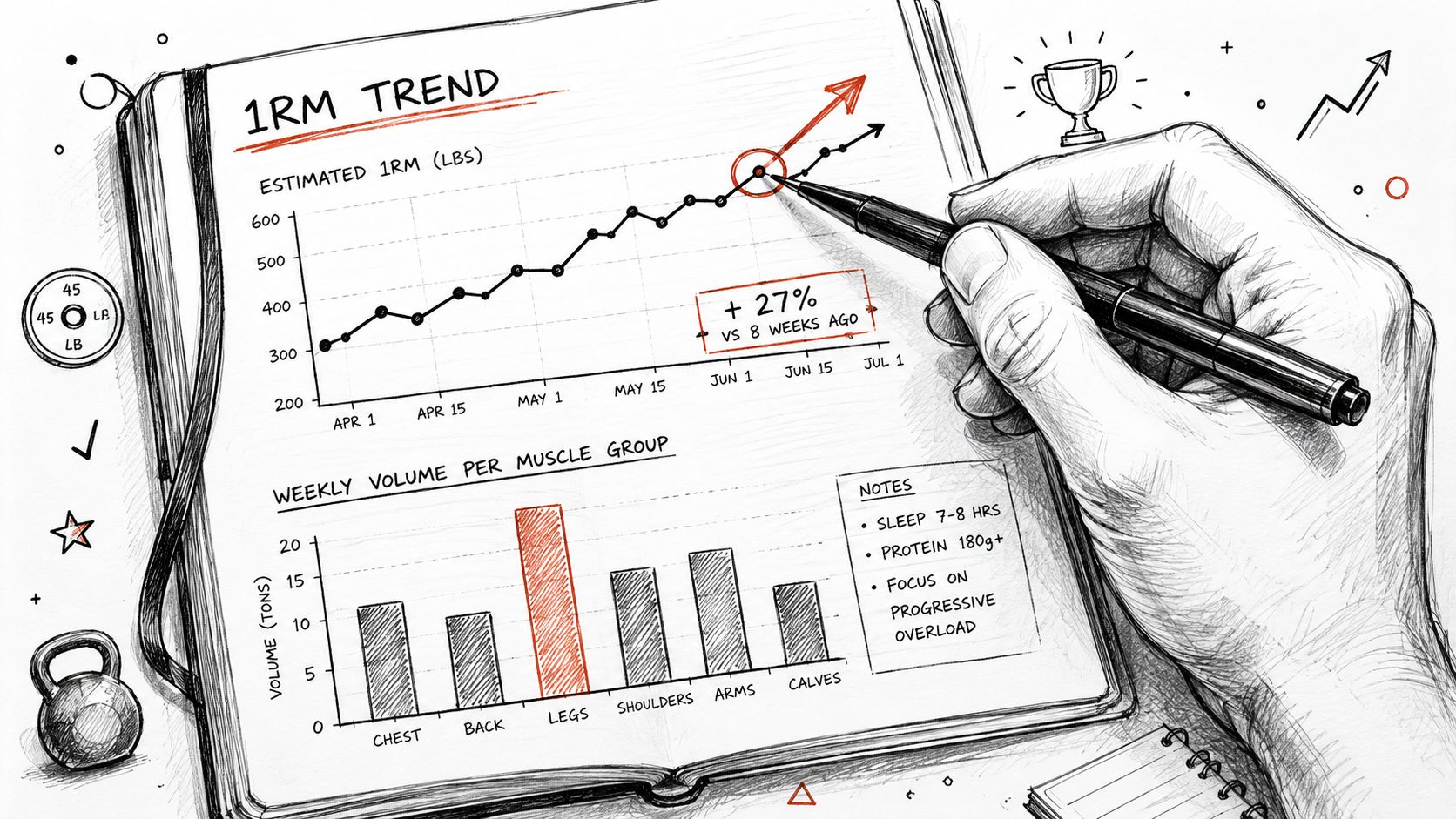
A chart can reward the wrong decision. Rising volume may mean productive work, or it may show that fatigue is accumulating. A flat estimated 1RM may reflect a strength plateau, but it can also fit a hypertrophy phase in which reps, technique, ROM, or muscle measurements are improving. Configure the log so those variables appear together before changing the program.
Read trends as combinations, not isolated scores
Begin at the exercise level. Compare load, reps, RIR, and ROM for the same variation. More reps at the same load, with similar effort and technique, is clear progression. An estimated 1RM that rises only because ROM shortened should not trigger a heavier load.
Review weekly sets by muscle group after checking individual exercises. Resistance-training evidence shows a graded relationship between weekly sets and hypertrophy. One meta-analysis reported that each additional weekly set was associated with a 0.023 increase in effect size, approximately a 0.37% increase in percentage gain, and found a 3.9% larger gain when higher-volume groups were compared with lower-volume groups. The volume meta-analysis supports recording sets by muscle group, while recovery, effort, and set quality determine whether that added work is useful.
A recent meta-regression also found a positive dose-response for hypertrophy and strength, with diminishing returns for strength at higher volumes. The meta-regression supports reviewing volume as a trend rather than treating one session record as proof that the plan is working.
Push, hold, or deload
Use several charts before selecting the next action:
- Strength trend rising, stable fatigue: keep the plan and apply the progression model you selected.
- Volume rising, performance falling: hold or reduce work before adding sets.
- Performance flat, reps or ROM improving: continue when the phase targets hypertrophy.
- Bodyweight or circumference changing alongside performance: treat the combined pattern as stronger evidence than either chart alone.
- Performance repeatedly declining with worsening fatigue: schedule a deload or reassess exercise selection and recovery.
A productive plateau can still include better execution, more reps, or stronger target-muscle stimulus. A stalled phase shows no meaningful improvement across the variables that matter for the goal. The log should separate those outcomes, instead of turning every flat line into a reason to change the program.
Building a Weekly Volume Plan That Progresses
Weekly volume organizes a program, but adding work without checking recovery can reduce performance. Evidence supports a dose-response relationship for muscle growth, while total sets alone do not show whether technique, effort, or recovery are adequate. Start with a manageable baseline, then increase volume only when performance and recovery remain stable.
For beginners and hypertrophy-focused lifters, resistance-training prescribing literature often uses 8 to 12 sets per muscle group as a mesocycle baseline. The prescribing review supports treating that range as a starting point, not a fixed requirement for every lifter or muscle.
A workable volume process
Assign exercises to training days and have the log total direct and relevant indirect sets by muscle group. Review the weekly trend instead of reacting to one unusually strong or weak session. The volume-trends framework provides a useful way to examine volume as a pattern rather than a single-session verdict.
A practical mesocycle can follow this sequence:
- Weeks 1 and 2: establish repeatable loads, reps, ROM, effort, and baseline volume.
- Weeks 3 and 4: add sets only for muscles that recover well and maintain performance.
- Weeks 5 and 6: hold volume while progress continues, or reduce work when fatigue accumulates.
- After the block: use a deload when performance, recovery, or motivation shows that the next block needs a reset.
Count set quality, not just set quantity. A controlled set performed close enough to failure may provide more useful stimulus than a rushed set with compromised technique. Extra sets that lower performance later can add fatigue without improving the target muscle's work.
Configure the log to compare planned and completed sets, chart performance by muscle group, and mark deloads clearly. Volume should rise because the current workload has become manageable, not because the calendar demands another set.
Strive Workout Log records exercises, sets, reps, loads, set types, targets, measurements, and progression notes. Its charts can show volume, estimated 1RM, effective reps, bodyweight, and other trends. Visit Strive Workout Log to build routines, set manual or automated progression rules, plan the training week, and base the next workout on recorded performance.
Leave a Reply