
More data doesn't automatically produce more muscle or strength. A log packed with calories, workout duration, accessory details, and colorful dashboards can still fail at the one job that matters: telling you what to do in your next session.
The practical answer to how to track strength training is narrower. Record the variables that let you judge load progression, effort, performance, and consistency, then review them over enough sessions to separate a real trend from a bad day. The method has deep roots. Thomas L. DeLorme's progressive resistance work, developed in 1945, formalized the idea of recording workload and comparing performance over time, and his 1948 method used three progressively heavier sets of 10 repetitions. He later published Progressive Resistance Exercise: Technic and Medical Application in 1951. Modern reviews still frame progression around volume, intensity, and rest density (historical and practical review).
Why Most Lifters Track the Wrong Things
A larger dashboard does not produce faster progress. In the gym, total volume can rise from low-effort sets, workout duration can expand because rest periods drift, and calories burned reveal little about whether a target muscle received enough challenging work.
A useful training log is a decision record. Open it and answer four questions:
- What did I do?
- How hard was it?
- Did performance improve under comparable conditions?
- What should change next time?
Strength research commonly uses 1-repetition maximum, prescribed versus actual load, and perceived exertion to evaluate progression. One systematic review required pre-test and post-test 1-RM assessments when examining strength changes. Research involving professional rugby league players also found meaningful differences between prescribed and completed loads, making regular monitoring useful for interpreting fatigue and setting future loads (strength monitoring review).

Track decisions, not decoration
The common error is chasing a volume target without recording intensity or effort. A hundred easy repetitions do not carry the same training meaning as fewer hard repetitions completed with stable technique. Logging only the prescription, such as “bench press, three sets of eight,” creates the same problem. It records the plan while losing the session that happened.
Self-reported logs also have limits. In a study comparing exercise diaries with accelerometer data, diaries overestimated adherence by almost 20% on average and recorded 220 exercises versus 176 objectively (exercise diary comparison). Logging remains useful when repeated patterns guide decisions, rather than treating every entry as perfectly measured evidence.
Start with the smallest system that supports progression: exercise, load, repetitions, and effort. Record rest or tempo when they are deliberate programming variables. Otherwise, extra fields add friction without reliably improving overload or long-term adherence.
The Core Metrics You Must Log Every Session
Start with the working set, not the entire universe of gym information. For each meaningful set, record the exercise, external load, completed repetitions, and RIR, or reps in reserve. If you prefer RPE, use it consistently, but don't switch between systems casually.
A useful entry looks like this: back squat, 225 lb, 8 reps, 2 RIR. That tells you what movement you performed, how much resistance you used, how many repetitions you completed, and how close the set came to failure. “Squats, three by eight” doesn't tell you whether the final set was controlled, easy, or a technical grind.
| Metric | Example | Why It Matters |
|---|---|---|
| Exercise | Back squat | Identifies the movement and makes comparisons meaningful |
| Weight | 225 lb | Records the external resistance used |
| Repetitions | 8 | Shows completed work under that load |
| RIR or RPE | 2 RIR | Captures effort and helps interpret fatigue |
Why effort belongs beside load
Raw repetitions can mislead you. You might complete eight repetitions with a light load while having several repetitions left, or complete eight repetitions with a heavier load while nearing failure. RIR adds the missing context. It helps you determine whether a later performance change reflects actual progression, accumulated fatigue, or a different effort level.
For hypertrophy, proximity to failure deserves particular attention. A 2024 meta-analysis reported that muscle size increased as sets were terminated closer to failure, while strength gains were similar across a wide range of RIR (proximity-to-failure meta-analysis). That supports using RIR to keep working sets sufficiently challenging without making absolute failure the default for every set.
Rest time deserves a field when density is part of the plan. If you're deliberately trying to perform similar work with shorter rests, record the interval. Otherwise, a simple timer is usually enough. A 2024 Bayesian meta-analysis found that longer rests produced a small hypertrophy advantage over shorter rests, with no appreciable difference once rest exceeded 90 seconds (inter-set rest meta-analysis). That makes rest worth tracking during density-focused blocks, not necessarily during every ordinary session.
Tempo is even more situational. Log it for rehabilitation, pauses, eccentric-emphasis work, or a technique block. For normal progressive training, exercise, load, reps, and RIR usually provide the highest return for the least input.
For a movement-specific example of comparing performance across loads and repetitions, Lila's guide to deadlift progress can help you think about strength standards without confusing them with your own progression target. Your personal log remains more useful than a generic comparison because it reflects your technique, equipment, range of motion, and fatigue.
A practical digital workflow is described in this guide to tracking workout progress. Whatever tool you use, the core remains the same: capture what you completed, not only what the program prescribed.
Setting Progression Rules and Planning Deloads
A training log earns its place by changing your next decision. Without explicit progression rules, numbers become decoration, and load selection starts following ego, fatigue, or whichever plate looks heaviest that day.
Double progression is a reliable starting system. Set a repetition range, hold the load steady while adding repetitions, then increase resistance after reaching the top of the range at the planned RIR. For example, keep the same weight until every working set reaches the upper boundary with consistent technique and comparable effort.
One successful session is weak evidence for an immediate load increase. Add weight after reaching the top of the range at the target RIR for two consecutive sessions. If the next jump is too large, keep the load fixed and add repetitions in smaller steps. This protects technique and prevents one unusually good workout from creating several poor ones.
Use the three progression levers
Resistance-training research commonly groups progression into volume, intensity, and density (resistance-training review).
- Volume increases through more sets or repetitions.
- Intensity increases through heavier resistance or greater effort.
- Density increases when similar work takes less time.
Log which lever changed. Adding weight while losing repetitions raises intensity, but may leave total volume unchanged or lower. Adding a set raises volume even when the load stays fixed. Separating these variables makes plateau analysis more useful.
Deload criteria should appear in the same log as your hard sessions. Your plan might call for a reduction after three consecutive sessions missing rep targets, RIR drifting above 4 despite a normal warm-up, or a training block lasting 4 to 6 weeks. These thresholds are planning tools, not universal laws. Their value comes from producing a consistent response before motivation and performance deteriorate.
A deload keeps the movement pattern while reducing the workload. Retain the same exercises, cut volume to roughly 50% to 60%, and lower intensity enough to restore performance and technique. Record the deload with the same care as a hard week, because the reduced workload explains why the following session may differ from the previous peak.

Long-term expectations also shape useful progression rules. A study of minimal-dose resistance training found that strength gains followed a linear-log pattern and began to plateau after about 1 to 2 years of consistent training (long-term resistance-training study). Review performance monthly or across several months instead of demanding a heavier bar every week indefinitely.
For a practical implementation, use this guide to progressive overload. The operating rule remains simple: adjust training when comparable performance supports the change.
Choosing Exercises That Deserve Detailed Tracking
Detailed logging belongs on exercises that produce a clear, repeatable signal. Prioritize movements where technique stays stable, the target muscles work through a consistent range of motion, and load or repetitions can increase without excessive systemic fatigue. If an exercise changes dramatically from session to session, its numbers are harder to interpret.
Stable compound and machine-supported movements often meet those requirements. Squats, deadlifts, bench presses, overhead presses, and rows can build strength and muscle, but the most trackable variation is the one you can perform consistently and recover from. A chest-supported row may give cleaner comparisons than a demanding bent-over row. A machine press may train the chest hard with less balance and fatigue than a technically demanding barbell variation.
For hypertrophy, heavier loading is not automatically better. A 2021 systematic review and meta-analysis found similar whole-muscle growth across very low to high loads when volume was matched. It defined very low load as below 30% 1RM or above 35 reps, low load as 30% to 59% 1RM, moderate load as 60% to 79% 1RM, and high load as at least 80% 1RM (loading-spectrum meta-analysis). Log effort, repetitions, and repeatable performance alongside load. A heavy number has little value if technique and effort are inconsistent.
Give priority lifts more attention
A 2019 review on maximizing hypertrophy supported multiple sets, commonly 3 to 6 sets per exercise, around 6 to 12 repetitions per set, moderate loading near 60% to 80% 1RM, and weekly volume rising into roughly 12 to 28 sets per muscle per week (hypertrophy programming review). These ranges provide context, not a reason to force more work. Track the exercises that determine whether your program is progressing, then keep less important movements simple.
| Tier | Exercise Examples | Metrics to Log | Progression Rule |
|---|---|---|---|
| Tier 1 | Squat, bench press, deadlift, row, machine press | Load, reps, RIR, sets, occasional rest | Add load or reps after comparable target performance |
| Tier 2 | Lateral raise, triceps pushdown, calf raise | Load, reps, effort, consistency | Stay within a target range and progress when technique remains stable |
Isolation exercises still deserve a record, especially when they address a muscle that compounds do not train well. Their numbers are less precise because cable height, attachment, setup, and range of motion can shift. Log the weight, repetition range, and effort, then add a brief note when setup changes. Detailed notes should support a decision, such as increasing load, holding volume steady, or changing an exercise. They should not turn every cable adjustment into an administrative task.
Reading Your Charts to Spot Plateaus Early
A single poor workout isn't a plateau. Sleep, stress, nutrition, soreness, and an unusually demanding previous session can all affect performance. The chart becomes meaningful when the same direction appears across repeated, comparable sessions.
Start with three views. For a hypertrophy block, inspect volume over time, using sets multiplied by repetitions multiplied by weight as a rough external-load measure. For a strength phase, inspect estimated 1RM trends and compare similar top sets. For effort management, inspect RIR and ask whether the same load now feels easier, harder, or unchanged.
Use trends instead of emotional snapshots
The most useful chart isn't always the most complex one. A rolling average can smooth out noisy sessions and show whether performance is moving. If your load and repetitions remain stable while RIR falls, fatigue may be rising even though the headline volume looks unchanged. If RIR improves at the same load, you may be progressing without adding weight yet.
You can use conservative triggers to prompt investigation. A 5% volume drop across two consecutive weeks or a flat estimated 1RM across four sessions can justify checking recovery, technique, exercise order, and progression rules. These thresholds are practical flags, not proof of failure. Confirm that the exercises, range of motion, equipment, and effort are comparable before changing the program.
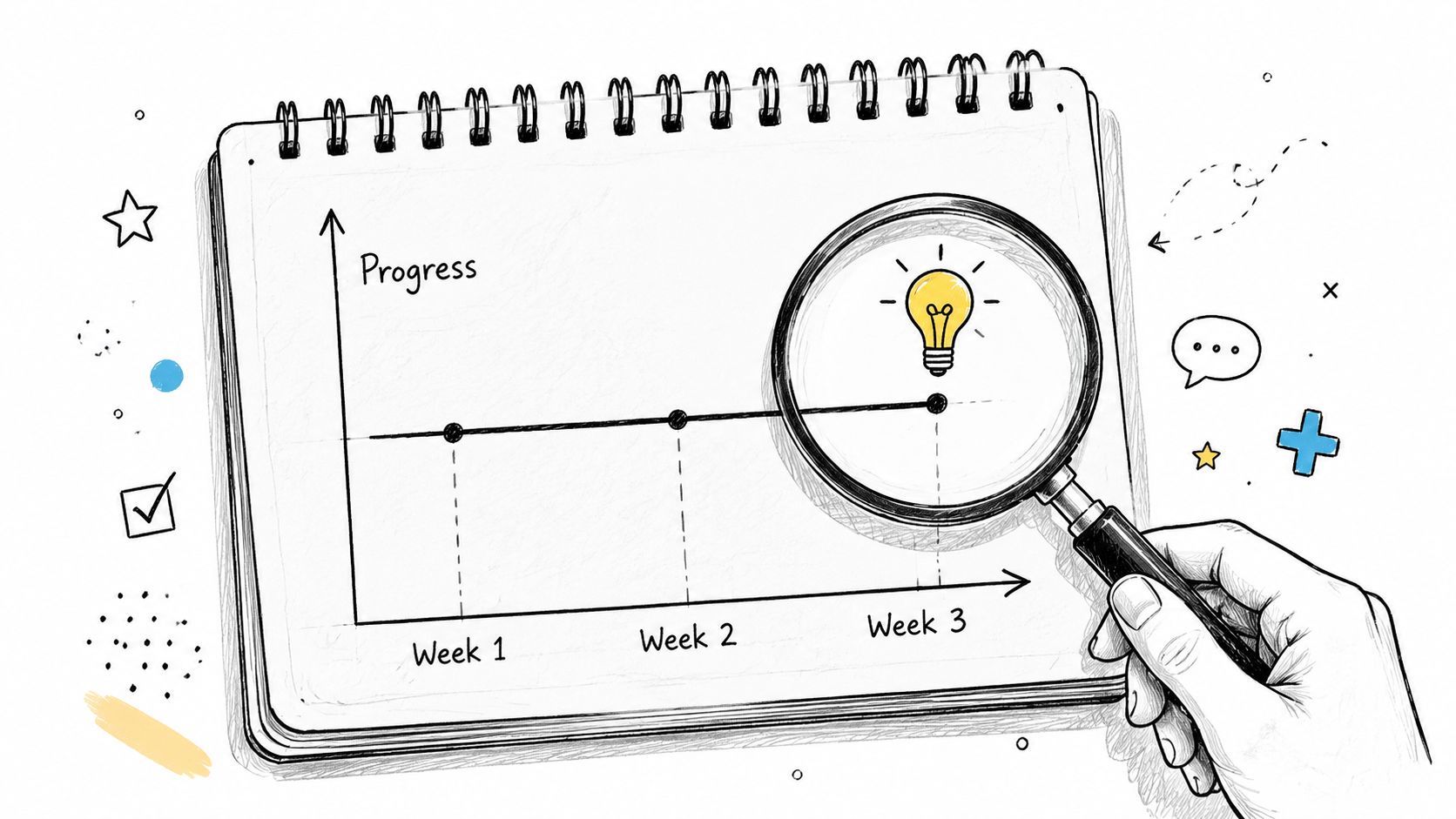
A chart can also reveal when you shouldn't add more work. If volume rises while estimated 1RM falls and RIR worsens, another set may be the wrong response. Reduce fatigue first, then assess performance after recovery. Long-term training data suggests that progress eventually slows and plateaus, so your review cycle should become broader as your training age increases, rather than treating every week as an isolated test.
The volume trends guide offers a useful way to think about these patterns. Keep the display simple enough that you can identify a decision within a few seconds. If a chart requires a long explanation before it tells you whether to add, hold, or reduce work, it isn't serving the session.
Building a Tracking Habit That Sticks
A tracker only helps while you keep opening it. Adherence usually fails because logging takes too much time or thought, not because the lifter lacks motivation. Research on app-based resistance-exercise behavior found that consistency during the first 28 days strongly predicted longer-term adherence, while only 10.1% of beginner users remained adherent at 12 months (app-based adherence research).
Design the first version around the next entry. Preload the previous session's exercises, weights, and repetitions. Use a rest timer that lets you continue between sets without rebuilding the workout. Keep notes for unusual events, such as pain or a missed range of motion, but avoid turning every set into a questionnaire.
Build the smallest reliable routine
Begin with three priority exercises. Log those every session before adding detailed accessory tracking. Expand the template only when the additional field can change a programming decision.
A practical workflow includes:
- Templates: Schedule recurring workouts so exercise selection is not a daily task.
- Quick entry: Use shortcuts or a custom keyboard to record load and repetitions while the details are fresh.
- Rest timers: Set normal and warm-up intervals when rest affects the training block.
- Review prompts: Check charts on a planned cycle instead of reacting to every fluctuation.
Choose the tool that creates the least friction. A notebook works when you write consistently. A spreadsheet provides flexibility but may require more setup. Strive Workout Log includes exercise, set, repetition, weight, RIR/RPE, routine templates, rest timers, deload marking, and charts for volume, intensity, and estimated 1RM. Core workout logging is available without ads or a subscription.
Treat adherence data as a useful record, not a perfect measurement. Exercise diaries can overestimate what occurred, and comparisons with objective device data have shown limited agreement in some settings (exercise-log accuracy research). The practical standard is simpler: record the same fields often enough to see whether performance and consistency are improving.
Use Strive Workout Log to create repeatable routines, record sets, reps, weights, and effort, then review charts for progression and plateaus. Set up your three priority exercises, log the next session accurately, and use the trend to choose your next change.
Leave a Reply