
You're at the cable station with the stack loaded, a D-handle clipped to the low pulley, and one arm ready to work. The first few reps feel strong, then the torso starts turning, the shoulder creeps toward the ear, and the handle finishes higher on the chest than it did on the first rep. That's the usual failure point of the 1 arm cable row. The exercise isn't difficult because pulling a handle is complicated. It's difficult because your back has to produce force while your trunk prevents the cable from rotating you.
A good setup gives you a controlled range of motion, a stable line of pull, and enough loading potential to progress without turning every set into a full-body heave. The advice below connects each major cue to the available biomechanics, then turns those findings into a practical plan you can record and progress in Strive.
Why the 1 Arm Cable Row Belongs in a Science-Based Back Day

After heavy bilateral pulling, the 1 arm cable row gives you a repeatable way to add back volume without asking the hips and spinal erectors to support another demanding free-weight position. Set beside a low pulley with one hand braced on the machine, you can train each side separately, compare performance, and keep the cable loaded through much of the pull.
The main training cost is trunk control. A 2009 comparison of rowing exercises found that the standing one-arm cable row challenged the trunk's ability to resist torsion. Low-back extensor activation was significantly higher in this variation, 9.3% MVC, than in the bent-over row at 4.2% MVC and the inverted row at 3.8% MVC, with a statistically significant difference, F = 7.29, p = 0.0085. The researchers also reported the greatest demand on axial-twist muscular stiffness, so the torso must resist rotation as the arm moves the cable (NSCA comparison of rowing exercises).
Why the cable earns its place
A barbell row remains valuable for bilateral loading and whole-body strength. It also requires the hips, spinal erectors, and posterior chain to hold the torso in position. The cable row offers a different trade-off: a consistent line of pull, independent left and right work, and simple elbow-angle changes that can shift emphasis between the lats and upper back.
Place the cable row after a heavy bilateral pull when the goal is controlled back volume with fewer stability demands from a free implement. It works as an accessory, not a substitute for a heavy barbell row or weighted pull-up. The difference between these loading approaches is outlined in this guide to bilateral versus unilateral training.
Log each side separately in Strive, including load, repetitions, and any form limit that ended the set. Progress only when both sides reach the planned repetitions without torso rotation or shortened range of motion.
Practical rule: Use the cable row for targeted, repeatable pulling volume. Keep heavy bilateral work in the session when whole-body strength is also a priority.
Step-by-Step Setup and Pulling Technique
Start with the pulley at the bottom of the stack and attach a single D-handle. Step back until the cable has tension before the first pull, then use a staggered stance with the foot opposite the working arm forward. That stance gives you a wider base against the cable's rotational pull without forcing you to lock the torso into an awkward position.

Hinge until your torso sits around a 45-degree angle, reach forward, and set the shoulder before you grip hard. Depress the scapula slightly, keep the neck long, and take a diaphragmatic breath that expands the abdomen and sides of the trunk. Your working hand should sit in a neutral, roughly shoulder-width relationship to the cable path. The handle doesn't need to be pulled from an exaggerated reach, but you should begin with the arm long enough to let the back work through a meaningful range.
Use the cue “ribs down, elbow close, hand to pocket.” Keep the hips square and brace the oblique on the side opposite the working arm. Pull the elbow back and slightly upward, but keep it close to the torso, within roughly 15 degrees of the body for the lat-focused version. Bring the hand toward the lower ribs or pocket line instead of dragging it toward the upper chest.
Exhale gradually against the load as you complete the pull. Pause for about one second at the contracted position, squeeze the lat, and check that your shoulder hasn't shrugged. Return the handle over two to three seconds, allowing the arm to extend while you resist rotation rather than letting the cable pull your torso around.
Use this sequence to self-correct:
- Set the base: Opposite foot forward, hips square, free hand braced if needed.
- Create tension: Remove slack before the first repetition.
- Set the shoulder: Keep the scapula controlled and the neck relaxed.
- Drive the elbow: Move the upper arm before chasing the handle with the hand.
- Own the return: Reach long without losing the brace.
The movement should feel like a back exercise with a trunk-control requirement, not a standing twist with an arm pull. A broader cable setup can also fit well inside a cable upper-body workout when you want consistent resistance and straightforward exercise substitutions.
Elbow Path, Scapular Control, and Anti-Rotation
Elbow direction determines which part of the back carries more of the work. Keep the upper arm close to the torso for a lat-focused row. Move it farther from the body to shift more demand toward the upper and middle back, rear delts, and scapular retractors.
A biomechanics comparison of seated cable-row variations found an angle-dependent trade-off. As shoulder abduction approached 90 degrees, upper trapezius, middle trapezius, and posterior deltoid activation increased. Positions nearer 0 degrees produced greater latissimus activation and peak force output (biomechanics of seated cable-row variations).
| Setup | Elbow Path | Primary Muscles | Best Use |
|---|---|---|---|
| More upright torso, shoulder close to the side | Close to the ribs, toward the hip | Latissimus and teres major | Lat-focused pulling |
| Moderate hinge, shoulder slightly away from the side | Back and slightly outward | Lats with upper-back support | General back hypertrophy |
| Flatter torso, shoulder more abducted | Wider path toward the upper ribs | Middle trapezius, rhomboids, rear delts | Upper-back emphasis |
Control the scapula before adding aggressive elbow flexion. Set the shoulder, then move the elbow. This sequence keeps the pull connected to the back and limits the tendency to turn the opening portion into a biceps curl.
The standing one-arm cable row also tests trunk control. A 2009 comparison identified it as a torsional challenge, with unilateral rows producing meaningful, though lower, oblique and multifidus activation than a free-weight row. External-oblique activation reached 50 to 57%, while multifidus activation reached 70 to 73% of the free-weight benchmark (peer-reviewed rowing comparison).
Brace before the handle leaves the stack. Swaying plates, opening hips, or ribs turning toward the working side signal a stability problem the cable is exposing. Lower the load, brace the free hand against the rack, and keep both sides visually consistent at the finish. In Strive, log the elbow-path variation beside the load and repetitions, so progression reflects the target muscle emphasis rather than weight alone.
Programming for Hypertrophy and Strength
The one-arm cable row works well as an accessory because you can load it progressively without requiring the same whole-body output as a heavy free-weight row. For muscle growth, use a load that lets you maintain a full, controlled range and finish most sets with two to three reps in reserve. A broad loading spectrum can support similar whole-muscle hypertrophy, with research recommendations extending to about 30% of 1RM and above, so you don't need to force maximal loading when a lighter weight gives you cleaner execution (2021 loading review).
For strength, heavier work makes sense, but the torso must remain still. The 2026 American College of Sports Medicine position stand reports improved voluntary strength with loads at 80% of one-repetition maximum or higher, a complete range of motion, 2 to 3 sets, early-session placement, and training at least 2 times per week (2026 ACSM position stand summary).
| Goal | Sets x Reps | Load vs 1RM | Tempo | Rest | RPE |
|---|---|---|---|---|---|
| Hypertrophy | 3 to 4 x 10 to 15 per side | 60 to 75% | Controlled pull, 2 to 3 second return | 60 to 90 seconds | 7 to 8 |
| Strength | 4 to 5 x 6 to 8 per side | 80 to 87% | Controlled throughout | 2 to 3 minutes | 7 to 8 |
| Technique | 2 to 3 x 12 to 15 per side | Light to moderate | Deliberate pause and return | As needed | Comfortable |
Treat each side as its own work. The stronger arm doesn't get extra repetitions, and the weaker arm doesn't get rushed rest. If you use heavier loading and need to control total volume, a 2:1 rep ratio can be used temporarily, with two controlled repetitions on the weaker side for every one on the stronger side, but equal sets and consistent execution should remain the default.
Longer rest can be useful when fatigue causes your elbow path or brace to deteriorate. A 2024 systematic review and Bayesian meta-analysis found that hypertrophy can occur across a wide range of rest intervals, while longer inter-set rests offered a small advantage over shorter rests for muscle growth (2024 rest-interval review). Don't shorten rest merely to make the workout feel harder.
Common Mistakes and How to Fix Them
The heaviest stack setting is rarely the most productive choice. Cable rows usually fail because the lifter can move the handle, while the target muscles cannot control the intended path.
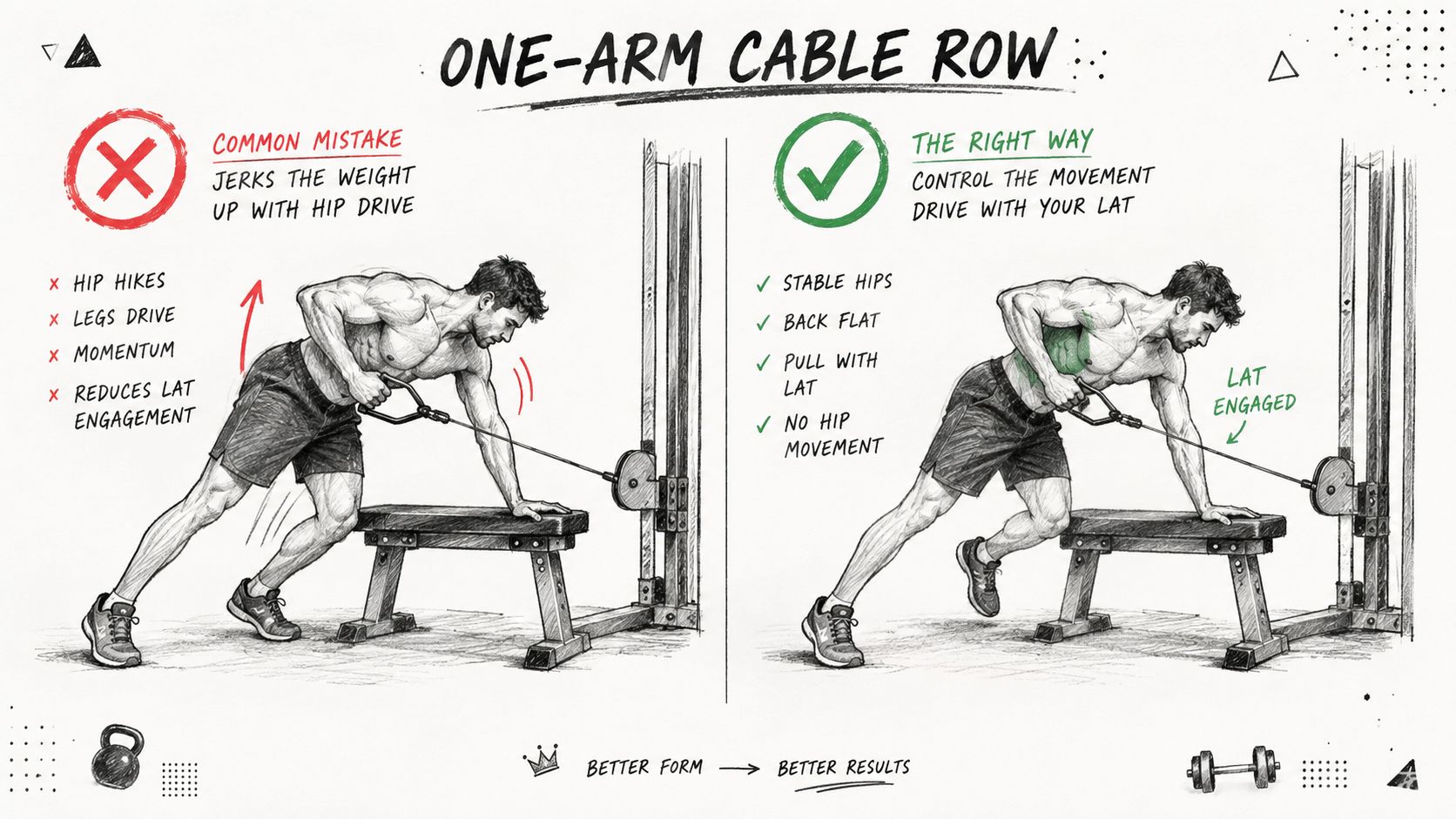
The torso moves before the elbow
Hips snapping, ribs flaring, or the shoulder rolling forward before the pull begins signals a load too heavy for the position or an unestablished brace. Reduce the weight, shorten the set, and set the scapula before bending the elbow on every repetition. A free hand against the rack provides a useful regression. It gives you more stability while you rebuild the intended line of pull.
The elbow drifts wide
A wide elbow can suit an upper-back and rear-delt emphasis. It becomes counterproductive for a lat-focused row when the hand travels toward the chest and the shoulder shrugs. Keep the elbow near the torso, pull toward the lower ribs, and end the repetition as soon as the shoulder begins to roll forward. The elbow path should match the muscle emphasis, not the load on the stack.
Rotation replaces resistance
Turning toward the working side makes the handle feel lighter because the trunk contributes to the movement. Square the hips, brace the opposite-side oblique, and use the free hand for support while you relearn the line. Research on the standing one-arm cable row identified a strong torsional challenge, so trunk rotation is a demand to control, not a harmless detail. Log whether the set stayed square, because a heavier load with more rotation is not the same performance as a cleaner repetition.
The biceps take over
Use the cue “drive the elbow” or “bend the bar” instead of focusing on pulling the handle. Grip selection and elbow timing can change how quickly the arms become the limiting factor. A pronated grip has been associated with greater biceps brachii activation than other tested row grips, so choose the grip according to whether you need more back emphasis or can accept greater arm involvement.
The range gets cut short
A partial pull can make the set look stronger in the log while removing the lengthened position and controlled finish. Reach forward under control, allow the arm to extend without losing trunk position, then pull until the elbow passes the ribs without forcing a shrug. Record the load only alongside repeatable range and control. Once that path disappears, end the set rather than adding compensatory movement.
Logging, Progression, and Tracking in Strive
A useful log records more than the number on the stack. Create the exercise as a unilateral movement, record the load and repetitions for each side, and add a short note about stance, elbow path, and whether the free hand was braced. That information helps you distinguish a real strength gain from a heavier set performed with more rotation.
Use a double-progression target. Keep the load fixed while you build repetitions inside your chosen range, then increase the weight once you exceed the top of the range for two sessions. A practical rule is adding 2.5 pounds when the last set exceeds the target, then returning to the lower end of the repetition range. Because cable stacks vary between machines, use the same station whenever possible.
Strive Workout Log can record sets, repetitions, weights, RIR or RPE, exercise notes, and progression rules. Its charts can display exercise performance and training volume, which makes it suitable for checking whether one side is consistently falling behind rather than relying on memory.
A simple tracking workflow
- Log each side separately: Keep left and right records visible instead of entering one blended number.
- Use an execution note: Write “elbow close,” “wide upper-back path,” or “free hand braced” so the next session matches the current setup.
- Set the next target: Use a rep range first, then prescribe the next load after the range is achieved.
- Review the charts weekly: Look for a persistent side difference, falling repetitions, or rising effort at the same load.
- Tag the session: Mark it as “pull day” so you can compare the exercise inside the relevant training block.
Use the workout progress tracking guide for a broader system, but keep this lift's notes specific. A deload becomes reasonable when bar speed drops by more than 10% or when sets repeatedly reach RPE 9 to 10, then volume should be reduced before normal progression resumes.

Weekly Pull Day Plan and Final Takeaways
Build the session around the role you want the one-arm cable row to play. It works best after a heavier bilateral pull when the main strength work is finished, but before smaller isolation movements when you still have enough focus to control the trunk and shoulder.
A balanced pull day can use a horizontal-to-vertical emphasis of roughly 2:1. Start with a barbell row or weighted pull-up for 3 to 4 sets of 5 to 8, then perform the one-arm cable row for 3 to 4 sets of 8 to 12 per side. Finish with a vertical pull or supported row, then add rear-delt, face-pull, or curl work as needed.
| Day | Exercise | Sets x Reps | Load Focus | Goal |
|---|---|---|---|---|
| Heavy | Barbell row or weighted pull-up | 3 to 4 x 5 to 8 | Heavy, around 80 to 87% effort | Bilateral strength |
| Heavy | 1 arm cable row | 3 to 4 x 8 to 12 per side | Challenging, strict | Unilateral back volume |
| Heavy | Lat pulldown or chest-supported row | 3 x 10 to 12 | Moderate | Additional pulling volume |
| Heavy | Face pulls, rear delts, or curls | 2 to 3 sets | Controlled | Smaller-muscle work |
| Volume | 1 arm cable row | 3 to 4 x 10 to 15 per side | Moderate | Hypertrophy |
| Technique | 1 arm cable row | 2 to 3 x 12 to 15 per side | Light | Scapular control |
Rotate the emphasis across your week if you train pulling more than once. Keep one heavier session, one moderate volume session, and one technique-focused session when recovery supports it. A deload every 4 to 6 weeks, using half the usual volume for one week, can give you room to restore performance before building again.
The main lesson is straightforward. Keep the hips square, choose the elbow path for the muscle you want to train, and progress the load only while the range and brace stay consistent. Log both sides, because unilateral work is valuable partly because it shows what bilateral numbers can hide.
Use Strive Workout Log to record each side of your 1 arm cable row, track repetitions, load, RPE, rest, and technique notes in one workout history. Set a double-progression target, review the exercise charts each week, and take your next pull session to the cable station with a plan instead of guessing.
Leave a Reply