The popular advice is simple: use a neutral grip because it's the “best” way to build your lats. That claim sounds confident, but it doesn't match the evidence. Neutral handles can make the exercise feel better on your shoulders and elbows, yet they don't appear to create a special lat-growth signal that other pulldown grips can't match.
The more useful question is different: which grip lets you train hard, use a long controlled range of motion, recover, and add load or reps consistently? For many lifters, the neutral grip pulldown wins that practical comparison. It's not magic. It's a reliable tool for accumulating productive work without turning every back session into a negotiation with irritated joints.
Why the Neutral Grip Pulldown Deserves a Second Look
A neutral grip pulldown isn't automatically superior for lat development. A 2025 electromyography study tested seven lat-pulldown variations in 40 trained men, with each participant performing five repetitions at 70% of one-rep max. Latissimus dorsi activation didn't differ significantly across the grip types and forearm orientations tested, so neutral grip wasn't clearly better for lat stimulation in the laboratory (the 2025 electromyography study).
That result should change how you choose exercises. Muscle growth depends on applying enough challenging work, reaching a suitable level of effort, loading the muscle through a useful range of motion, and repeating the process long enough to progress. The angle of your palms matters, but it usually matters less than whether you can perform clean reps close to failure without your shoulders, elbows, or lower back ending the set first.
Comfort is a performance variable
The parallel handles place your hands in a neutral position and often allow the shoulders to move without the forced rotation of a very wide pronated grip. That doesn't make the exercise medically safe for everyone, and it won't solve an injury, but it can make the movement more tolerable for lifters who dislike wide overhand pulling.
The same applies to the elbows. A neutral wrist and a natural elbow path may reduce the irritation some people feel during repeated pronated or supinated work. Better comfort can mean better technique, more repeatable loading, and fewer missed sessions. For anyone managing recurring mid-back stiffness or trying to understand the muscles involved in upper-body pulling, MEDISTIK's guide to mid-back health offers useful anatomical context.
Practical rule: The best grip is often the one that lets the target muscles work hard while your joints stay quiet.
The latissimus dorsi remains the primary target in a pulldown, while grip changes tend to alter supporting-muscle contribution more than lat activity. You can read a practical breakdown of the muscles involved in the lat pulldown before deciding how to organize your pulling work.
Neutral grip earns its place as a joint-friendly default, not as a guaranteed superior lat builder. It's especially useful when a pronated grip feels rough, when a supinated grip makes your biceps fail early, or when you want a vertical pull you can train consistently for months.
Setting Up and Executing the Neutral Grip Pulldown
Start with the seat rather than the handle. Adjust the thigh pad so your knees sit firmly underneath it, with your feet flat on the floor and your hips anchored. The pad should hold you down without crushing your legs, because a stable base lets you move the upper body deliberately instead of bracing against the machine throughout every rep.
Reach up and take the parallel handles with your palms facing each other. A shoulder-width position or a slightly narrower grip usually gives you a clean elbow path, although the available attachment determines what's possible. Wrap your thumbs around the handles. That small detail improves control and stops the hands from becoming passive hooks as the load gets heavy.
Set your torso close to vertical, then allow a modest backward lean of roughly 10 to 15 degrees. Keep your neck long, ribs controlled, and chest comfortably lifted. You're creating a stable pulling angle, not preparing to turn the movement into a row.
Make the elbows start the rep
Begin by drawing the shoulder blades down without aggressively pinching them together. Then drive the elbows down and slightly back, keeping them broadly aligned with your torso. Think about moving the upper arms rather than pulling the handles toward you with your hands.
Bring the handles toward the upper chest or just below the collarbone. You don't need to force them low if doing so makes your shoulders roll forward or your wrists bend. Pause briefly when the elbows reach their strongest position, and notice whether the lats are loaded or whether your biceps have taken over.
The return is where many otherwise strong lifters lose the exercise. Let the handles travel upward under control for two to three seconds, allowing the lats to lengthen without shrugging hard or letting the weight stack slam. At the top, reach into a full comfortable stretch while keeping tension and your torso anchored.
Use a repeatable rhythm
A useful starting tempo is approximately 2-1-1-1. Pull for two seconds, pause briefly at the bottom, return for one second, and hold the stretched position for one second before the next repetition. You can also use a slower eccentric when you need to improve control, but don't turn every set into an endurance test that forces you to use an artificially light load.
Breathe in as the handles rise, brace before the pull, and exhale through the concentric phase. If you have to jerk your torso backward, shorten the range, or finish each rep with your elbows far in front of you, the load is too high for the purpose of the set.
What the Science Says About Muscle Activation
Neutral grip is a sensible default for training quality, not a guaranteed lat-isolation tool. The 2025 study described in the previous section found no significant difference in latissimus dorsi activation across its seven variations, while the lats remained the primary target in each version. Earlier research also reported broadly similar activation across narrow, medium, and wide grips in trained men, with tested 6RM loads of 80.3 kg for narrow, 80.0 kg for medium, and 77.3 kg for wide grips (the grip-width research summary).
Those findings matter because they shift the decision away from chasing a supposedly superior hand position. Grip changes still alter the exercise's feel and the supporting muscles' workload. Your biceps, brachialis, brachioradialis, teres major, trapezius, rhomboids, and rear delts all contribute, and their fatigue can change with hand position, elbow path, and torso angle even when lat activation stays broadly similar.
| Grip | Latissimus Dorsi | Biceps Brachii | Trapezius/Rhomboids | Teres Major |
|---|---|---|---|---|
| Neutral | Similar overall recruitment across tested variations | Moderate contribution | Supports scapular control and pulling | Assists shoulder extension and adduction |
| Pronated | Similar overall recruitment across tested variations | Often less dominant than supinated work | Contributes strongly to upper-back control | Assists the downward arm path |
| Supinated | Similar overall recruitment, but the feel can change | Usually more involved | Supports the pull as the elbows travel down | Assists alongside the lats |
| Wide | Similar overall recruitment in the available evidence | Can feel less dominant for some lifters | May contribute more as the elbows travel outward | Helps control the wider arm path |
Use symptoms and performance to interpret the table. If your biceps fail well before your back feels challenged, the grip or elbow path may be a poor match for the set. If your shoulders become the limiting factor before the back reaches meaningful fatigue, a neutral attachment can preserve loading quality and let you train closer to your intended effort.
Read the set, not the marketing
A useful repetition begins with a controlled lat stretch. During the pull, direct the elbows toward the hips instead of curling the handles toward your face. At the bottom, assess the position of the upper arms and the tension through the back, rather than forcing the weight to touch a specific point.
A brief pause at peak contraction can reveal whether you are controlling the load. It will not radically change the exercise, but it reduces the chance that momentum is doing the work and makes poor positioning easier to detect. For a clear explanation of the lifting and lowering phases, Lake City Physical Therapy on contraction types provides a useful reference.
EMG records acute muscle activation, not the amount of muscle you will build over a long training block. The available evidence suggests that grip differences are relatively small for the lats. Progressive loading, sufficient effort, stable technique, and recoverable volume deserve more attention than chasing a perfect palm angle.
Choosing Neutral Grip Over Other Pulldown Variations
Neutral, pronated, supinated, and wide grips are not competing exercises where one wins every category. They're tools with different costs. Your shoulder history, elbow tolerance, biceps involvement, range of motion, and ability to progress should determine which one anchors your training.
The neutral grip is usually the sensible default when comfort is the priority. Your wrists stay stacked more naturally, your shoulders aren't forced into the same position as a very wide overhand pull, and many lifters can keep the elbows closer to the torso. That combination often makes it easier to maintain a controlled stretch and approach failure without joint discomfort.
A pronated grip remains valuable if it feels good. A medium overhand grip can provide a stable vertical pull and may fit naturally alongside rows and pull-ups. The evidence doesn't show that changing from narrow to wide creates a major difference in lat activation. A 2014 study concluded that grip widths around one to two times biacromial distance generally produced similar activation and likely similar hypertrophy potential (the 2014 grip-width study).
| Grip | Shoulder Comfort | Elbow Feel | Best For |
|---|---|---|---|
| Neutral | Often comfortable for lifters who dislike wide pronated work | Usually balanced and predictable | A repeatable default, shoulder-sensitive training, long-term progression |
| Medium pronated | Good when the shoulders tolerate the position | Can feel demanding with frequent high-volume pulling | General vertical pulling and grip rotation |
| Supinated | Depends heavily on wrist and elbow tolerance | Can load the elbow flexors more noticeably | Biceps carryover and chin-up practice |
| Wide pronated | More demanding for some shoulders at the stretched position | May feel fine or restrictive depending on anatomy | Lifters who prefer the classic wide-pull setup |
The supinated grip earns its place when you deliberately want more biceps contribution or want to build familiarity with chin-up mechanics. It isn't automatically a better lat exercise, and it can be a poor choice if elbow tendons are already irritated.
Wide grip is also a preference, not a shortcut to a wider back. Some lifters like the sensation, while others lose range of motion or feel shoulder pressure before the back reaches a hard effort. Don't choose it because social media calls it a width builder. Choose it if your anatomy tolerates it and you can progress it.
Joint-first decision: If two grips train your back similarly, keep the one that lets you add productive work without accumulating irritation.
Handle Width, Torso Angle and Tempo Tweaks That Matter
Small changes can alter the feel of a neutral grip pulldown without changing the exercise entirely. A narrow V-handle keeps the hands close and usually encourages the elbows to travel tight to the sides. A medium neutral handle gives you a balanced setup for most lifters, while a wider neutral attachment can create a broader elbow path and a different upper-back demand.
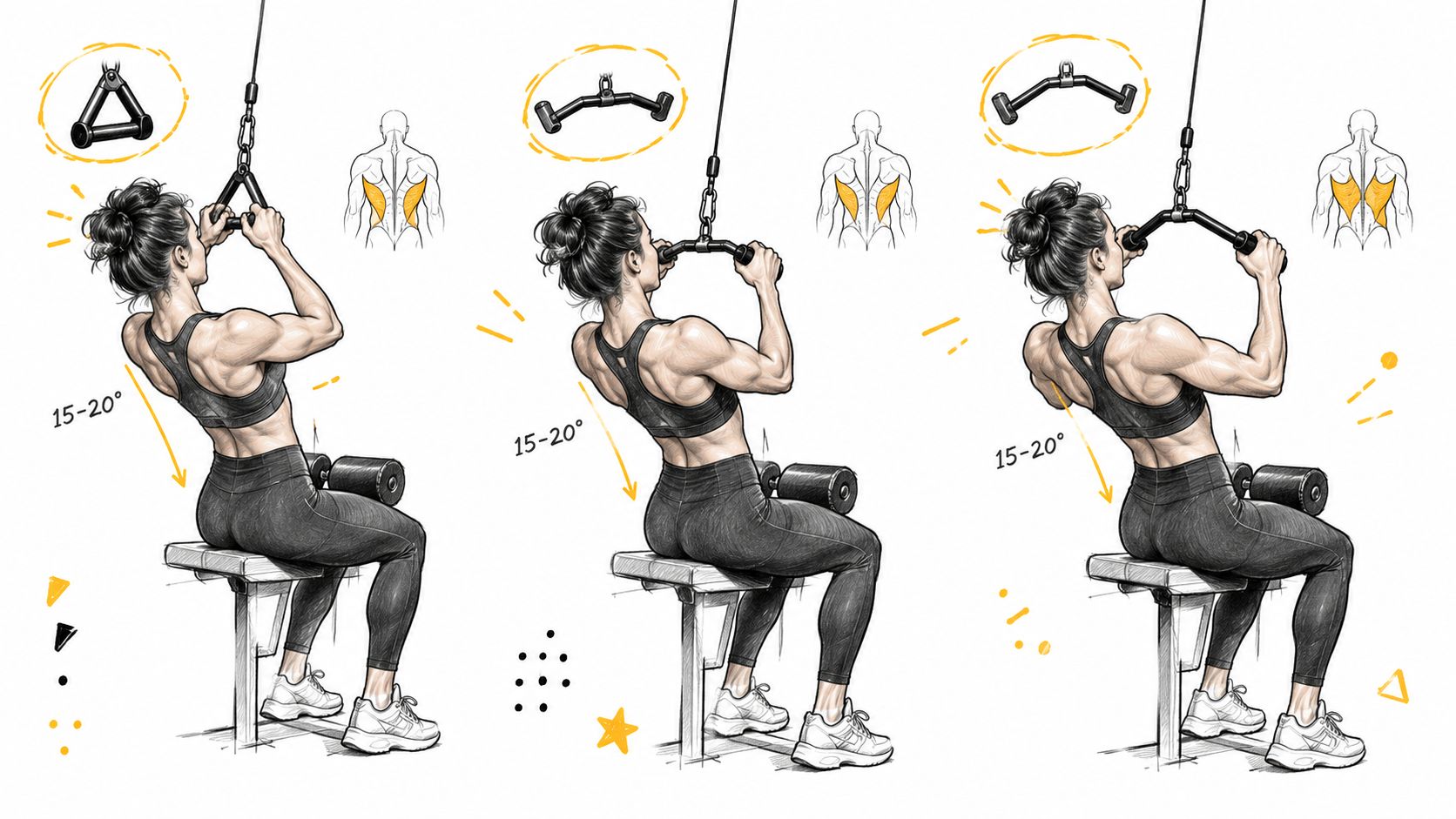
Use the narrow option when you want a compact elbow path and a strong stretch overhead. Try the medium handle when you need the most repeatable setup for progressive overload. Use the wider neutral option only if you can keep the shoulders comfortable and complete a similar range of motion.
Adjust the torso without swinging
A mostly upright torso keeps the movement closer to a vertical pull and can make it easier to focus on the lats. A modest 15 to 20 degree lean may bring more mid-back contribution and give the elbows room to travel behind the torso. The distinction matters because excessive leaning changes the exercise into a high row, especially when the chest rises toward the handles.
Pull toward the upper chest when you want a controlled vertical path. Pulling lower may feel powerful, but it can encourage excessive backward lean and shoulder extension that your lats aren't controlling. At the bottom, allow the shoulder blades to move naturally rather than forcing a hard retraction that shortens the available range.
Recent evidence summaries continue to show that grip orientation alone may not meaningfully change lat recruitment, while torso position and hand placement can affect supporting-muscle contribution (a guide to lat-pulldown grip differences).
Tempo gives you another way to standardize the stimulus. A 2-1-1-0 rhythm is practical for normal progressive work. A 3-1-2-0 rhythm makes the eccentric and return more demanding, which can help when technique is inconsistent or when you want to reduce momentum without immediately changing the attachment.
Don't rotate every variable at once. Keep the handle fixed, adjust one torso or tempo variable, and record whether your range of motion, reps, effort, and joint comfort improve.
Programming the Neutral Grip Pulldown for Hypertrophy
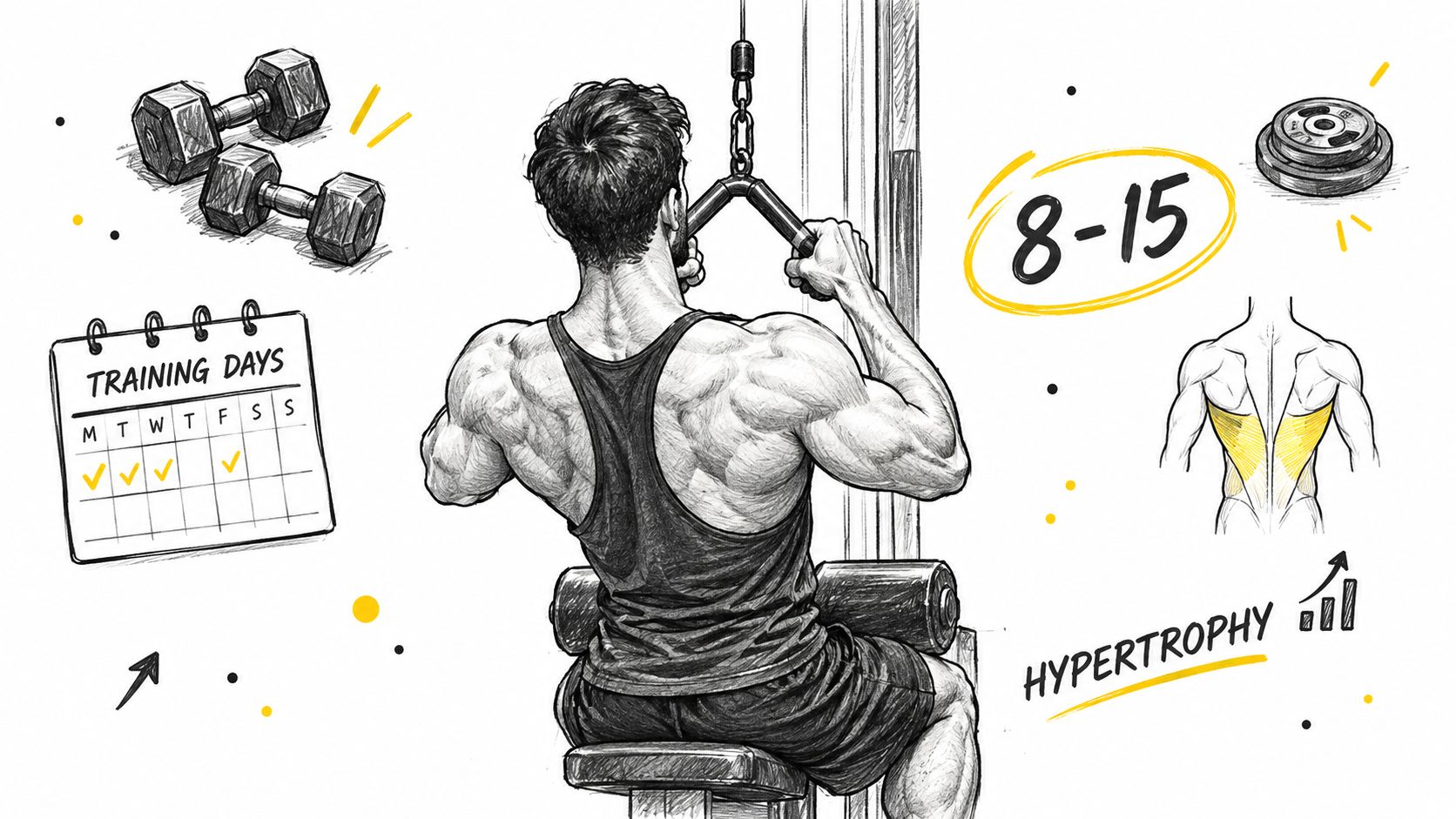
Treat the neutral grip pulldown as a main movement, not an optional finisher you perform after your energy and attention are gone. A practical hypertrophy starting point is 3 to 4 sets of 8 to 15 reps, using approximately 60 to 75% of one-rep max or an effort of RPE 7 to 9. Those are programming targets, not laws. The correct load is the one that keeps the planned range of motion and leaves the intended reps in reserve.
The exercise can appear 2 to 3 times per week if your elbows, shoulders, and back recover well. Use it as the primary vertical pull in one session and as a lighter secondary pull in another, or keep the same attachment while varying the effort. The evidence-based exercise-selection principle is straightforward: favor movements you can overload, perform through a long useful range, and recover from without excessive systemic fatigue (an evidence-based exercise-selection framework).
Use double progression
Pick a rep range, keep the attachment and execution consistent, and add reps before adding load. For example, if your target is 8 to 12 reps, hold the weight steady until every set reaches the top of that range with your technique intact. Then add a small amount of weight and return to the lower end.
RIR-based autoregulation keeps the plan flexible. Start farther from failure when the movement follows heavy rows or deadlifts, and work closer to failure when the pulldown is your first back exercise. The guide to effective reps and hypertrophy volume can help you think about effort and total work without treating either as a substitute for good execution.
Pair the pulldown with a row for balanced pulling volume. A chest-supported row is particularly useful when you want back work without adding much whole-body fatigue. Keep direct elbow-flexor work in mind too, because hard pulldowns already ask the biceps and brachialis to contribute.
Know when to reduce stress
A deload is appropriate when rep speed drops across otherwise normal loads, your range of motion keeps shrinking, or shoulder and elbow discomfort persists between sessions. Don't respond to every difficult workout by changing the exercise. First check sleep, recent pulling volume, rest periods, and whether you've allowed the eccentric to become uncontrolled.
Anchor the neutral grip pulldown for a training block when you want clean progression. Rotate to a pronated or supinated variation when comfort, motivation, or a specific weak point gives you a reason. Variation should solve a problem, not hide the fact that the current plan lacks consistent overload.
Tracking Progress and Building a Plan Around It
A pulldown only becomes a growth-focused exercise when you can tell whether performance is improving. Record the exercise as a distinct movement and note the attachment type, range-of-motion standard, tempo, RIR target, set weight, reps, and session tag. Without those details, a heavier number may only reflect a shorter stretch, more torso movement, or a different handle.
A workout log such as Strive Workout Log can store those set details, separate custom exercise variants, show exercise history, and provide charts for volume and tonnage. The point isn't to collect data for its own sake. It's to make sure the same movement is actually progressing under comparable conditions. The workout progress tracking guide explains how to use that kind of record more systematically.
Apply one clear progression rule
Use this rule for the neutral grip pulldown: add one rep per set, then add 2.5 kg when all sets hit the top of the rep range across two sessions. Keep the RIR target stable while you build reps. If the load increases and your reps fall, that's expected. Rebuild the range rather than forcing the old rep total immediately.
| Week | Sets x Reps | Load Progression | RIR Target | Notes |
|---|---|---|---|---|
| 1 | 3 x 8 to 10 | Establish a controlled baseline | 3 | Record attachment, tempo, and ROM |
| 2 | 3 x 9 to 11 | Add one rep per set where possible | 2 to 3 | Keep the same torso position |
| 3 | 3 x 10 to 12 | Continue reps before load | 2 | Stop if technique changes materially |
| 4 | 3 x 8 to 10 | Add 2.5 kg after the top range is met across two sessions | 2 to 3 | Rebuild reps with the heavier load |
Review the volume and tonnage charts alongside your actual performance. A rising tonnage number isn't useful if the range of motion is declining or your RIR is drifting toward failure. A stall becomes more convincing when the load, reps, attachment, tempo, and effort remain consistent across repeated sessions.
If the lift stalls while your joints feel good, keep the neutral grip and adjust rest, weekly placement, or set volume. If the stall comes with persistent irritation, swap to a different grip or handle and preserve the same progression logic. The exercise can change without abandoning the training objective.
Strive Workout Log lets you record neutral grip pulldown sets, reps, weights, effort, attachments, and custom progression rules while using history and charts to review your trend. Visit Strive Workout Log to build a repeatable back-training plan and track whether your pulldown is improving week to week.
Leave a Reply