Download free →

8 Best Gluteus Medius Exercises for Strength & Growth

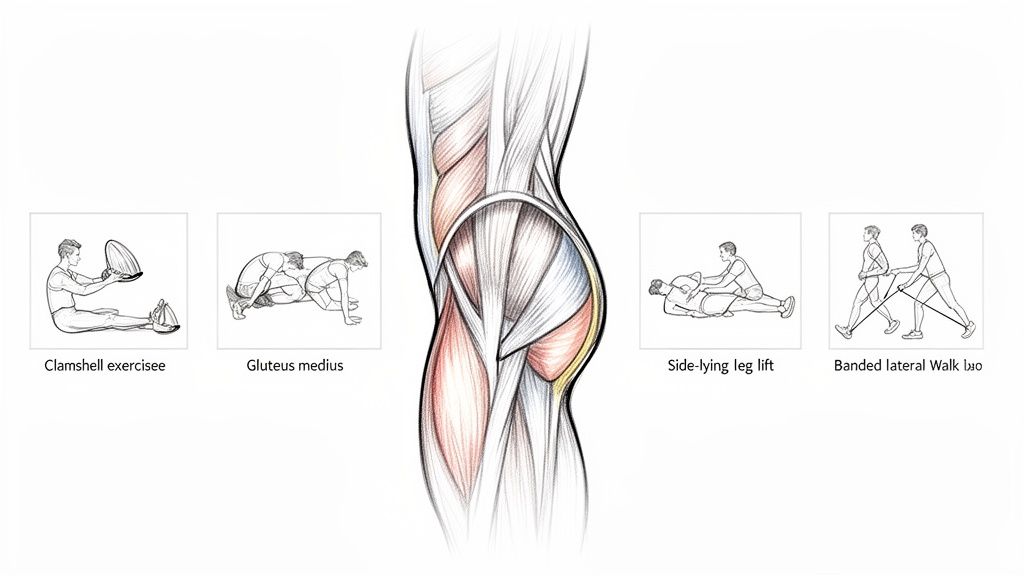
Are you spending a lot of time on squats, lunges, and hip thrusts, but still feel unstable on one leg or underwhelmed by the side-glute development you want? That usually means your glute training is missing a specific job, not just more effort. The gluteus medius doesn't get built well from random “booty” work, and it definitely doesn't get built well from rehab drills that never progress.

Individuals often make one of two mistakes. They either stay stuck with low-load activation forever, or they jump straight to heavy compound lifts and assume the gluteus medius will take care of itself. Neither approach is enough on its own. This muscle helps control pelvic position, contributes to hip abduction, and matters most when your body has to stabilize force on one leg. If your exercise selection doesn't reflect that, your training has a gap.

The evidence is also more specific than most gym content admits. A major systematic review on segment-specific gluteus medius exercise selection showed that different portions of the gluteus medius respond best to different exercises. That matters if you want real progress instead of just feeling a burn.

So this list isn't a random collection of band moves. These are gluteus medius exercises I'd build into a program for strength and hypertrophy, with an emphasis on movements you can load, repeat, and track. Just as important, I'll point out where an exercise is useful, where it falls short, and how to log it in Strive so progress is based on data instead of guesswork.

1. Barbell Hip Thrust

The barbell hip thrust isn't a pure gluteus medius isolation lift, and that's exactly why it belongs here. If you're trying to build bigger, stronger glutes overall, you need at least one exercise that lets you push meaningful load with low balance demands and manageable fatigue. Hip thrusts do that well.

A woman performing a hip thrust exercise with a barbell while leaning on a gym bench.

For the gluteus medius specifically, the value is indirect but real. The medius contributes to pelvic control and femoral stability while the larger glute complex handles hip extension. In practice, hip thrusts give you a stable base of glute strength that supports the harder single-leg and lateral work where the medius has to do more of the steering.

If someone only does band walks and clamshells, they usually hit a ceiling fast. If someone only does heavy bilateral compounds, they often get strong without fixing lateral hip weakness. The hip thrust solves one side of that problem. It gives you a progression-friendly main lift that doesn't chew up recovery the way some free-weight lower body work can.

How to make it useful for glute growth

Set your upper back on a bench, keep your ribs down, and drive through your heels until your hips reach full extension. Don't turn it into a lower-back movement. The top position should come from the hips, not spinal overextension.

A few practical rules matter more than fancy cues:

  • Use a stable setup: Put the bench against something solid if possible so it doesn't slide.
  • Protect your hips: A bar pad or folded towel makes heavy work much more repeatable.
  • Own the lockout: Pause briefly at the top instead of bouncing reps.

Practical rule: If your feet are too far forward, you'll feel more hamstrings. If they're too close, you'll feel more quads. Adjust until the glutes do the work.

For hypertrophy, this works best as an early-session lift. Log load, reps, and rest in Strive, then set a small target for next time. That's how this movement earns its place. Not because it “activates” everything, but because it can be overloaded cleanly for a long time.

Here's a demo if you want to check setup details before loading it hard.

2. Side-Lying Clamshells

Clamshells are one of the most overprescribed and underexplained gluteus medius exercises around. They aren't useless, but they're often treated like a complete answer when they're really an entry point.

That distinction matters because a 2017 JOSPT study on gluteus medius and gluteus minimus exercise ranking found the clam exercise was the least active of the exercises tested for nearly all segments, while isometric hip hitch variations ranked highest across all portions of both muscles. So if clamshells are the only side-glute work in your plan, you're probably leaving a lot on the table.

A digital illustration of a woman performing the clamshell exercise with a resistance band on her legs.

Where clamshells still help is early-stage training. They're simple, low-fatigue, and easy to feel. Beginners, people coming back from pain, and lifters who struggle to connect with the lateral hip can use them to learn what proper abduction and external rotation feel like before progressing.

When clamshells work and when they don't

Clamshells work best as warm-up or accessory volume. They don't work well as your main hypertrophy driver because loading options are limited and the resistance curve is poor compared with stronger abduction patterns.

Use them when:

  • You need a low-skill entry point: Great for learning to feel the side glute.
  • You want prep work before bigger lifts: A short set can help you clean up single-leg mechanics.
  • You need low systemic fatigue: They won't interfere much with the rest of the session.

If you want a fuller progression path, pair them with stronger options from this guide to gluteus medius and gluteus minimus exercises.

Add a miniband around the knees if bodyweight is too easy, but don't crank the reps mindlessly. Keep the pelvis stacked, move from the hip, and pause at the top. Once you can control the movement easily, move on to exercises with more loading potential.

Use this demo if you need a visual check on position.

3. Bulgarian Split Squats

If I had to choose one free-weight pattern that exposes weak gluteus medius function fast, it would be the Bulgarian split squat. You can't hide on one leg. If the lateral hip can't control the femur and pelvis, the movement tells on you immediately.

That doesn't make it the highest-activation gluteus medius exercise in the research. It makes it one of the best real-world builders because it combines loadability, range of motion, and unilateral demand in a way that transfers well to training and daily movement.

Why this one punches above its weight

A good Bulgarian split squat asks the front hip to do more than just extend. The gluteus medius has to help stabilize the pelvis and resist the knee collapsing inward as you descend and drive up. That's why this lift often lights up the side glute even when the cue is “stay centered and own the front leg.”

I like it for lifters who want hypertrophy with fewer moving parts than a pistol squat or a very balance-heavy single-leg drill. You can load it with dumbbells, a barbell, or even a Smith machine if the goal is muscle rather than proving coordination.

A pencil sketch of a man performing a Bulgarian split squat with dumbbells, focusing on gluteus activation.

Real-world example: field sport athletes often use split squats because sprinting, cutting, and decelerating all punish poor single-leg control. Lifters can steal that logic without pretending they're training for a combine.

Setup details that matter

Keep your front foot far enough forward that you can descend without your heel popping up. A slight forward torso lean is fine and often helps the glutes contribute more. What you don't want is a sloppy drop into the bottom with the front knee diving inward.

Stay heavy through the midfoot and heel of the front leg. If the rear leg is doing much work, the setup is off.

Start with bodyweight if needed, then build into loaded sets. Strive is useful here because you can log each leg separately and spot asymmetries over time. If you want more lower-body staples that pair well with this, this roundup of lower body compound exercises is a solid next read.

Watch a demonstration before you start chasing load.

4. Lateral Band Walks

Lateral band walks are useful, but people oversell them. They're not a top hypertrophy movement. They're a preparation tool and a low-fatigue accessory.

That said, they earn a place because they teach exactly what many lifters are missing. Tension through the lateral hip while the pelvis stays controlled and the knees track well. For warm-ups, movement prep, and groove work before single-leg training, that's valuable.

Best use case for band walks

Band walks shine before compound work. A short set can wake up the lateral hip and make split squats, step-ups, and single-leg hinges feel more organized. They're also practical when training at home or when someone needs gluteus medius exercises that require almost no setup.

The trade-off is straightforward. They're easy to recover from, but also hard to overload with precision. Once you can do them cleanly, they should support your main work, not replace it.

A practical sequence looks like this:

  • Band above the knees: Usually easier and cleaner.
  • Slight squat, not a deep squat: Too much knee bend turns it into something else.
  • Small controlled steps: Huge steps usually dump tension and wreck position.

The broader exercise-selection issue matters here. A review summarized by E3 Rehab on how to train the gluteus medius notes that side-lying hip abduction, standing hip abduction, pelvic drop or hip hitch, lateral step-ups, and single-leg bridges are strong options, but harder functional exercises like side planks, single-leg squats, split squats, single-leg Romanian deadlifts, and single-leg hip thrusts likely expose the gluteus medius to higher peak forces. That's the progression most articles skip.

If your band walk numbers in Strive never change because the movement is always “2 sets with a random miniband,” you're not programming. You're just repeating an exercise.

Here's a basic walkthrough for technique.

5. Single-Leg Romanian Deadlifts

Single-leg Romanian deadlifts are one of the best gluteus medius exercises for lifters who want strength that transfers. They're not the easiest exercise to learn, but once you own the hinge, they train the lateral hip in a way isolation work can't.

The gluteus medius must earn its keep. The stance leg controls the pelvis while you hinge, reach, and resist rotational drift. If your hip stability is poor, the movement gets wobbly fast.

Why this works so well

A 2019 EMG study comparing gluteus medius activation across exercises reported that side-lying hip abduction reached 81% ± 42% MVIC, while the single-limb squat and single-limb deadlift produced 64% ± 25% and 59% ± 25% MVIC respectively. That doesn't mean the single-leg RDL is worse. It means it fills a different role.

Side-lying abduction is the benchmark if you want maximal isolated recruitment. Single-leg RDLs are better when you want gluteus medius involvement inside a heavier kinetic-chain pattern. For hypertrophy, that combination matters. One exercise isolates. The other teaches the muscle to work under load while the rest of the body moves.

Coaching points worth using

Keep a soft bend in the stance knee and hinge by sending the hips back. Don't chase depth by rounding the spine. If balance is the weak link, hold a dumbbell in the opposite hand and use the free hand lightly on a rack until the pattern improves.

Most lifters rush this movement. Slow eccentrics usually clean it up and make the gluteus medius work much harder.

This is a great Strive exercise because unilateral loading can be tracked cleanly. Log left and right separately if one side feels less stable or weaker. That's often where useful programming decisions come from.

Here's a technique reference for the hinge pattern.

6. Glute Bridges with Pause

The glute bridge with a pause sits in the middle ground between rehab work and hard loading. That's what makes it useful. It's simple enough for beginners, but with a real pause and added load, it becomes more than a throwaway finisher.

I like this movement when someone needs more glute volume without the setup demands of a hip thrust or the balance challenge of single-leg work. It also works well after compounds, when technical quality starts to drop but you still want targeted tension.

Why the pause changes the lift

Without the pause, many people rush glute bridges and turn them into short, sloppy reps. The pause forces you to own hip extension and keep tension where it belongs. It also gives you a very easy progression variable to track alongside load.

Start bodyweight if needed, then add a dumbbell or barbell across the hips once the top position is clean. The rep should finish with ribs down, pelvis controlled, and glutes doing the work. If your lower back is cramping, you're pushing range you can't stabilize.

This exercise also fits well with lower-glute focused work. If you want ideas that complement it, this guide to the best lower glute exercises pairs well with medius training.

A useful way to run it:

  • As a primer: Lighter sets with a deliberate squeeze before your main lower-body work.
  • As an accessory: Moderate to higher reps after thrusts, split squats, or RDLs.
  • As a home option: Bodyweight plus long pauses if equipment is limited.

For Strive logging, note the pause duration in the exercise notes so progression isn't based on load alone. A clean bridge with a true hold is harder than anticipated.

Here's a simple demo to lock in the top position.

7. Cable or Machine Lateral Hip Abduction

If your goal is gluteus medius hypertrophy, cable or machine lateral hip abduction deserves a lot more respect than it gets. This is one of the few options that lets you train the muscle directly, through a clear line of resistance, with simple progressive overload.

A lot of “functional” glute work falls apart because the limiting factor is balance, coordination, or general fatigue. Machines remove much of that noise. That's useful when you're trying to grow a muscle, not audition for a movement screen.

Why machines are underrated here

The strongest case for isolated abduction work is that it keeps the target muscle as the bottleneck. You can take sets close to failure, standardize setup, and add load in small increments. That's exactly what hypertrophy programming needs.

This also lines up with the broader evidence base. The earlier review already established that exercise choice should reflect the specific segment of the gluteus medius and the training phase. In practical terms, that means direct abduction work belongs in the program even if you're also doing split squats, hinges, and thrusts.

For lifters who train in commercial gyms, there are two good versions:

  • Standing cable abduction: Better if you want each side trained independently with freedom to adjust angle and stance.
  • Seated hip abduction machine: Better if you want stability and easy loading without balance limits.

Keep the torso steady and avoid swinging the leg. The rep should be controlled, not theatrical. If the stack is moving but your pelvis is twisting around, the gluteus medius isn't getting the clean stimulus you think it is.

For tracking, Strive makes this easy. Log each side separately on cables, or keep machine settings in the notes so your setup stays consistent. That consistency is what turns accessory work into measurable progress.

Here's a video reference for the movement pattern.

8. Resistance Band Pull-Throughs

Band pull-throughs aren't typically the first exercise that comes to mind for the gluteus medius, and they shouldn't be your first choice if direct side-glute hypertrophy is the only goal. But they do fill a useful slot in a program.

They train hip extension with very little spinal loading, they teach a clean hinge, and they let you add glute volume with minimal setup. For home training, deload weeks, or accessory work after heavier compounds, that's enough reason to keep them around.

Where pull-throughs fit best

Think of pull-throughs as a bridge exercise. They're more athletic and loadable than floor activation work, but less demanding than barbell hinges. That makes them a practical option for people who need glute work without much systemic fatigue.

They're especially useful if your main issue is learning to extend the hips without overusing the lower back. The band gives continuous tension and reinforces finishing through the glutes.

The context question matters here too. BSR Physical Therapy's discussion of gluteus medius progressions highlights that goals differ. Some standing and banded variations challenge pelvic control well, while some common rehab drills like the prone bridge plank, stable-surface bridge, lunge with neutral trunk, and unilateral mini-squat show relatively modest activation values. That doesn't make those drills bad. It means exercise choice should match the goal instead of defaulting to the same list for everyone.

How to use them without wasting time

Anchor the band securely, face away from it, and let the resistance pull your hips back into a hinge. Keep a slight knee bend, maintain a neutral spine, then drive the hips through to stand tall.

A few good use cases:

  • Home sessions: Easy to set up when you don't have cables or a barbell.
  • Warm-up sets: Helpful before RDLs or hip thrusts if you need to groove the hinge.
  • Accessory volume: Good late in a session when you still want glute work.

In Strive, log the band color or resistance level in the exercise notes so progression has some structure. Otherwise, it becomes one more movement people “do” without knowing whether it's improving.

Here's a quick demo for the setup and finish.

Gluteus Medius: 8-Exercise Comparison

Exercise Implementation complexity Resource requirements Expected outcomes Ideal use cases Key advantages
Barbell Hip Thrust Moderate, requires bench setup and precise positioning High, barbell, plates, bench, padding Max glute activation; strong hypertrophy and strength stimulus Strength and hypertrophy programs in gyms Highest glute activation; clear progressive overload metrics
Side-Lying Clamshells Low, simple pattern and low skill demand Minimal, mat; optional resistance band Targeted gluteus medius activation and motor control Rehabilitation, warm-ups, beginner activation work Portable, low injury risk, easy to scale with bands
Bulgarian Split Squats High, balance, coordination, and setup needed Moderate, bench plus dumbbells or barbell Unilateral strength, stability, corrects imbalances Athletic training, imbalance correction, single-leg strength Strong unilateral demand; scalable load; reveals asymmetries
Lateral Band Walks Low, straightforward but requires form control Minimal, resistance band and small space Improved lateral hip stability and activation; warm-up benefit Pre-workout activation, rehab, mobility routines Excellent warm-up; portable; easily scalable band resistance
Single-Leg Romanian Deadlifts High, advanced hip‑hinge and balance required Moderate, dumbbell or kettlebell Posterior chain strength, balance, high unilateral glute activation Functional training, athletic conditioning, imbalance work High unilateral activation; scalable load; improves mobility
Glute Bridges with Pause Low, easy to learn; pause emphasis for TUT Minimal, mat; optional barbell or dumbbell Increased time‑under‑tension, improved glute activation and hypertrophy Beginners, home workouts, accessory volume Accessible, low equipment, easy progression via pause or load
Cable/Machine Lateral Hip Abduction Low, machine-guided, simple to perform High, cable machine or dedicated hip‑abduction equipment Direct gluteus medius isolation with controllable resistance Bodybuilding isolation, rehab clinics, gym accessory work Precise loading, consistent resistance, easy unilateral tracking
Resistance Band Pull-Throughs Moderate, requires hip hinge skill and anchor setup Minimal, resistance band and stable anchor Hip extension pattern improvement and posterior chain activation Home training, warm-ups, portable accessory work Portable; accommodating resistance curve; low joint stress

Building Your Gluteus Medius Workout Plan

Knowing the exercises isn't enough. Progress comes from matching the right movement to the right job, then tracking it long enough to see whether it's working. Most lifters need a mix of isolated abduction work, unilateral compounds, and at least one stable lift they can push hard without balance being the limiter.

Start with the big picture. Use one heavy, progression-friendly glute movement like a barbell hip thrust. Add one unilateral pattern like a Bulgarian split squat or single-leg Romanian deadlift. Finish with direct gluteus medius work like cable hip abduction, or use clamshells and band walks as prep if you still need that bridge.

Strive Workout Log fits this kind of training because you can log sets, reps, load, rest, and exercise notes in one place. If you're more advanced, tracking RPE or RIR helps keep effort where hypertrophy work usually does best, but the bigger win is simpler than that. You need a record of what you did last time so the next session has a target.

Two simple mini-programs work well for many individuals.

Routine 1 Gym-based hypertrophy

  1. Barbell Hip Thrust. 3 sets of 6 to 10 reps
  2. Bulgarian Split Squat. 3 sets of 8 to 12 reps per leg
  3. Cable Hip Abduction. 3 sets of 12 to 15 reps per leg

Routine 2 Minimalist home workout

  1. Resistance Band Pull-Through. 3 sets of 15 to 20 reps
  2. Single-Leg RDL. 3 sets of 12 to 15 reps per leg
  3. Side-Lying Clamshell. 3 sets of 15 to 20 reps per leg

The trade-offs are straightforward. Isolation lifts are easier to standardize and often easier to push close to failure safely. Single-leg compounds usually give you more global return, but they also bring more balance demands and more technique drift. Warm-up drills have value, but they shouldn't dominate the program if the goal is visible growth.

The cleanest approach is this: use activation work sparingly, train unilateral control hard, and keep at least one exercise in the plan that can be overloaded for months. That's how gluteus medius exercises stop being rehab fluff and become productive muscle-building work.

If your broader goal includes staying capable outside the gym, it also helps to keep general movement quality in mind. This article on how to improve senior mobility is aimed at an older audience, but the bigger point applies to everyone. Strength holds up better when basic movement does too.

Choose a handful of movements you can perform well, log them consistently, and beat your previous performance over time. That's still the essential path to growth.


If you want a straightforward way to track your gluteus medius exercises, Strive Workout Log lets you record sets, reps, weights, notes, rest timers, and progression targets without clutter. Build a simple lower-body routine, track unilateral work side to side, and make your next session slightly better than the last.

Leave a Reply

Discover more from Strive Workout Log

Subscribe now to keep reading and get access to the full archive.

Continue reading