The most popular advice about progressive overload for beginners is also the most limiting: add weight every workout or you're wasting your time. That rule can work briefly, but it turns normal variation, technique practice, and recovery into apparent failure. Muscle and strength don't require a heavier bar every session. They require a training stimulus that becomes more demanding over time while you preserve repeatable form.
Progress can mean another clean repetition, a fuller range of motion, an additional set, better control, or a small load increase. The practical challenge is choosing the right variable at the right time, then logging enough information to know whether your training is moving forward.
Why You Do Not Need to Add Weight Every Workout
Adding weight every session is a poor beginner rule. It treats normal changes in sleep, technique, and recovery as failure, even though a muscle can grow while the load stays the same. A planned progression still matters, but it should describe how training demand rises across weeks, not force a personal record every time you enter the gym.
A controlled study of 55 untrained young women training unilateral elbow extensions three times weekly for eight weeks found muscle growth with both fixed and progressive loading. The progressive-overload group gained more triceps thickness, with reported summed increases of 22.9% versus 11.6% (study summary). The useful conclusion is measured: a stable workload can produce adaptation, while a clear progression strategy may improve the stimulus over time.
What counts as overload
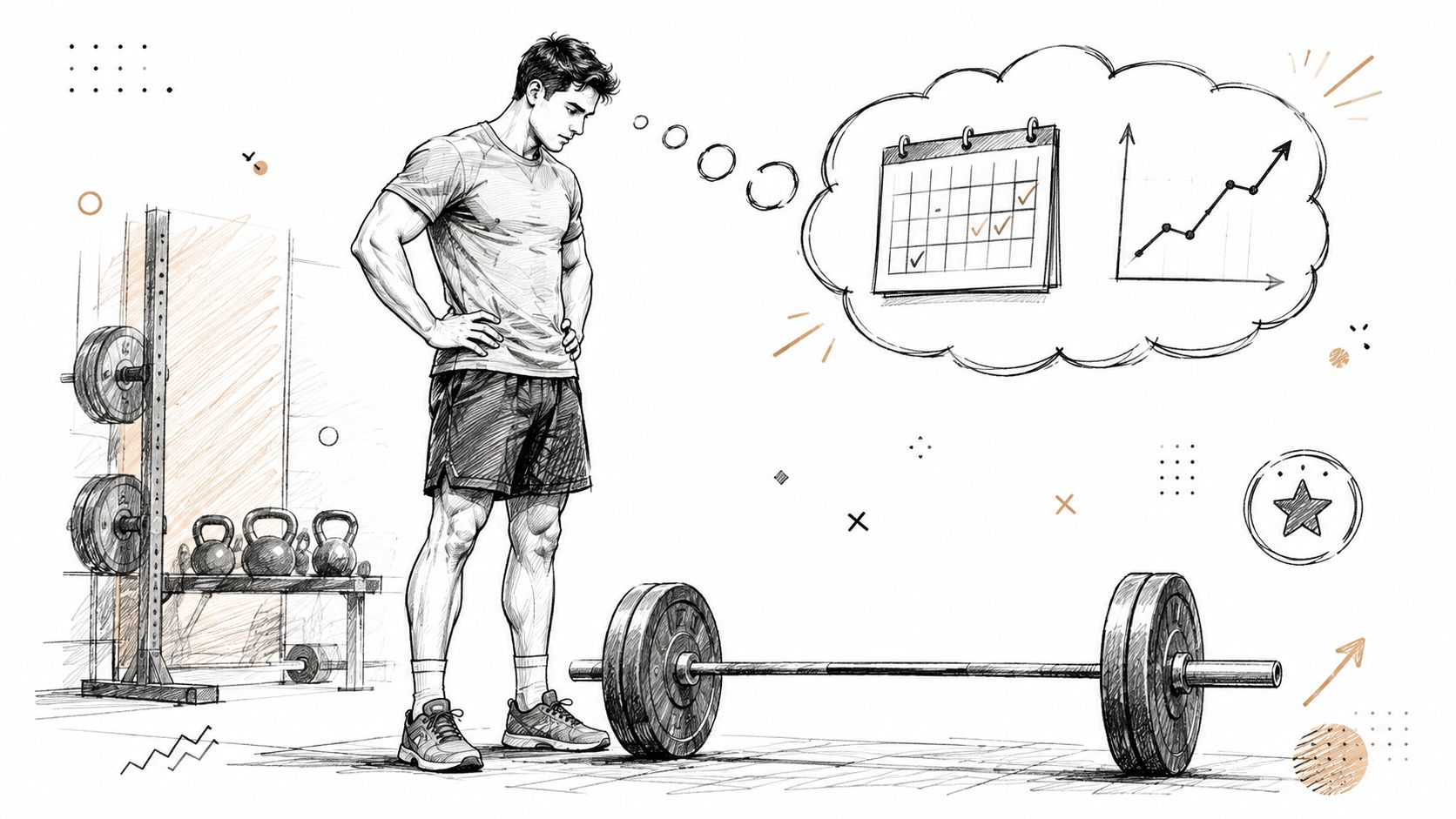
Load is only one progression variable. You can make an exercise more demanding by completing another clean repetition, adding a set, using a fuller range of motion, improving stability, or controlling the lowering phase more deliberately. These changes increase the quality or quantity of work without requiring an immediate jump in weight.
For hypertrophy, proximity to failure matters more than the number printed on the dumbbell. A moderate load performed with consistent technique and only a few good repetitions left can challenge the target muscle effectively. The 2026 ACSM position stand reports that sets taken to momentary muscular failure do not add extra gains in strength, hypertrophy, or power, so failure is not required for progress (ACSM position stand).
Practical rule: If you can improve a repetition, set, range of motion, or movement control without degrading technique, you have created progress.
Why linear progress stalls
Early strength gains often arrive quickly because beginners are learning the movement as well as adapting to resistance. That rate slows. A missed repetition, poor sleep, or small technique change can make the same load feel different from one workout to the next.
ACSM guidance for novice programming uses 8-12 repetition maximum loads, 1-3 sets per exercise, and training on at least 2 non-consecutive days per week. It recommends a 2-10% load increase when a lifter exceeds the target by 1-2 repetitions, supporting small, conditional jumps rather than automatic increases (ACSM resistance-training guidance).
Treat a stall as information. Keep the load steady, improve the next repetition, review recovery, or adjust another overload variable. Adding weight too soon can shorten the range of motion, create compensatory movement, and add fatigue that obscures whether the target muscle is improving.
The Core Variables of Progressive Overload
You don't need to manipulate everything at once. Pick one variable, keep the others reasonably stable, and make the next decision from the last completed workout. For most beginners, repetitions are the easiest first lever, followed by load and then additional sets.
Five ways to make training harder
Load is the obvious option, but it should be earned. Stay with the current weight until you reach the top of your chosen range with clean form, then use the smallest practical increase. ACSM's broader progression model supports moderate loading around 70-85% of one-repetition maximum for most major lifts, with reassessment every 4-6 weeks helping keep progression measurable (ACSM progression model).
Repetitions work well when the weight is stable. A set of 8, 8, 7 can become 8, 9, 8, then 9, 9, 8. You're improving the total work without pretending that a heavier jump is necessary.
Sets increase weekly volume, but they also increase recovery demands. Evidence-based beginner guidance commonly uses 1-3 sets per exercise, while broader beginner volume recommendations often sit around 6-10 hard sets per muscle group per week (volume guidance). Add a set when the current work is recoverable and performance has stabilized, not because one workout felt easy.
Range of motion is a legitimate progression method. A deeper squat performed under control, a press that reaches a consistent bottom position, or a row that allows a complete shoulder-blade movement can increase the training challenge without changing the load. A 2023 review found a small overall advantage for full range of motion over partial range, with a trivial standardized mean difference of 0.12, while longer ranges are particularly supported for lower-body hypertrophy (range-of-motion review).
Rest periods influence training density. Shortening rest can make the same work harder, but don't sacrifice performance on demanding compound lifts just to finish faster. For hypertrophy, ACSM guidance supports 1-2 minutes between sets, a useful starting point for maintaining quality work (ACSM hypertrophy guidance).
| Variable | How to Progress | When to Prioritize | Example |
|---|---|---|---|
| Load | Add the smallest practical increment | All sets reach the top of the rep range | Move from a manageable press load to the next available increment |
| Repetitions | Add one clean rep while keeping weight fixed | Technique is stable but reps remain below the range ceiling | Progress from 8, 8, 7 to 8, 9, 8 |
| Sets | Add one working set | Current volume is recoverable and performance is steady | Move from 2 sets to 3 sets |
| Range of motion | Gradually use a fuller, controlled path | Technique is still developing | Reach consistent squat depth |
| Rest | Reduce rest while preserving output | The goal includes training density | Use the same load and reps with slightly less recovery |
For a clearer explanation of how sets accumulate across a program, use this guide to understand training volume. The decision remains simple: change one variable, observe the response, and avoid turning every workout into an experiment.
Choosing Exercises That Actually Build Muscle
An exercise earns a place in a beginner program when it gives you a strong stimulus, allows a repeatable range of motion, and can be progressed without creating disproportionate systemic fatigue. The most impressive-looking movement in the gym isn't automatically the most useful one.
Full-body exercises such as squats, presses, rows, and hinges can train a lot of muscle efficiently. They also demand coordination and can become fatiguing when loaded heavily. Isolation exercises such as leg curls, lateral raises, cable flyes, and triceps extensions often create a more focused stimulus with less whole-body fatigue, which makes them useful additions rather than inferior substitutes.
The exercise-selection filter
Ask four questions before adding a movement:
- Can you repeat it? The exercise should feel similar enough from session to session that changes in reps or load mean something.
- Can you progressively load it? You should be able to add repetitions, resistance, sets, or difficulty without guessing.
- Can you use a useful range of motion? Full range is generally a sound default, provided the position is comfortable and controlled.
- Does it target the intended muscle? If a movement creates more joint irritation or coordination fatigue than muscular challenge, choose a better-supported alternative.
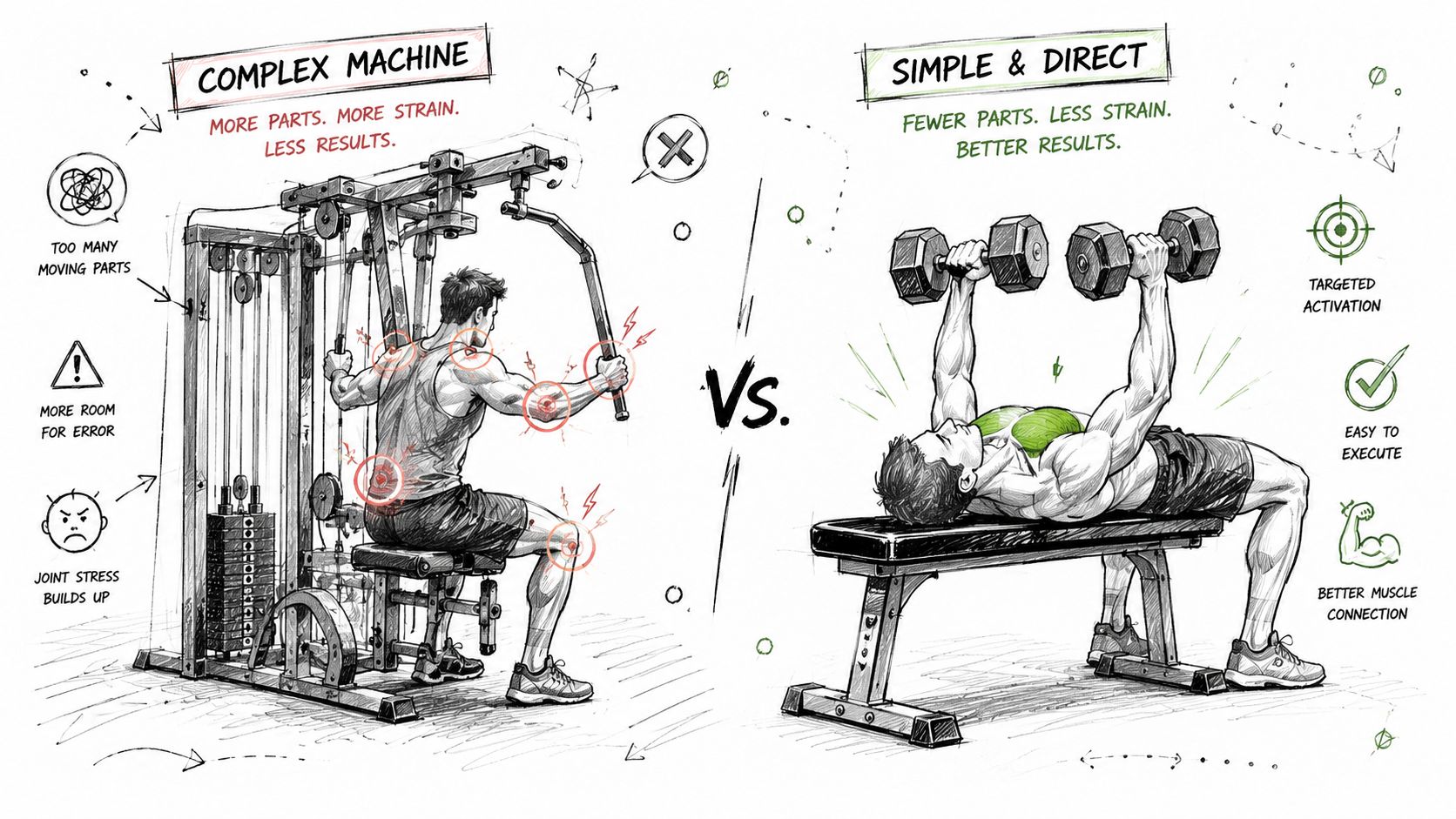
Stable machines aren't bad. A chest press, hack squat, or supported row can reduce balance demands and let you train the target muscle consistently. The issue is unnecessary variety. Beginners usually benefit more from repeating a small group of well-tolerated exercises than from rotating through every machine in the gym.
Unstable movements have a place in specific rehabilitation or sport contexts, but they're usually a poor default for hypertrophy progression. Instability can reduce the load and make it harder to measure whether the target muscle is receiving more work. Stable execution generally gives you a clearer progression path.
Compounds plus focused accessories
Build the program around movement patterns, then fill gaps with low-fatigue accessories. A squat or leg press can cover knee extension and hip contribution. A Romanian deadlift or leg curl can emphasize the posterior chain. A press can train the chest, shoulders, and triceps, while a row or pulldown trains the upper back and elbow flexors.
Technique also affects exercise access. If hip or ankle mobility limits squat depth, address the restriction rather than forcing heavier loading. A practical resource is Empire Athletics' guide to 7 hip mobility exercises, which can help you explore controlled mobility work before turning a restricted movement into a loaded progression test.
Choose the exercise that lets you train the intended muscle hard, through a repeatable range, with the least unnecessary fatigue.
A Beginner Workout Template With Clear Progression Rules
A three-day full-body schedule gives beginners repeated practice without making every session a maximal event. Alternate Workout A and Workout B across the week, leaving recovery between sessions. Start each exercise with a load that allows controlled repetitions and roughly 1-3 repetitions in reserve, rather than testing your limit.
Workout A
- Squat or leg press, 3 sets of 8-12
- Bench press or machine chest press, 3 sets of 8-12
- Chest-supported row, 3 sets of 8-12
- Leg curl, 2 sets of 10-15
- Cable lateral raise, 2 sets of 10-15
Workout B
- Romanian deadlift, 3 sets of 8-12
- Overhead press, 3 sets of 8-12
- Lat pulldown, 3 sets of 8-12
- Split squat, 2 sets of 8-12 per side
- Cable triceps extension or dumbbell curl, 2 sets of 10-15
The core progression method is double progression. Begin at the bottom of the range. Keep the load fixed while adding clean repetitions across sessions. Once every set reaches the upper limit, increase the load by the smallest practical amount and return to the lower end.
For example, a bench press could move from 3 sets of 8 at the starting load to 8, 9, 8, then 9, 9, 8. When you reach 12, 12, 12 with consistent technique, add a small increment and rebuild. For squat, row, and overhead press, use the same rule. ACSM's novice guidance supports load increases of 2-10% after exceeding the target by 1-2 repetitions, so the jump should match the exercise and your available equipment, not an arbitrary “5 pounds every time” rule (ACSM progression guidance).
What to do when a lift stalls
A stall doesn't automatically call for more weight. First, keep the load steady and try to add a repetition. If technique is limiting you, improve range of motion or use a slower lowering phase. If recovery is good but the exercise remains underdosed, add a set. If performance falls across two consecutive sessions, reduce training stress and reassess.
A deload can mean fewer working sets, lighter loading, or both. Don't schedule it as a punishment. Use it when fatigue is masking performance, and review the training block every 4-6 weeks as a practical checkpoint. For more detail on when a straight-line approach needs adjustment, see this guide to linear progression workouts.
| Week | Sets x Reps | Load (lbs) | Progression Rule Applied |
|---|---|---|---|
| 1 | 3 x 8 | Starting load | Establish clean baseline |
| 2 | 3 x 8-9 | Same load | Add a repetition where form stays stable |
| 3 | 3 x 9-11 | Same load | Continue rep progression |
| 4 | 3 x 12 | Same load | Reach the top across all sets |
| Next exposure | 3 x 8 | Small increase | Reset the range after earning the load increase |
The load column is intentionally exercise-specific. Your starting weight depends on skill, equipment, and strength. For readers interested in the interaction between squat, bench, and foundational strength, building raw strength with squats bench and offers useful context without changing the beginner rule: repeatable technique comes before aggressive loading.
How to Track Your Progress and Stay on Course
Progressive overload is easier to manage when you stop trusting memory. Log every working set, including the exercise, load, repetitions, and whether the set met your intended standard. Add RIR, or repetitions in reserve, once you can estimate it consistently. Record rest times when fatigue or training density may explain a change in performance.
Keep the process fast enough to use every session. Enter the weight and repetitions immediately after each set. Add a short note only when something affected the result, such as unusually long rest, different equipment, pain, or a technique adjustment. A dependable history should answer two practical questions: what did you do last time, and what should you attempt today?

The data that earns attention
Load and repetitions show external performance. RIR adds context. The same weight and repetitions represent different efforts if one set ends with three controlled repetitions left and another reaches a technical breakdown. Rest time can also explain lower output, particularly on compound movements.
Weekly volume summaries show whether one muscle group is receiving far more work than another. A useful hypertrophy reference is at least 10 sets per muscle group per week, though beginners may start below that level and build gradually as recovery allows. Treat the target as a reference, not an instruction to add work immediately. Rising soreness, declining performance, and poor recovery are reasons to question volume before increasing it.
Short notes about sleep, unusual soreness, or equipment changes can prevent a bad conclusion. A single weaker workout does not establish a plateau. Look for a repeated pattern in the same exercise under comparable conditions.
Use the history view to confirm a genuine stall. If load and repetitions remain unchanged across two consecutive sessions, review technique, rest, sleep, and the size of the planned load increase before rewriting the program. Marking a deload is useful when fatigue is high and performance is falling, because it distinguishes a planned reduction from an unexplained poor workout.
Auto-progression without blind automation
An auto-progression rule should suggest the next step, not make the decision for you. Set a repetition range, add repetitions while technique remains stable, then apply the smallest available load increase after every set reaches the top of that range. Beginners can progress by adding repetitions, improving range of motion, reducing unnecessary rest variation, or increasing load. Weight is only one progression variable.
Override the suggestion when range of motion changes, pain appears, fatigue is unusually high, or the recommended jump is too large for the exercise. If you cannot repeat the target standard, keep the load steady and earn the next increase later.
For a practical walkthrough of recording load, repetitions, and progression decisions, use this guide to track progressive overload. Strive Workout Log can store sets, repetitions, weights, RIR, rest information, progression targets, and training history in one place.
End each week with three questions:
- Did I log every planned session?
- Which exercises met the trigger for more repetitions or load?
- What should next week's targets be, given performance and recovery?
That review turns training data into a clear decision instead of a collection of numbers.
Common Mistakes That Kill Your Gains
Beginners often mistake exhaustion for effectiveness. Taking every set to failure can feel productive, yet the resulting fatigue makes later sets and sessions harder to judge. Momentary muscular failure is not required for additional strength, hypertrophy, or power gains, as noted earlier.

Mistake one, chasing failure
Most beginner working sets can stop with 1-3 RIR. Stop sooner if the final repetition changes your range of motion, torso position, or joint path. A technically inconsistent set gives you a poor basis for judging progress.
Mistake two, increasing load before earning it
A heavier bar with reduced depth is a different movement, not a successful overload. Keep the load steady, or reduce it, when technique breaks down on the final repetition. If the prescribed jump causes missed repetitions, use a smaller increment or stay at the current weight longer.
Mistake three, refusing to reduce fatigue
A deload protects training quality when accumulated fatigue hides your adaptation. Reduce workload if performance declines across two sessions, effort feels unusually high, or ordinary soreness and joint discomfort stop resolving. Planned fatigue management is part of progression, not evidence that progress has stopped.
Mistake four, treating weight as the only variable
Repetitions, sets, range of motion, control, and rest periods can all increase training demand. The 2021 loading review found similar muscle growth across a wide range of loads, while local muscular endurance improved more with 15 or more repetitions. Choose the repetition target according to the exercise and goal (loading recommendations review).
Run this self-audit before changing the plan:
- Technique: Is the movement consistent from set to set?
- Stimulus: Is the intended muscle limiting the set?
- Progression: Have you tried adding repetitions or improving range of motion before forcing load?
- Recovery: Do repeated performance declines justify less workload?
- Tracking: Can you compare today's work with the previous exposure?
Use the same standards each week. A load increase only counts when the repetitions, range of motion, and technique remain comparable.
Progressive overload works best when it is measurable, conservative, and flexible. Strive Workout Log records sets, repetitions, weights, RIR, progression targets, and training history, making it easier to compare exposures and identify genuine progress before changing the program. Log the actual result after your next workout, then base the next decision on performance and recovery.
Leave a Reply