
Most lifters hear “warm up” and immediately think of two empty-bar sets, a few arm circles, and getting on with work. That shortcut misses the point. A warm up set is not decorative preparation. It's a controlled exposure to the movement, range of motion, and loading pattern you're about to use, with a cost that should be low enough to preserve your working performance.
The right approach isn't to perform as many preparatory sets as possible. It's to match the ramp to the exercise, the planned intensity, your readiness, and the amount of systemic fatigue you can afford. Heavy barbell compounds usually need more specific preparation than machine accessories. A bodyweight session may need almost none. The useful question is not “Did I warm up?” but “Did this warm-up improve the next set without stealing from it?”
Why Your Warm Up Set Deserves More Thought Than You Think
Jumping straight to a challenging barbell set can expose a problem before you've had a chance to rehearse the position. Your first working set may become a test of whether your hips, shoulders, bracing, and bar path are ready, rather than a productive strength or hypertrophy set. You may also lose valuable technique practice at manageable loads, then compensate by adding extra sets to feel prepared.
A token empty-bar routine can fail in the opposite direction. It may raise general temperature, but it doesn't necessarily prepare you for the specific joint angles, stability demands, and force production required by a heavy squat, bench press, or deadlift. A systematic review found that warm-up improved performance in 79% of the criteria examined, with little evidence that warming up harms performance overall (PubMed review). The useful detail is that specific preparation tends to matter more as the target load becomes demanding.
Signs your preparation is poorly calibrated
Your warm-up needs adjustment if:
- The opener stalls: A weight that normally moves smoothly feels unexpectedly slow before fatigue should be a factor.
- The first heavy rep feels unstable: Your joints feel stiff, your setup changes, or you lose the intended position immediately.
- You need emergency sets: You keep adding “just one more” ramp because the planned work still feels unfamiliar.
- Your early work turns into failure practice: Excessive warm-up repetitions leave the first working set slower and less technically consistent.
A controlled study on resistance-training warm-ups found that a progressive protocol using 2 sets of 6 repetitions at 40% and 80% of the training load outperformed a single lighter set at 40% for bench press performance, including faster time to maximal velocities and greater total work (controlled warm-up study). That doesn't mean every lift needs the same sequence. It does show that load and set structure can change what happens after the warm-up.
Practical rule: Treat every warm-up set as a decision about readiness, specificity, and fatigue. If it doesn't help one of those three, it probably doesn't belong.
What Counts as a Warm Up Set in Strength Training
A warm up set is a submaximal set of the exercise you're about to train, performed to prepare for heavier or more demanding work. It uses the same movement pattern, or a close variation when equipment or loading requires it, and finishes comfortably before technical breakdown or failure.
That definition separates warm-up sets from several useful but different activities:
- Mobility work changes or explores available joint motion. A hip rotation drill may help you access a squat position, but it isn't a squat warm-up set.
- Activation work gives attention to a muscle or stabilizer. Band pull-aparts can prepare the shoulders, but they don't rehearse a loaded bench press setup.
- Re-warm-ups happen after a long gap or a major exercise change. They prepare you for the next movement, not necessarily the first lift of the session.
- Working sets provide the planned training stimulus. Warm-up sets usually shouldn't be counted as effective hypertrophy or strength volume because they're intentionally too easy.
The three jobs of a warm up set are straightforward. First, it can help raise local and general temperature. Second, it rehearses the groove of the lift, including stance, grip, bracing, depth, and bar path. Third, it gives you feedback as load increases, so you can confirm whether your setup cues still work under meaningful resistance.
The line between preparation and training
A bar-only squat before loaded squats is a warm-up set because it rehearses the exercise. Bodyweight lunges may prepare the legs and hips, but they're better classified as mobility, activation, or general movement preparation unless lunges are the planned working exercise.
Keep the effort deliberately low. The target is a crisp set that feels roughly RPE 5 or below, not a challenge that creates soreness or a pump. A practical warm-up should leave you feeling more coordinated and more confident, not relieved that you survived another set.
For hypertrophy-focused work, use the full movement pattern you intend to load. A review of resistance-training technique describes full range of motion as the largest exercise-specific range achievable at each joint and notes that reviews generally support a hypertrophic benefit from full ROM over partial ROM (resistance-training technique review). Your preparatory reps should therefore look like the working reps, unless pain, mobility limits, or a specific coaching modification says otherwise.
What the Latest Research Says About Warm Up Load and Volume
Recent research challenges the idea that every warm-up should be a long, ceremonial sequence. Specificity beats ceremony. A general movement routine may reduce stiffness, but a bench press warm-up should usually involve bench pressing, while a squat warm-up should reproduce the intended depth, control, and loading position.
A 2024 study compared warm-up loads of 40%, 60%, and 80% of 10RM across the bench press, incline leg press, and lat pulldown. The 80% condition, equivalent to about 5 repetitions before the working sets, produced significantly higher total training volume than both lighter conditions, with reported differences versus 60% and 40% at p=.010 and p=.038 (2024 warm-up-load study). The researchers also reported higher bench press volume load and repetition counts than with 60%.
That finding does not mean the warm-up should become a hard working set. It supports a meaningful but controlled heavier exposure before demanding work. The study recommended warming up at roughly 80% of the first exercise's load, but repetition count still has to reflect fatigue, exercise complexity, and the work that follows. A heavy primer that reduces the quality of your first working set has missed its purpose.
Range of motion matters too
Warm-up repetitions should match the range of motion you intend to train. Full-ROM resistance training produced significantly greater adaptations than partial ROM for muscle strength, with an effect size of 0.56 and p = 0.004, and for lower-limb hypertrophy, with an effect size of 0.88 and p = 0.027 (full-ROM meta-analysis). A later analysis reported a smaller overall difference between full and partial ROM, with a standardized mean difference of 0.12 and a 95% confidence interval from -0.02 to 0.26. Its subgroup findings also suggested that partial ROM performed at long muscle lengths may produce a different hypertrophy profile.
The useful application is straightforward. Rehearse the movement you plan to load, rather than replacing it with an unrelated light exercise. That does not require exhaustive preparation. It requires enough range and control to confirm that your working position is available and repeatable.
| Warm-up style | Typical intensity | Effect on working-set performance | Fatigue cost |
|---|---|---|---|
| General mobility only | Unloaded | May improve movement comfort, but does not fully rehearse the lift | Low |
| Light, high-repetition lift-specific set | Light | Can prepare the groove, but may create unnecessary local fatigue | Moderate |
| Progressive, exercise-specific ramp | Light to heavy | Suits demanding compound work and load-specific preparation | Low to moderate |
| Controlled heavier primer | Close to the target lift | Can improve readiness when brief and technically clean | Moderate if overdone |
The broader evidence remains mixed. A 2025 preprint found that 1 or 2 warm-up sets of 3–4 repetitions at 55% and 75% of 10RM produced similar performance and perceptual responses to no warm-up sets. Strength capacity did not meaningfully change that effect (2025 preprint).
That result is why a fixed ritual makes little sense across every exercise. Use low-repetition ramps instead of 8–12-repetition burnouts when fatigue is a concern, match ROM to the target lift, and record preparation separately from working volume. Strive's training volume categories provide a useful framework for keeping those sets distinct and making the plan enforceable.
How to Build a Warm Up Ramp for the Big Lifts
Use the planned working weight as the reference point, then climb toward it with fewer repetitions at each step. For a typical working set of 100 kg, squats and deadlifts can use 50% for 8 reps, 70% for 5 reps, and 85% for 2–3 reps. Those percentages produce 50 kg, 70 kg, and 85 kg in this example.
The first set should establish the movement without creating fatigue. The middle set lets you confirm bracing, depth, and tempo under a more noticeable load. The final set is a rehearsal of the heavier demand, not a test of endurance. Between jumps, use bar-only knee stretches or controlled pause-breath work if those actions help you find the intended position without turning preparation into a separate workout.
Match the ramp to the lift
Bench press often benefits from more opening groove work because shoulder position, touch point, leg drive, and lockout timing need to align. A practical bench sequence is bar-only for 10 reps, 60% for 6 reps, then 80% for 3 reps before the working weight.
For curls, triceps extensions, and lateral raises, one ramped set at roughly 60% is usually enough before the working weight. These movements generally require less whole-body bracing and create less systemic demand, so additional ramps often add time without adding useful readiness.
Rest should also rise with the load. Use 1–2 minutes between lighter ramps and 2–3 minutes before the top warm-up set. The final rep should feel rehearsed, stable, and fast enough to support confidence in the next set.
| Lift | Set 1 | Set 2 | Set 3 | Rest before working set |
|---|---|---|---|---|
| Squat | 50% × 8 | 70% × 5 | 85% × 2–3 | 2–3 minutes |
| Deadlift | 50% × 8 | 70% × 5 | 85% × 2–3 | 2–3 minutes |
| Bench press | Bar × 10 | 60% × 6 | 80% × 3 | 2–3 minutes |
| Curl, triceps, or lateral raise | 60% × 6–8 | Working weight | Not required | 1–2 minutes |
For a deeper look at structuring demanding barbell work, this guide to barbell training for serious strength is a useful adjacent resource. You can also compare this ramp with a broader warm-up before lifting approach, especially if mobility or activation work is part of your preparation.
Logging Warm Up Sets and Rest Timers in Strive Workout Log
Warm-ups become easier to improve when you stop recording them as vague notes. “Warmed up” tells you almost nothing about why a bench session felt slow, whether a deadlift ramp was too long, or whether your first working set suffered after an overenthusiastic preparation block.
In Strive Workout Log, open or build the main lift as usual. Tap the set row, change the set type to Warm Up, enter the ramped weight and repetitions, and start the built-in rest timer for that round. The workflow keeps the load and rep details attached to the exercise instead of forcing you to reconstruct the session later from memory.

Why separate logging improves decisions
The key distinction is analytical. Warm-up sets are excluded from working-volume statistics automatically, which keeps weekly tonnage and RPE charts focused on the work you intended to count. They still appear in the session timeline, so you can audit how much preparation preceded a difficult performance.
That separation lets you ask better questions:
- Did a longer ramp coincide with lower working-set output?
- Did the final warm-up load make the opener feel more familiar?
- Did morning sessions require more preparation than later sessions?
- Did a deload need the same ramp, or was it unnecessarily time-consuming?
Save recurring ramps as templates. A bench sequence or squat sequence that appears with one tap is much more likely to be performed consistently than a scheme you calculate beside the rack. The workout log guide covers the broader logging workflow, while the warm-up set type keeps this specific variable visible without confusing it with productive training volume.
PR tracking, exercise history, and bodyweight overlays can also include warm-up data when you filter it on. That gives you a fuller view of session RPE drift, especially when the same working weight begins to feel different after changes in sleep, bodyweight, training stress, or preparation time.
When You Can Skip Warm Up Sets Without Losing Performance
More preparation does not guarantee better performance. The 2025 preprint cited earlier found similar performance and perceptual responses between no warm-up sets and brief warm-up protocols under the tested conditions. That finding challenges the habit of adding several ramps to every exercise, while still leaving room for specific preparation before heavy, technical lifts.
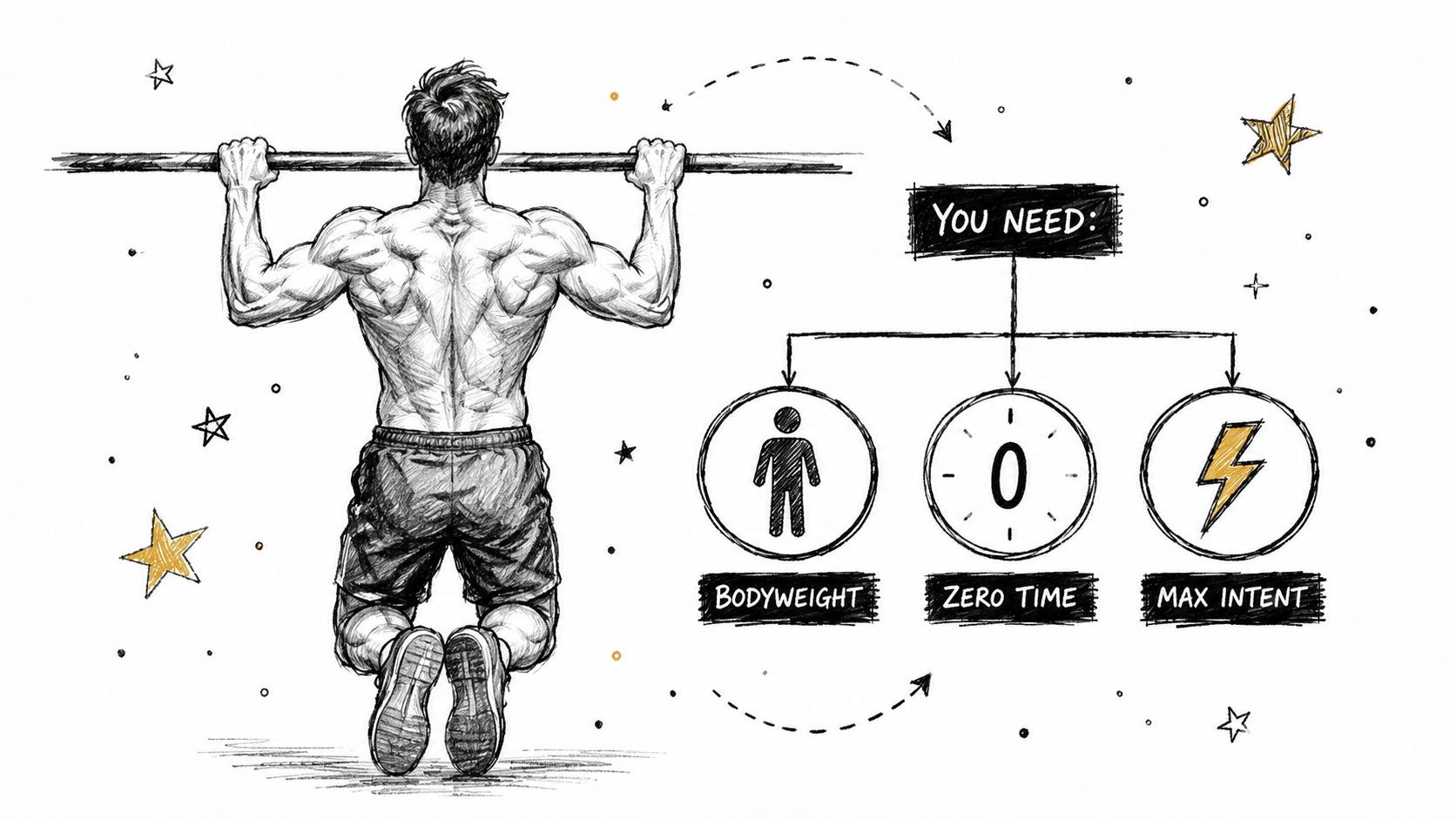
Minimal or zero ramping can work in three situations. A bodyweight skill session, such as a pull-up volume day, may need only a few controlled practice repetitions instead of loaded ramps. Machine-dominant accessory work usually places fewer demands on stabilization and setup, so you can move directly to the planned weight if the first set feels comfortable. A deload may also require less preparation because the session deliberately reduces the demand for maximal output.
Keep the ramp when the cost of being unprepared is high
Use a fuller ramp in a cold gym, during early-morning training, after time away from lifting, or before a heavy single or double. A barbell compound near a true effort set demands more positional control than a stable machine movement. Skipping preparation to save time can backfire when technique deteriorates before muscular fatigue becomes obvious.
A practical decision rule is simple. If the next working set is below roughly 70% of your recent max and the exercise is a machine, a brief readiness check may be enough. If the movement is a barbell compound and the set approaches a high effort, run the ramp.
The best warm-up is the smallest one that makes the target movement feel organized under its intended load.
Use this video as a visual supplement for pull-up preparation and bodyweight practice. It does not replace judgment about the day's first set.
If the first rep feels cold, unstable, or unusually slow, add one short, easy rehearsal set and reassess. If the movement feels normal, start the planned work instead of adding preparation to satisfy a generic rule. Record the choice in Strive Workout Log so you can compare readiness, warm-up time, and working-set performance across sessions.
Putting It Together for Your Next Session
Build the warm-up block into the workout before you arrive. It should sit as a fixed pre-session header in your plan, with the exercise, load, repetitions, and rest already defined. The working sets begin only after the heaviest ramp rep clears with the target bar speed and the setup feels repeatable.
For a squat, use 50% × 8, 70% × 5, and 85% × 2–3, resting 1–2 minutes after the lighter sets and 2–3 minutes before the final ramp. Follow with your programmed working sets. Use the same structure for the deadlift, but keep the repetitions especially crisp because accumulated fatigue from pulling can affect the rest of the session.
Bench press gets bar × 10, 60% × 6, and 80% × 3. After the final ramp, rest 2–3 minutes, then begin the planned work. For a curl, triceps movement, or lateral raise, use one set at roughly 60%, then move to the working weight after a short rest.
| Exercise | Set | Load | Reps | Rest (s) |
|---|---|---|---|---|
| Squat | 1 | 50% | 8 | 60–120 |
| Squat | 2 | 70% | 5 | 60–120 |
| Squat | 3 | 85% | 2–3 | 120–180 |
| Bench press | 1 | Bar only | 10 | 60–120 |
| Bench press | 2 | 60% | 6 | 60–120 |
| Bench press | 3 | 80% | 3 | 120–180 |
| Deadlift | 1 | 50% | 8 | 60–120 |
| Deadlift | 2 | 70% | 5 | 60–120 |
| Deadlift | 3 | 85% | 2–3 | 120–180 |
| Curl | 1 | 60% | 6–8 | 60–120 |
Save two versions
On a fresh day, use the full ramp when the session includes a heavy top set or technically demanding compound. On a high-fatigue day, save a reduced version with fewer repetitions in the first two ramps, then keep only the final specific exposure before working sets. The adjustment should reduce fatigue, not remove the movement rehearsal entirely.
Log each preparatory set as Warm Up, start the appropriate timer after every round, and keep working sets separate from the ramp. After several sessions, your history will show whether a longer preparation improves readiness or delays the work. That feedback is more valuable than copying a universal warm-up routine.
Strive Workout Log lets you record warm-up sets separately, attach weights and reps to each ramp, and enforce custom rest timers before your working sets. Visit Strive Workout Log to turn this warm-up plan into a repeatable workout template you can track session after session.
Leave a Reply