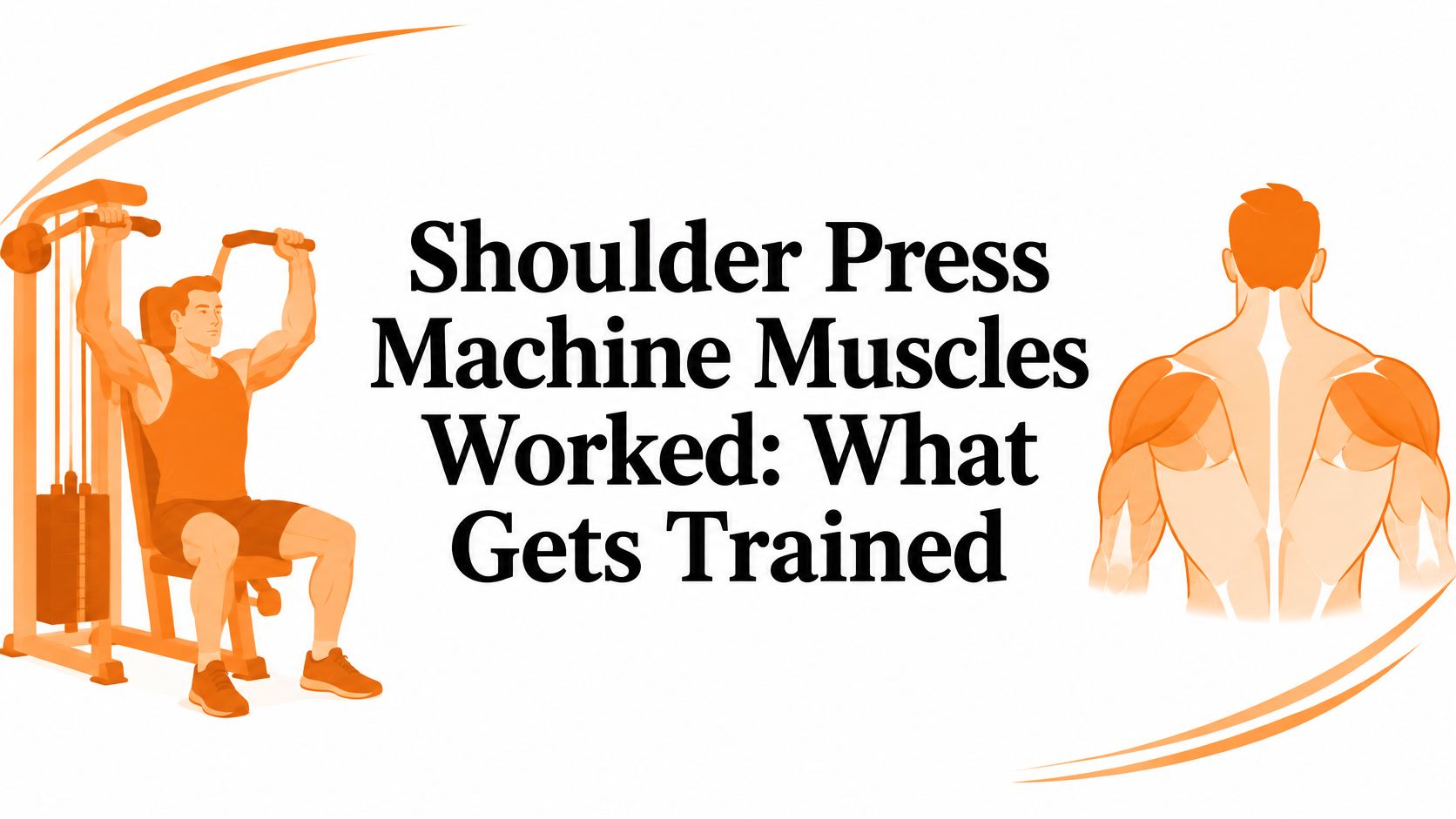
If a shoulder press machine isolates your shoulders, why do your triceps sometimes give out first? The name tells you the main target, not every muscle doing the work. Understanding the shoulder press machine muscles worked means separating the muscles that raise your arms from those that straighten your elbows and support your shoulder blades.
That distinction helps you choose exercises, adjust the machine, and judge progress without mistaking a stronger burn for a better muscle-building stimulus.
Muscles Worked by the Shoulder Press Machine at a Glance
The machine shoulder press is a deltoid-led vertical push, with the triceps extending your elbows and the upper chest and upper traps assisting. It's a compound exercise, not a shoulder isolation movement.
Your upper arms move upward while your elbows straighten. Those actions happen together, but different muscles supply them, which explains why the exercise can fatigue both your shoulders and the backs of your arms.
Muscles worked by the shoulder press machine
| Muscle | Role in the press | Relative involvement | Where it is felt |
|---|---|---|---|
| Anterior deltoid | Primary mover that drives arm elevation | Highest | Front of the shoulder |
| Medial deltoid | Secondary mover through the upward path | Moderate | Side of the shoulder |
| Posterior deltoid | Minor contributor, lightly loaded | Low | Back of the shoulder |
| Triceps brachii | Primary elbow extensor, strongest near lockout | High | Back of the upper arm |
| Upper chest (clavicular pectoralis major) | Assistant that changes with seat and handle position | Moderate | Upper front of the chest |
| Upper trapezius | Stabilizer that works harder as load rises | Low to moderate | Top of the shoulder and base of the neck |
These are qualitative roles, not fixed proportions. A machine with forward-facing handles and a reclined backrest won't feel identical to a more upright machine with a different pressing arc.
The sensation column is a rough anatomical guide, not a requirement. You don't need to feel every assisting muscle to train it, and feeling your traps doesn't automatically mean your shoulders have stopped working.
Read the table by role, not by burn
A smaller assisting muscle can become the limiting factor before the main target does. If your triceps fatigue near the end of a set, that doesn't turn the exercise into a triceps isolation movement.
Likewise, a pump at the front of your shoulder doesn't tell you whether your side and rear delts received enough direct work. Judge the exercise by its movement pattern, your repeatable technique, and your progression rather than sensation alone.
Remember the hierarchy: Front delts lead, with triceps supplying elbow extension.
Chest and traps support the press.
Side and rear delts still need their own exercises for balanced development.
Why the Deltoids Lead and the Triceps Assist
Think of a crew lifting a crate. The anterior deltoid is the lead lifter raising the upper arm, the triceps supplies the elbow-straightening action, and the upper chest helps carry the load upward. They contribute to the same task without doing the same job.
In a shoulder-press-apparatus study of trained swimmers, contractions at 40% of maximum voluntary load produced a measured activity distribution of approximately 63.3% deltoid, 24.0% clavicular pectoralis major, and 12.6% long-head triceps. The deltoid accounted for the largest share of the measured activity, but it clearly wasn't working alone.
The illustration shows how these pressing muscles sit around the shoulder and upper arm.

What electrical activity tells you
Electromyography, or EMG, measures electrical activity during contraction. Those percentages aren't percentages of the weight lifted, shares of mechanical force, or predictions of future muscle growth.
The swimmers also aren't interchangeable with every gym-goer. Load, machine geometry, technique, and the population tested can change the pattern, so you shouldn't use that split as a personal training calculator.
Comparisons of flat, incline, and shoulder pressing also distinguish vertical pressing from chest-focused pressing. The shoulder press emphasizes the anterior deltoid and upper trapezius, while flatter pressing angles place more emphasis on the pectoralis major.
How to count the work
A compound exercise loads multiple joints and muscle groups within the same movement. Here, shoulder movement and elbow extension make the press relevant to both deltoid and triceps training.
- Front delts: Treat hard machine-press sets as direct work.
- Triceps: Count meaningful assisting work, particularly when planning additional elbow-extension exercises.
- Upper chest: Recognize the contribution without treating machine pressing as a replacement for chest-focused training.
Giving full programming credit to the front delts and partial credit to the triceps and chest is a useful bookkeeping approach. It's not a validated formula for converting compound sets into fractional isolation sets.
How Each Deltoid Head Responds to the Press
The machine press is an efficient way to train the front of your shoulders, but it isn't a complete deltoid program. Muscle involvement doesn't mean equal loading, and each deltoid head benefits from movements suited to its function.
The American Council on Exercise's evidence-based deltoid training review supports combining pressing with lateral-raise and rear-delt patterns rather than expecting pressing alone to develop every region equally.
Front, side, and rear delts have different jobs
Anterior deltoid. The front head carries much of the shoulder's pressing work. If your goal is to progressively load arm elevation with a stable setup, the machine press is a practical choice.
Medial deltoid. The side head contributes as your upper arm travels upward, but pressing doesn't necessarily provide the most direct stimulus for this region. Lateral raises let you train the side delts without requiring elbow extension to finish each repetition.
Posterior deltoid. The rear head contributes relatively little to a conventional vertical press. Reverse flies and other rear-delt patterns provide a more direct way to load the back of the shoulder.
Training all the muscles around a joint isn't the same as training them all equally well.
Build a balanced exercise selection
Consider a hypothetical week containing three hard machine-press sets, with no other direct shoulder work. That plan emphasizes the front of the shoulder rather than providing balanced coverage.
Adding three lateral-raise sets and two reverse-fly sets would broaden the exercise selection. Those numbers are an example, not a proven minimum or a promise of equal growth.
Choose versions you can load progressively through a large, comfortable range. A cable lateral raise or reverse-fly machine may be easier to standardize than an exercise that requires substantial body movement to finish the repetition.
- Already doing substantial bench and incline pressing: Consider whether more front-delt work is useful before adding another press.
- Side delts are the priority: Reserve energy and recoverable training time for lateral raises.
- Rear delts receive little direct work: Add a controlled rear-delt movement rather than assuming overhead pressing covers them.
Use the machine press as your main vertical press when it fits your goals. Fill the remaining gaps with direct exercises instead of adding pressing volume indiscriminately.
How Form and Setup Shift the Target Muscle
The machine guides the handles, but you still choose your starting position, range, load, and intent. Those decisions can change the movement you perform, even when the equipment stays the same.
Seat height. Start with the handles around upper-chest to shoulder height, allowing for the machine's design. Your elbows should sit in a comfortable pressing position without forcing your shoulders backward or making you shrug just to reach the handles.
Grip. Choose an available grip that lets your wrists stay aligned with your forearms. Coaches commonly describe wider grips as more shoulder-focused and narrower grips as more triceps-focused, but these are practitioner-reported patterns, not outcomes established by the studies cited here.
Range and back position
Use the largest controlled, tolerable range the machine and your anatomy allow. Don't chase extra depth by rolling your shoulders forward, and don't shorten every repetition to move more weight.
Stopping just short of lockout is often described as keeping the emphasis on the shoulders, while completing lockout is described as emphasizing the triceps. That full-lockout claim is also a practitioner convention, not a measured outcome from the cited studies, and neither approach has established superior hypertrophy here.
Keep your back supported and your rib cage controlled. A pronounced backward lean changes the pressing angle and makes your performance harder to compare between sessions.
Attention can change activation
A machine shoulder-press study examining attentional focus found that focusing on the deltoids increased deltoid activity, while focusing on the triceps increased triceps activity; upper-trapezius activity didn't change significantly. That supports using a deliberate cue, but not the claim that a stronger mind-muscle sensation guarantees more growth.
Try thinking about driving your upper arms upward rather than merely moving the handles. Keep the load manageable enough that the cue doesn't disappear as soon as the set becomes difficult.
For a more detailed setup walkthrough, use our shoulder press machine form guide.
Before each session, run these checks:
- Starting position: Can you reach and press the handles without shrugging or forcing your shoulders backward?
- Supported torso: Can you keep your back against the pad without exaggerated lumbar extension?
- Comfortable path: Can you lower and press smoothly without pinching?
If you feel pinching near the top, reduce the load and shorten the painful portion rather than forcing lockout. Stop the exercise and seek qualified assessment if discomfort persists.
Machine Versus Free-Weight Press Variations
A machine press isn't automatically better or worse than a free-weight press. It trades some balance and stabilization demands for a guided path, which can make hard pressing sets easier to control.
A 2022 EMG study of eight competitive bodybuilders compared front and behind-the-neck barbell presses with corresponding machine variations and found greater ascending-phase anterior-deltoid activity in the behind-the-neck barbell press than the behind-the-neck machine press, with an effect size of 1.42 and a 95% confidence interval of 0.32 to 2.51.
That was a statistically significant difference in that specific comparison, with a wide interval around its estimated size. It doesn't establish that every barbell press produces more growth than every machine press, nor does it make behind-the-neck pressing necessary.
Press variations compared on the same criteria
| Variation | Anterior deltoid involvement | Stabilization demand | Best fit |
|---|---|---|---|
| Machine shoulder press | High | Low | Hard sets, beginners, controlled progression |
| Seated barbell front press | High | High | Pressing strength and coordinated control |
| Behind-the-neck barbell press | Higher than the behind-the-neck machine press in the cited comparison | High | Experienced lifters with suitable shoulder mobility |
| Seated dumbbell press | High, as a deltoid-focused vertical press | Moderate to high | Training each arm independently and monitoring asymmetry |
The involvement column describes the main target, not a universal ranking of muscle-building potential. The stabilization column describes how much you must control the implement, while the final column helps match the exercise to your training needs.
Choose the constraint that suits your goal
A barbell requires you to manage its path rather than follow a machine's path. Dumbbells add independent arm control, which can reveal differences that a connected handle system lets you compensate for.
A machine can be useful when balance would otherwise end the set before the pressing muscles receive enough work. It may also simplify returning to consistent training after a break, provided the fixed path feels comfortable.
Small load increases are convenient on many selectorized machines, although the available increments are equipment-specific. A machine with large jumps isn't automatically easier to progress than a barbell with small plates.
Our comparison of machines versus free weights can help you choose equipment around your goals rather than a blanket ranking.
Behind-the-neck variations require suitable shoulder mobility and tolerance. Skip them if they cause pinching, and don't use an activation finding as a reason to force an uncomfortable position.
Choose the machine for controlled local effort, and free weights when independent control or free-weight strength matters. Log each variation separately, because its performance reflects different constraints.
Programming the Press for Muscle Growth
Resistance training can build muscle across a broad loading range, so you don't need a single supposedly perfect repetition target. A systematic review and Bayesian network meta-analysis in the British Journal of Sports Medicine found that loads above 80% of one-repetition maximum ranked highest for strength, while hypertrophy outcomes were comparatively similar across prescriptions and multiple-set protocols ranked highly for growth.
Use the illustration as a reminder to match the load to controlled repetitions rather than chase the stack.

Machine press dosage by goal
These are practical starting prescriptions, not individually tested optimal doses. The failure row is an optional coaching example, not a required schedule.
| Goal | Rep range | Effort (reps in reserve) | Role in the week |
|---|---|---|---|
| Hypertrophy focus | 6-15 reps | 1-3 RIR | Main press, 2-3 working sets |
| Strength focus | 3-6 reps, using heavier loads when appropriate | 2-3 RIR | Heavier press day with longer rest |
| General health | 10-15 reps | 3 or more RIR | Lighter accessory press |
| Occasional failure | 6-12 reps, last set only | 0 RIR | Optional machine-only set once every few weeks |
Repetitions in reserve, or RIR, means how many more clean repetitions you estimate you could complete. A resistance-training position stand reports that momentary failure doesn't improve strength, hypertrophy, or power compared with stopping short, supporting approximately 1 to 3 RIR as a defensible starting point for most working sets.
The demonstration below provides a visual reference for the pressing movement.
Progress without unnecessary fatigue
Once you reach the top of your chosen range at the intended effort, add the smallest available load increment. Keep your setup and usable range consistent so the heavier load represents genuine progress.
Fatigue check: A set shouldn't require a large back arch or uncontrolled lowering to qualify as hard enough.
A practitioner rule of thumb is roughly ten or more hard weekly sets across deltoid work, but that isn't a universal requirement or a machine-press prescription. Account for your chest pressing, direct side- and rear-delt work, recovery, and actual progress before adding more.
Beginners should first establish repeatable technique at moderate effort. A stable machine can reduce balance-related limitations, but these sources don't establish that it produces the least systemic fatigue of every shoulder exercise.
Log the Machine Press and Progress It
A useful log distinguishes stronger pressing from an easier setup. Raising the seat, reducing depth, or leaning farther back can change your results without demonstrating improved performance under the same conditions.
Keep the process simple enough to repeat. Record the variables that affect your interpretation, not an essay about every repetition.
Record the exercise you actually performed
Name the exact variation. Use a label such as Seated Machine Shoulder Press, adding the machine model or location if necessary. Keep it separate from barbell and dumbbell presses, and from machines with noticeably different resistance systems.
Record each working set. Enter load, repetitions, and effort. If your logger offers an RIR field, use it; otherwise, put your estimate in the notes.
Check the previous performance before lifting. Compare against the same exercise and similar effort. Add the smallest load increment only when you've met your progression rule without changing technique.
Save your setup. Note seat height, handle choice, grip, and any range adjustment. A brief note such as “upright seat, neutral handles, comfortable full range” is more useful than “felt good.”
Review trends at a regular checkpoint. A practical review cadence is every four weeks, comparing exercise performance and overall shoulder workload rather than reacting to one disappointing session.
Write down the decision rule. Save your chosen rep range and effort target in the exercise notes so you don't rewrite the plan based on how motivated you feel that day.
Review comparable performances
Our guide to tracking workout progress explains how to turn individual entries into useful training decisions. Look for more repetitions at the same load and effort, or more load with comparable repetitions and technique.
In Strive Workout Log, every set shows your previous weight and repetitions beside the input fields; when auto-progression is enabled, we propose the next weights and repetitions after each workout. Our per-exercise progress curves, bodyweight trends, total volume, and estimated maximums can be filtered by time frame, weight type, and rep range.
Treat proposed increases and estimated maximums as decision aids, not instructions to override discomfort or deteriorating form. Log your next session with a setup note, then review the trend before changing the load.
Strive Workout Log offers unlimited routines, full workout history, advanced charts, and automatic progression without ads. Visit Strive Workout Log to record your exact shoulder press variation, keep its setup consistent, and build your next session around measurable progress.
Leave a Reply