
You follow the program exactly. The spreadsheet says bench press at a certain percentage, squat at a certain percentage, and accessory work after that. Some days it clicks. Other days the bar feels welded to the rack, your warm-ups feel heavy, and the same load that moved cleanly last week suddenly feels off. You might assume you're losing progress, but more often you're seeing something normal. Your readiness changes from day to day.
That's where autoregulation training earns its place. Instead of forcing your body to match a plan written days or weeks ago, autoregulation adjusts training stress to your current performance. It doesn't mean training randomly. It means using feedback from the session itself to decide whether to push, hold steady, or pull back.
For lifters who want size and strength, that matters. Hypertrophy responds best to exercises that can be overloaded, train the target muscle through a large pain-free range of motion, and keep unnecessary systemic fatigue under control. Strength benefits from a similar logic. The best plan isn't the most rigid one. It's the one that keeps high-quality work coming week after week.
If you want more ideas on evidence-based lifting practice, it's worth browsing discover strength training with PlateBird, especially if you like practical training content without fluff.
Introduction to Autoregulation Training
Autoregulation training is a way to adjust load, volume, or effort based on how you perform that day. Instead of saying, “I must lift this exact weight because the program says so,” you ask a better question. “What dose of training will produce the best adaptation today?”
That shift sounds small, but it changes everything. A fixed plan assumes your readiness is stable. Real life doesn't work like that. Sleep, stress, soreness, nutrition, and the accumulated fatigue from prior sessions all change what you can do productively.
What autoregulation looks like in the gym
On a good day, autoregulation might mean adding load because the bar is moving fast and your target effort feels lower than expected. On a rough day, it might mean keeping the load lighter, trimming a set, or swapping hard work for technique practice.
The key is that you're still progressing. You're just choosing the version of progression your body can use.
Practical rule: The best session isn't the hardest session. It's the one that gives you a strong training signal without digging a recovery hole you can't fill.
Why lifters use it
Many plateaus aren't true plateaus. They're repeated mismatches between planned stress and actual readiness. If the plan overshoots, you grind through low-quality reps and build fatigue faster than you build adaptation. If it undershoots, you leave progress on the table.
Autoregulation solves that by turning training into a feedback system. You perform, measure, adjust, and repeat. For hypertrophy, that helps you keep quality work in the rep and intensity ranges that promote muscle growth. For strength, it helps you match heavy work to days when your nervous system and movement quality are ready for it.
Understanding the Core Principles
Readiness works like a thermostat, not a light switch. You're not “ready” or “not ready.” Your output drifts up and down within a range, and training works better when the plan responds to that range instead of ignoring it.

That's why hard percentage plans can miss the mark. They're written as if your body is a machine with the same battery level every day. It isn't. If you want a broader sense of how recovery signals can fluctuate, this conversation on Dr. Torkil Faero on HRV is useful background.
The three moving parts
Baseline. You need a normal reference point. That could be how a warm-up usually feels, how a known load usually moves, or how a jump test usually performs.
Daily signal. You compare today against that baseline. The signal might come from bar speed, reps in reserve, perceived exertion, or another repeatable marker.
Decision rule. You need a clear response. If performance is down, you reduce stress. If performance is up, you allow more load or more work.
This is the same logic behind progressive overload meaning, except now overload becomes responsive instead of rigid.
What changes readiness
Internal factors include sleep quality, soreness, motivation, and general stress. External factors include what you did in prior sessions, how much you ate, and how demanding your day has been outside the gym.
Those factors don't just affect how strong you feel. They affect what kind of training is productive. A hard squat session on a day with poor readiness can become junk volume. The same session on a strong day can become a real adaptation driver.
Your plan should act like a thermostat, not a train schedule. When readiness drops, training stress should drop with it. When readiness rises, the plan should let you use that extra capacity.
Why this matters for hypertrophy
Muscle growth responds best when the target muscle does the work. That's why exercise selection matters so much. Movements that train a muscle through a large pain-free range of motion tend to support better hypertrophy than partial range work, especially in lower body musculature, according to this review on exercise range of motion and hypertrophy. Pair that with exercises you can progressively overload without excessive whole-body fatigue, and your autoregulation choices get better fast.
Exploring Autoregulation Methods
Autoregulation isn't one method. It's a family of methods that all try to answer the same question. How hard should you train today?
Comparison of Autoregulation Methods
| Method | Key Parameter | Typical Use Case |
|---|---|---|
| RPE and RIR scales | Perceived effort and reps left in reserve | Lifters who want simple day-to-day adjustment without equipment |
| AMRAP sets | Reps completed before technical failure or planned stop | Checking whether a load prescription is too easy or too hard |
| Daily max testing | Best smooth top set on the day | Strength-focused sessions where technical consistency is high |
| APRE | Performance on work sets determines next load | Lifters who want structured, performance-based load jumps |
| Percentage-based velocity adjustments | Bar speed compared with target or baseline | Lifters using a velocity app or sensor who want objective feedback |
RPE and RIR
RPE and RIR are the easiest on-ramp. You assign effort based on how many reps you had left. If you finish a set and could've done two more clean reps, that's a different stimulus than a set that nearly buries you.
This method is practical, but it takes honesty and skill. Intermediate lifters often confuse discomfort with proximity to failure. They stop too early on some days and overshoot on others. If you want a cleaner breakdown of the distinction, this guide on RIR vs RPE helps.
AMRAP and daily max work
AMRAP sets give you feedback through performance. If you get more reps than expected, the load was probably conservative. If you get fewer, fatigue may be higher than the plan assumed. That makes AMRAP useful as a checkpoint.
Daily max testing works best for experienced lifters who can hit heavy singles or top sets without turning every session into a grind. The point isn't to force a lifetime PR. The point is to find the heaviest load that moves well today and build the session from there.
Use daily max work only if your technique stays stable under heavy loads. If bar path, depth, or bracing fall apart, the data gets noisy fast.
APRE and velocity-based adjustment
APRE is more structured. It uses your actual performance to determine the next load instead of relying on prewritten percentages. That appeals to lifters who want objective progression without guessing.
Velocity-based adjustment goes one step further by measuring how fast the bar moves. That gives you immediate feedback before fatigue gets out of hand. It's especially useful when you want to manage performance tightly on squat, bench press, or similar lifts where bar speed gives meaningful information.
Which one fits most intermediate lifters
Choosing a single camp is often unnecessary. The most practical setup is often hybrid.
- Use RIR for effort. It helps you keep sets hard enough for hypertrophy without drifting into needless failure.
- Use velocity when available. It sharpens decisions on heavy compound lifts where daily fluctuations matter most.
- Use AMRAP sparingly. It can validate your loading, but doing it too often creates fatigue.
- Reserve APRE for focused blocks. It works well when strength is the main goal and you want built-in load adjustment.
That hybrid approach is the missing middle ground for many intermediate lifters. It keeps training flexible, but not vague.
Reviewing Evidence Benefits and Limitations
The strongest case for autoregulation training is simple. It works better than fixed loading for strength.
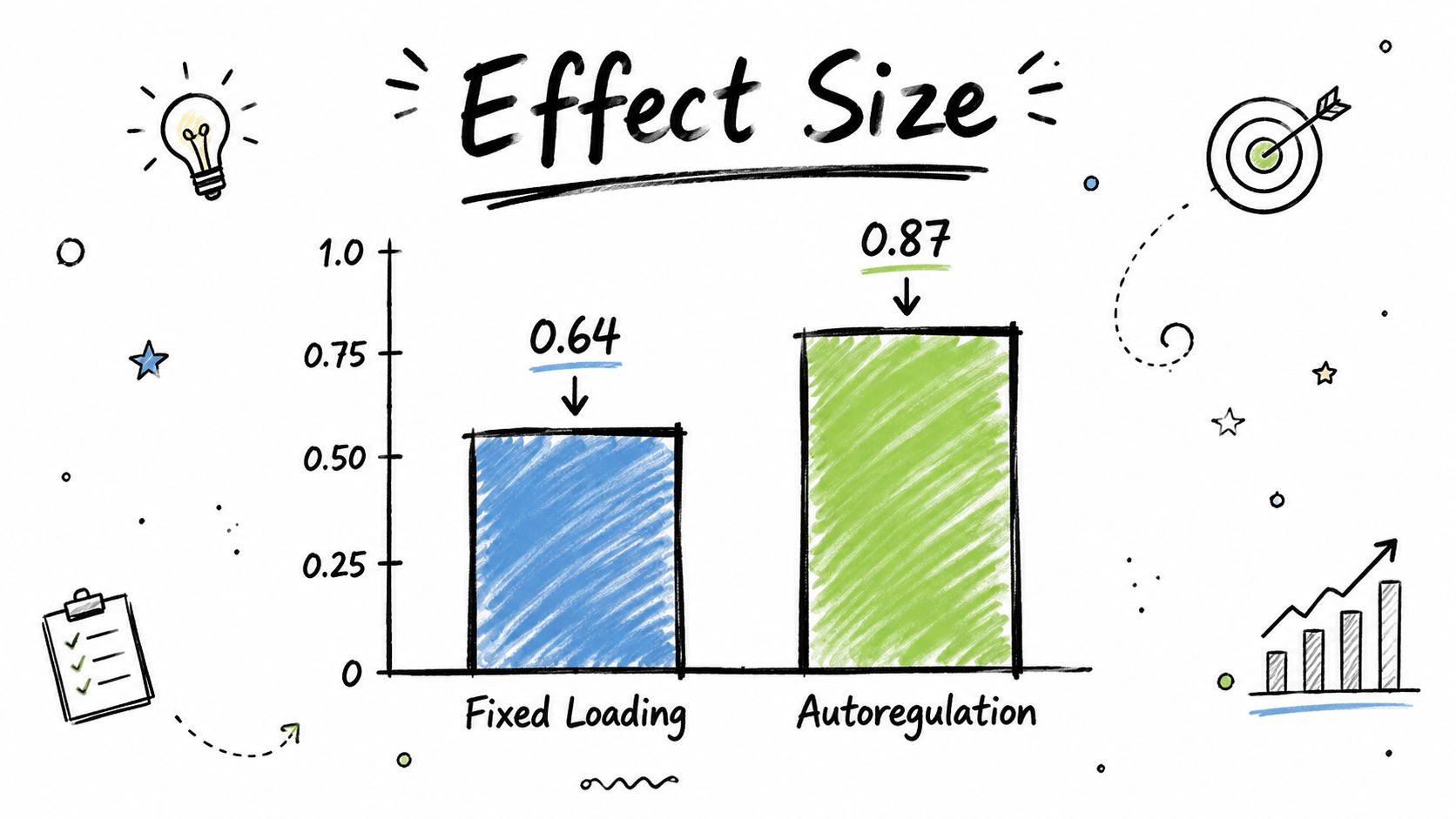
A meta-analysis of 166 experienced athletes found that autoregulation was significantly more effective than fixed-loading methods for improving maximum strength, with an effect size of 0.64 and p<0.001 in bench press and squat-focused contexts, according to Frontiers in Physiology.
Where the evidence looks strongest
That same analysis found the biggest strength benefits in blocks of 8 weeks or shorter, with an effect size of 0.87, while blocks lasting 8 to 10 weeks showed a smaller effect size of 0.32. It also identified APRE as the most effective specific autoregulation model in that dataset, with an effect size of 0.78 for strength gains.
That matters in practice. Shorter blocks are easier to monitor, easier to recover from, and easier to adjust before fatigue drifts too far from your original assumptions.
Another review comparing subjective and objective methods found that objective strategies using movement velocity produced larger and more certain improvements in strength and power than purely subjective methods. It also described a practical trigger. If rep velocity drops by 10% versus a weekly average, that's a signal to reduce sets, reps, or load, based on this comparison of subjective versus objective autoregulation methods.
Why the science doesn't mean every tool is equal
The evidence supports autoregulation. It doesn't mean every lifter should turn every session into a data lab.
RPE can drift if you're inexperienced, highly motivated, or anxious. Velocity tracking is more objective, but it depends on repeatable setup and good measurement habits. APRE can be effective, but it can also feel demanding because performance testing itself creates stress.
A newer review also reported that autoregulated resistance training outperformed percentage-based resistance training for maximal strength, and that APRE showed the highest efficacy among the compared methods for squat and bench press outcomes in controlled settings, as summarized in this review on autoregulated versus percentage-based resistance training.
The weak point most people miss
Baselines drift. That's a major limitation.
If you use a readiness baseline from a period when you were sleeping well and life was calm, then compare it to a week after travel, illness, or a deload, your “bad day” might be a bad reference point. Research on monitoring readiness highlights this baseline problem and notes that performance deviations should be interpreted relative to established variability, as discussed in this analysis of baseline reference drift in monitoring.
Good autoregulation depends on good baselines. If the baseline is stale, the adjustment can be wrong even when the daily data is accurate.
Designing Autoregulated Workout Programs
A productive hypertrophy plan should use exercises that train the target muscle through a large pain-free range of motion, allow stable overload, and don't create more systemic fatigue than needed. That usually means keeping big free-weight basics where they fit well, then leaning on machines, cables, and dumbbells when they let the target muscle stay the limiting factor.
For intermediate lifters, compound basics such as squats, deadlifts, and rows remain useful, while machines and adjustable dumbbells can lower joint stress and reduce unnecessary stabilizer demands, as discussed in this practical review on exercise selection for hypertrophy.
A hypertrophy block that autoregulates effort
For muscle gain, current evidence supports 3 to 6 sets of 6 to 12 reps per exercise, using moderate intensity in the 60 to 80% of 1RM range, with 60 seconds of rest, and a weekly total of 12 to 28 sets per muscle group. An umbrella review also supports at least 10 sets per week per muscle group as a threshold for optimal growth, according to this review of hypertrophy training variables.
Use those ranges as the structure. Then autoregulate inside them.
Sample hypertrophy template
- Primary compound lift such as squat, hack squat, incline press, or chest-supported row. Use a load that lands in the target rep range and stop with about 1 to 3 reps in reserve.
- Secondary movement that gives a deep loaded stretch and stable resistance. Think Romanian deadlift, dumbbell incline press, or cable fly variation.
- Isolation work where the target muscle is clearly the limiter, such as leg extensions, lateral raises, curls, or cable pushdowns.
- AMRAP check set only on the final week of the block for one main lift, stopping when form breaks down, not when technique gets ugly.
This works well over a short block because the core target stays the same. Quality work accumulates, but the exact loading adjusts with readiness.
A strength block using daily performance
If your main goal is maximal strength, use fewer exercises, a heavier top end, and tighter feedback. A practical setup is one top set based on the day, followed by backoff work.
For planned loading, hypertrophy phases often sit around 75 to 85% of 1RM for 3 to 5 sets of 6 to 12 reps, while heavier loading above that shifts emphasis toward strength. Deload weeks can reduce volume by about 50% to restore recovery, based on NASM's summary of hypertrophy and loading best practices.
Strength-focused setup
- Work up to a smooth top set that matches the day's readiness.
- Use APRE logic or a fixed backoff range based on how that top set moved.
- If the session feels flat, trim backoff volume first before cutting intensity completely.
- Keep accessories low-fatigue and specific. Rows, machine presses, split squats, and hamstring curls usually fit better here than adding more neurologically demanding barbell work.
Choose exercises you can repeat well. The more stable the movement, the cleaner the autoregulation signal.
The hybrid model most people should use
The most practical model for intermediate lifters is a blend of subjective intensity and objective volume control. Research supports the value of combining RIR or RPE with velocity-loss thresholds, and it also points out the gap in practical guidance for non-elite lifters trying to use this hybrid approach without expensive lab-style setups, as noted in this review on velocity loss and hybrid autoregulation strategies.
A simple hybrid rule looks like this:
- Use RIR to select a hard but repeatable effort target.
- Use velocity cues when available on key lifts to decide whether to add load, keep load, or stop a set.
- Use exercise selection to keep fatigue local. If a machine row gives the lats and upper back a strong stimulus with less whole-body stress than a fatigued bent-over row, the machine row may be the better hypertrophy choice that day.
Recovery support matters too. Sleep and nutrition do the heavy lifting, but some lifters also like reading broader recovery content such as HempWell USA CBD for muscle recovery when they're trying to build a more complete recovery routine.
Implementing Autoregulation Training Practically
Most lifters fail with autoregulation for one reason. They keep the idea vague. If you want it to work, turn it into a repeatable checklist.
Your basic setup
Start with one or two main lifts. Squat and bench press are ideal because they're easy to compare across weeks. Keep your accessories on a simpler effort target until you get consistent with the main lifts.
Then choose your feedback tools:
- Subjective marker. RIR or RPE on the final hard set.
- Objective marker. Bar speed if you have it, or a repeatable warm-up feel if you don't.
- Readiness context. Notes on sleep, soreness, stress, and bodyweight trend.
Warm-up and decision rules
If you use velocity-based autoregulation, one practical rule is to measure concentric mean velocity on a warm-up set at roughly 70% of 1RM. If mean velocity is 10% or more below your multi-week baseline, reduce the main session load by 5 to 10%. If velocity is above the target zone, such as greater than 0.6 m/s, increase the load by 2.5 to 5 kg, based on the implementation guidance in this GymAware overview of autoregulation in strength training.
That same guide also notes a second trigger using countermovement jump readiness. If jump displacement is more than 8% below baseline, replacing planned heavy strength work with technical drills or rest can be the better choice.
A simple gym-floor checklist
- Run the same warm-up. Keep it consistent so your comparison means something.
- Check the first signal. Use bar speed, jump, or your planned effort marker.
- Make one adjustment at a time. Change load first. If the session still feels off, cut a set. Don't rewrite the whole workout after one bad set.
- Keep the main objective. On hypertrophy days, preserve quality volume. On strength days, preserve bar speed and technique.
- Log what happened. The adjustment only becomes useful if you can review the pattern later.
Don't overreact to one bad day. React to the signal, but confirm the pattern across sessions before changing the whole program.
Common mistakes and fixes
Misreading RPE
A lot of lifters call a hard set “RPE 9” when they had several reps left. Others call every uncomfortable set “to failure.”
Fix it by filming top sets and asking a simple question after each one. Did bar speed crash, or did the set just feel hard? Over time, you'll get better at separating effort from emotion.
Forgetting to reset the baseline
After a deload, illness, travel week, or a rough stretch at work, the old baseline may stop reflecting reality.
Fix it by rebuilding the reference with a short run of normal training before making aggressive adjustments from the data. If everything reads red after a major stressor, your baseline may be the problem.
Choosing the wrong exercises
Autoregulation can't rescue poor exercise selection. If a movement never loads the target muscle well, creates joint irritation, or causes too much whole-body fatigue, adjusting the load won't make it a good hypertrophy tool.
Fix it by asking three questions. Can I overload it? Can I train the target muscle through a large pain-free range of motion? Can I recover from it and repeat it consistently?
When less is better
Some days the best autoregulated choice is restraint. If readiness is clearly low, dropping one set from a compound lift and putting more effort into a stable machine or cable movement often gives you a better hypertrophy session than forcing another grindy barbell set.
That's not backing off from progress. That's protecting it.
Tracking Autoregulation in Strive Workout Log
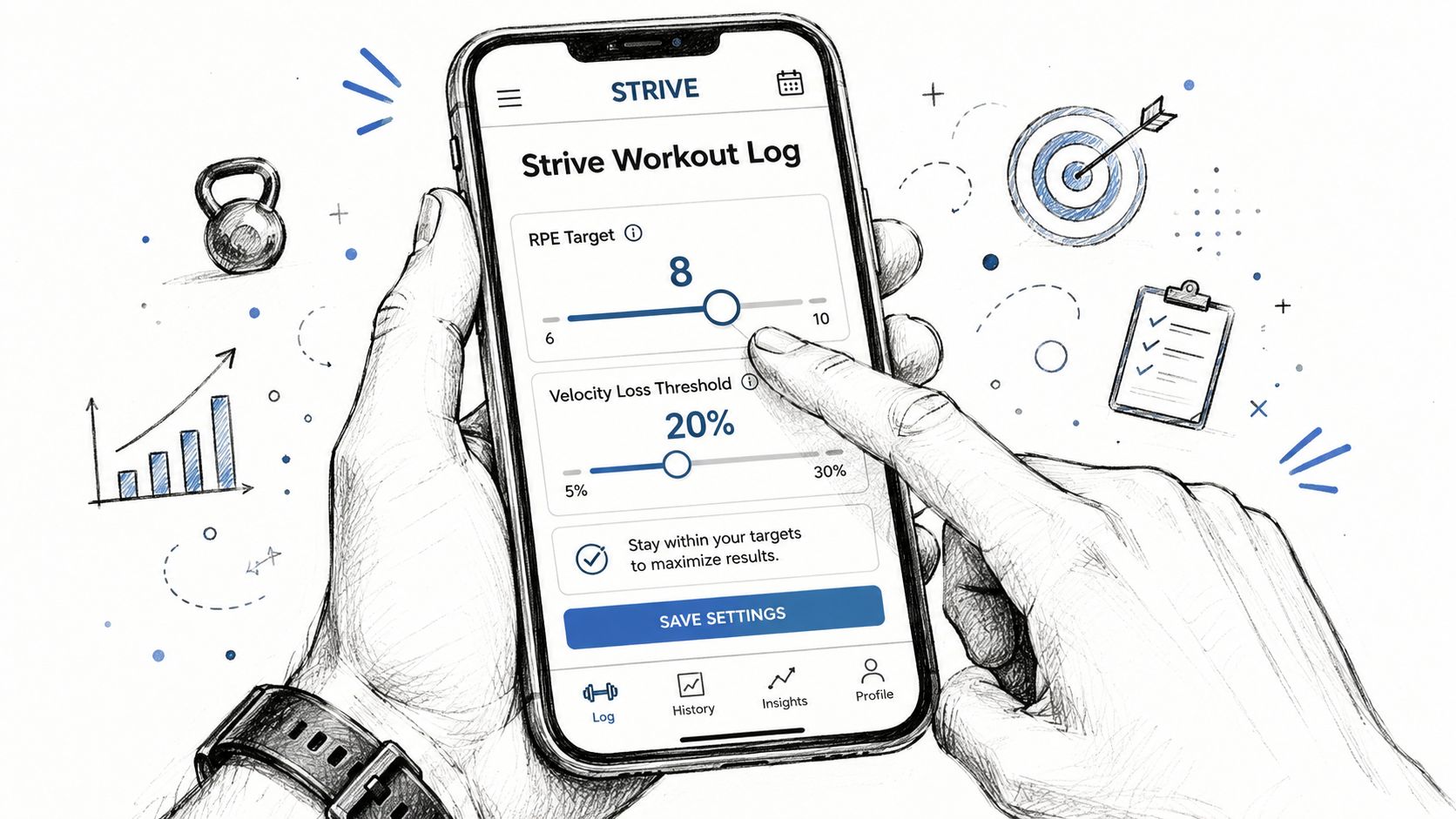
Logging autoregulation only helps if it stays fast enough to use during training. The cleanest workflow is to keep your normal routine structure, then layer readiness and effort data onto the sets that matter most.
Set up a simple tracking flow
Start with your main lift. Record the load, reps, and your final set's RIR or RPE. If you use a velocity sensor or app, add the warm-up velocity note and any load adjustment you made from it.
For accessories, keep logging lighter. You usually don't need detailed autoregulation on every lateral raise or curl set. Reserve the close tracking for exercises where performance changes affect the whole session.
If you like seeing long-term trends in strength work, it also helps to review a dedicated guide to PR tracking, because autoregulation works best when day-to-day decisions still connect to month-to-month progress.
What to record each session
- Readiness note. Short comment on sleep, stress, soreness, or bodyweight trend.
- Main lift performance. Load, reps, and top-set effort.
- Adjustment made. Added weight, reduced load, cut a set, or held steady.
- Outcome. Whether the target muscle got a strong stimulus and whether technique stayed stable.
This doesn't need to become a diary. A few reliable data points beat a long note you'll never review.
A video walkthrough can make this process easier to visualize:
How to read your own data
Look for clusters, not isolated sessions. If your bench press top set keeps landing at a harder effort than planned while your warm-up performance is flat, the issue may be programming fatigue or poor exercise order. If your squat performance rises while effort stays controlled, the plan is probably calibrated well.
The useful question isn't, “Was this workout perfect?” It's, “Did my adjustments make the session more productive than blindly following the original number would have?”
A good log turns autoregulation from a feeling into a pattern you can review.
Conclusion and Next Steps
Autoregulation training works because your body doesn't perform on a fixed schedule. Some days you can handle more. Some days you shouldn't. The skill is learning how to tell the difference and respond without losing sight of long-term overload.
For most intermediate lifters, the best place to start is simple. Use good exercise selection, keep the target muscle as the limiter, train through a large pain-free range of motion, and use RIR on your main working sets. If you have access to velocity feedback, add it to your main compound lifts and let it sharpen your decisions rather than take over the session.
Give yourself a month. Track your top sets, your readiness, and the small changes you make when a session feels unusually good or unusually flat. You'll usually find that better adjustments lead to better consistency, and consistency is what keeps both strength and hypertrophy moving.
The advanced layer comes later. That includes tighter baseline resets after life stress, more precise hybrid subjective-objective rules, and more refined deload decisions. Start with one method, use it well, and build from there.
If you want a clean place to log sets, reps, effort, routines, deloads, and progression rules without clutter, try Strive Workout Log. It's a practical fit for lifters who want to apply autoregulation training consistently and review whether their adjustments are working.
Leave a Reply