
A linear progression workout means adding a small, fixed amount of weight to your main lifts every session. For beginners, that simple rule often works better than clever programming because novices recover fast enough to handle the added load each time they train, and strength can climb quickly in that early phase (Barbell Logic, coach-led novice progression explanation).
Most lifters don't need more complexity, they need a cleaner way to apply stress, recover from it, and repeat the process without getting lost in the noise. Linear progression is useful because it makes the training signal obvious, and that matters most when the body is still adapting rapidly and technique is improving from session to session.
What Linear Progression Means
Fitness advice often turns simple training into a puzzle. A linear progression workout keeps the sets and reps stable while the load rises by a fixed increment each workout.
That pattern fits how strength training works in the gym. Training has to create enough stress for the body to adapt, and the easiest way to keep that stress moving in the right direction is to make each session slightly more demanding than the last. Linear progression gives you a clear stimulus, which is why it stays useful when the lifts are still moving up quickly and the training response is easy to track. As Barbell Logic notes, the value is in predictable overload, not in adding complexity for its own sake.
Why beginners respond so well
Beginners are usually limited by technique, coordination, and the ability to repeat a movement skill under a small amount of load.
Coach-led explanations of novice progression keep the set and rep structure steady while weight climbs gradually. The early wins come from better neuromuscular efficiency and movement skill, alongside muscle growth. In plain terms, the body gets better at producing force with the same exercise before the program needs to become more complicated. That idea is laid out clearly in this coach-led novice progression explanation.
Practical rule: If the weight jumps are so big that your technique changes from set to set, the progression is no longer serving the lift well.
Barbell Logic notes that squat performance can double in the first 1 to 2 months, and some larger men or gifted athletes can even triple it during the novice phase. That does not mean everybody should expect those exact numbers. It does mean the early phase is unusually responsive, which is why a basic progression scheme is often the smartest first move.
The main takeaway is simple. Linear progression fits the novice stage because it matches how fast beginners adapt and how little programming complexity they need.
For training decisions beyond the barbell, the same principle applies. Start with lifts you can repeat cleanly, load consistently, and recover from without turning every session into a grind. If your broader nutrition setup needs support while you train, the clean lean protein guide is a useful reference.

Choosing Exercises Backed by Hypertrophy Science
Linear progression only works well when the exercise itself can keep paying off as the load rises. The best candidates let you add weight in small steps, keep the movement pattern stable, challenge the target muscle through a large range of motion, and avoid so much fatigue that recovery becomes the bottleneck.
Modern hypertrophy research changes the conversation here. A 2023 review in the Journal of Sports Sciences found that muscle growth can happen across a wide rep spectrum, but loads around 30 to 80% of one-repetition maximum are the most directly associated with hypertrophy when sets are taken sufficiently close to failure (Journal of Sports Sciences review, 2023). You do not need to chase only heavy low-rep work to build muscle effectively.
Pick lifts that are easy to overload and hard to fake
The best candidates for a linear progression workout are usually compound lifts that stay technically consistent while the load climbs. Deep squats, Romanian deadlifts, overhead presses, and chest-supported rows fit that logic because they create meaningful tension without forcing you to change the exercise every week.
A 2024 systematic review and meta-analysis in Sports Medicine found that training a muscle at longer muscle lengths produces greater hypertrophy than training only at shorter lengths (Sports Medicine meta-analysis, 2024). Depth and range matter for that reason. A squat that reaches usable depth, or a row that starts from a stretched position, is more useful than a shortened-range version that only looks heavy.
Practical rule: If an exercise cannot be loaded in small, repeatable jumps, or if you cannot keep a consistent range of motion, it is a poor fit for pure linear progression.
That same 2024 review also supports building around movements that keep the target muscle under tension in stretched positions. I would rather progress a well-executed Romanian deadlift or deep split squat than rely on half-range “ego lifts” that are easier on the plate but less useful for growth.
For nutrition support, a straightforward resource like the clean lean protein guide can help when you are trying to keep food choices as repeatable as your training.
The same pattern shows up in volume research. A 2022 systematic review and meta-analysis in Sports Medicine found that multiple sets beat single sets for strength and hypertrophy, and that larger weekly volumes generally perform better up to at least moderate ranges before returns diminish (Sports Medicine meta-analysis, 2022). That is a strong argument for repeatable set structures, not random all-out sessions, when you want linear progression to keep working for more than a few weeks.
A practical example of how this gets applied in real programming is laid out in this Starting Strength program overview, where the lifts stay simple enough to progress while still giving the body a clear reason to adapt.
Beginner and Intermediate Linear Progression Programs
A program works best when the progression rule is hard to miss. For newer lifters, that usually means a full-body routine done three days per week on non-consecutive days, with the same main lifts repeated often enough to build skill and keep overload moving.
A beginner setup should stay simple enough that you can judge whether the lifts are improving. That is why a short list of repeatable movements is usually a better fit than a long menu of rotating exercises. The goal is to practice the same patterns, add load in small jumps, and keep the technique stable long enough for the muscle and the nervous system to adapt.
Beginner full-body template
Use this structure for most new lifters.
- Back squat: 3 working sets of 5 to 8 reps, add a small amount of weight each session if technique stays solid.
- Bench press or overhead press: 3 working sets of 5 to 8 reps, keep the bar path clean and the rep speed controlled.
- Barbell row: 3 working sets of 5 to 8 reps, progress the load only while the torso position stays consistent.
That gives you three overloadable compounds, enough weekly practice to learn them, and a training week that does not bury recovery. The main lifts are also easy to track, which matters because linear progression fails fastest when the lifter keeps changing exercises or guessing about effort.
I would rather see a new lifter add small amounts of weight to these basic lifts for months than chase variety too early. The trade-off is straightforward. You give up novelty, but you get cleaner technique, easier progression, and a clearer signal about what is working.
Practical rule: Add weight only when the last set still looks like the first set, not when you're turning every rep into a grind.
For a familiar example of how a beginner plan is usually organized, the internal guide on the Starting Strength program shows the lower-complexity end of this approach. If you are a coach building or adapting plans quickly, AI workout generation software for coaches can help you draft the outline before you refine it by hand.
Intermediate upper lower template
Once recovery starts to matter more, move to an upper/lower split four days per week. At that point, the issue is usually not a lack of effort. It is that the same all-out linear jumps that work for a beginner start to collide with accumulated fatigue.
- Upper day one: overhead press, chest-supported row, lateral raises, triceps extensions.
- Lower day one: Romanian deadlift, Bulgarian split squat, leg curls, calf work.
- Upper day two: repeat the main upper patterns with similar loading.
- Lower day two: repeat the main lower patterns with similar loading.
On the main lifts, linear progression can still work if the jumps stay small enough to preserve form. On accessories, double progression usually fits better, which means you add reps until you reach the top of the target range, then increase the weight. That keeps the plan sustainable without forcing every movement into the same progression rule.
The main lifts earn the clearest progression scheme because they are the easiest to repeat and overload. Accessories still matter for hypertrophy, but they do not need the same session-to-session load increases to be useful. A row, split squat, or leg curl can drive a lot of productive work as long as the loading stays repeatable and the range of motion stays honest.
The key difference between beginner and intermediate programming is not exercise quality. It is tolerance for fatigue. Beginners usually recover well enough to push the same lifts frequently, while intermediates often need more room between hard exposures so progress does not stall from accumulated stress.
How Linear Progression Rules Work
The rule is simple because the logic is simple. Add weight session to session, keep the structure stable, and keep applying the same pattern until progress slows enough that the method no longer fits.
The jump has to match the lift. Squats and deadlifts usually handle larger increases because the loads are bigger and the relative change is smaller. Bench press and overhead press usually need finer jumps, because a small change on the plates can feel large on the bar.
Use the right progression size for the lift
The exact plate jump matters less than the principle behind it. If the increase is so large that your technique falls apart, the session stops training the lift you wanted to repeat. If the increase is so small that nothing changes, the stimulus is too weak to matter.
Rep schemes also change how progression feels in practice.
| Rep Scheme | Best Use | What to Watch |
|---|---|---|
| 5 by 5 | Strength-focused linear progression | Fatigue can build quickly if every set turns into a grind |
| 3 by 8 to 10 | More hypertrophy-friendly progression | Easier to sustain, but only if form stays stable |
| Stable sets and reps | Simple novice progression | Best when consistency matters more than variety |
A 5 by 5 structure is the classic strength version of linear progression. A 3 by 8 to 10 format is usually easier to live with over months because it gives you more room to accumulate quality reps before the load gets heavy.
The question is whether the lifter can repeat the same effort pattern long enough for progression to mean something.
Linear progression is also a novice strategy. When you stop adding weight every session, that does not automatically mean the program failed. It often means you have outgrown the adaptation window that made the method work so well in the first place, as outlined in this novice linear progression explanation.
Missing the next weight jump is often a signal, not a disaster.
That signal can point to poor recovery, but it can also mean the progression model is too blunt for your current training age. A hybrid setup often works better here, with linear progression on the main lifts and rep- or RIR-based progression on the accessories. More advanced lifters may eventually need wave-based or block-style organization for the primary movements.
For a wider programming lens, the internal guide at progressive overload training program is a useful companion piece because it frames progression as more than load jumps alone.
Deloads and Plateau Troubleshooting
Progress doesn't stay linear forever, and pretending it should is how lifters grind themselves into the floor. A smart linear progression workout assumes plateaus will happen and builds a response into the process.
A deload is a planned reduction in training stress so fatigue can clear while adaptations stay in place. In practical terms, that often means cutting volume by about 30 to 50% while keeping frequency stable (deload guidance from contemporary coaching content). You still train on schedule, but with less total work.
Read the log before you change the plan
One failed session is not a crisis. It usually means sleep was off, food intake was poor, stress was high, or you just had a bad day.
Repeated failed attempts across two or more sessions are different. If the same load keeps missing, or the number of reps at that weight drops in a consistent pattern, the current stress is probably outrunning your recovery. That's when the deload makes sense, not as punishment, but as a reset.
A useful shortcut is to track a few simple markers.
- Failed reps: One miss can be noise, repeated misses are a trend.
- Bar speed: If the bar slows earlier than usual, fatigue may be building before the lift fails.
- Volume trends: A steady fall in completed work often shows up before a full stall.
That last point matters because the plate isn't the only signal. If total reps, set quality, or workout consistency are sliding, you're already paying the recovery cost somewhere else.
A hybrid progression model can help here too. Keep linear progression on the main lifts, then use rep or RIR targets on accessories so the session still moves forward without every movement trying to climb in lockstep. That gives you room to keep training hard while protecting the parts of the program that need more flexibility.
The best troubleshooting habit is boring but effective. Log the session, compare it with the last few workouts, and make the next decision based on that pattern instead of the emotion of the day.
Tracking Progress with a Workout Log
A linear progression workout without tracking is guesswork with gym clothes on. You might feel like you're progressing, but you won't know whether the load, the reps, or the recovery pattern is moving in the right direction.
That's where a workout log stops being optional. The point isn't to collect data for its own sake, it's to make the next session obvious. If you know what you did last time, you know exactly what needs to happen next.
What to track every session
The basics are enough for most lifters.
- Exercise, sets, reps, and load: These are the core variables of progression.
- Targets for the next workout: A clear next step removes hesitation between sessions.
- Deload markers: If fatigue is building, the log should make that visible.
- Bodyweight and measurements: These help you see whether training and recovery are moving together.
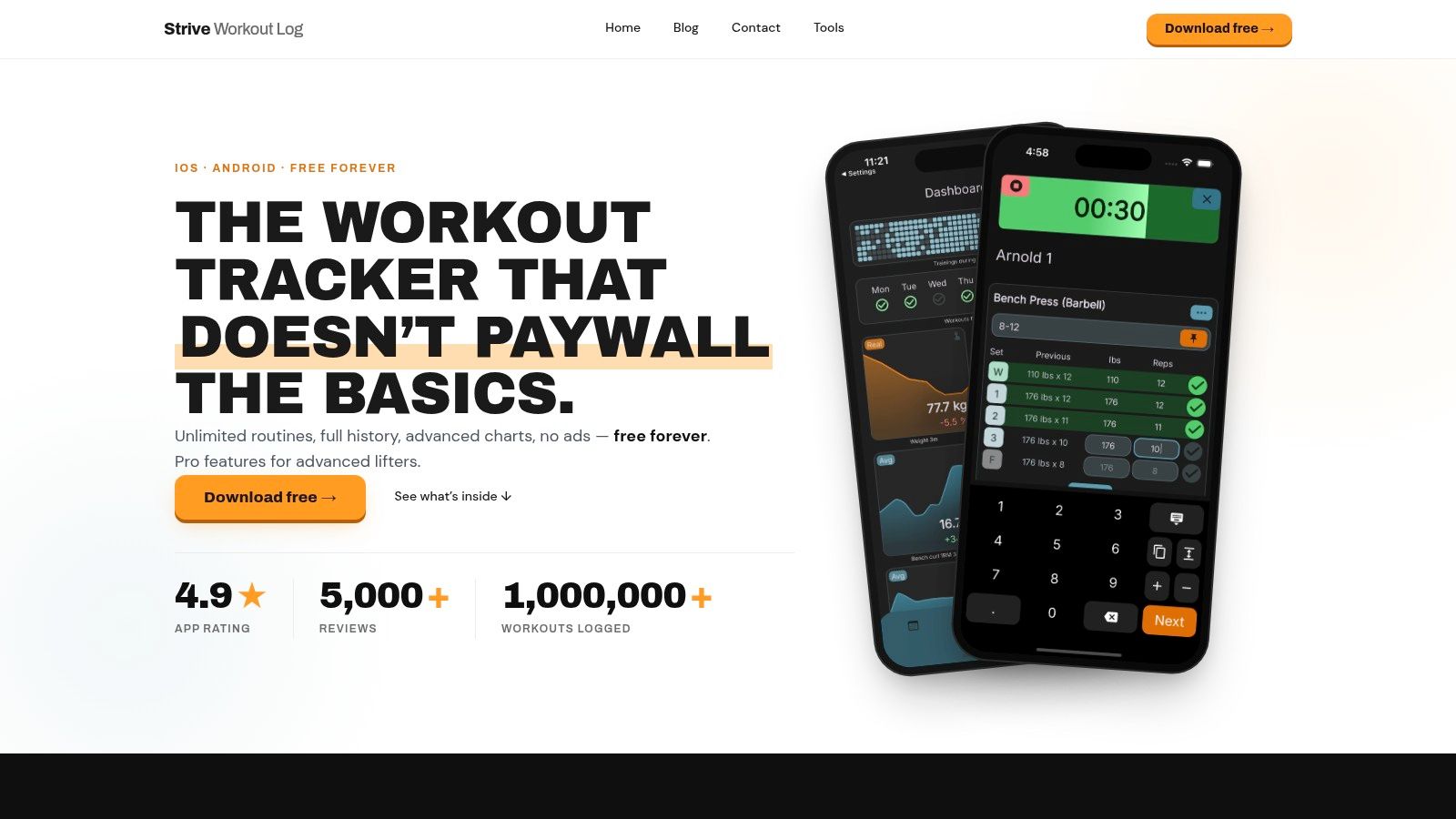
Strive Workout Log is one option that fits this use case. It lets you log exercises, sets, reps, and weights, then set targets for the next session manually. It also includes charts, rest timers, deload markers, unlimited routines, and workout plans, so the progression model stays visible instead of living in your head. The internal guide at Workout Log gives more context on how the tracking side works.
A good log also lowers decision fatigue. If the app or system can suggest the next target based on past performance, you spend less time debating small jumps and more time training. That matters more than people think, especially when the program is simple enough that the tracking should never feel like a second job.
The video below shows the tracking flow in a more visual way.
If you want the program to survive beyond the first burst of motivation, the log has to do three jobs at once. It needs to show what happened, what should happen next, and when the current approach is starting to stall.
Making Linear Progression Work for You
The best linear progression workout is the one you can repeat cleanly, track accurately, and adjust without guesswork. That usually means using overloadable compounds, keeping the rep range stable enough to compare sessions, and choosing exercises that load the muscle through a useful range of motion with limited wasted fatigue.
The science points in a clear direction. Moderate loading, close-to-failure effort, full or deep ranges of motion, and enough weekly volume all support strength and hypertrophy efficiently. Linear progression works because it packages those ideas into a rule you can execute in real life.
The method is not supposed to last forever. It's supposed to work beautifully while you're still a novice, then hand off to a more flexible progression model when the data shows you've adapted to it. That's not failure, that's good programming.
If you're ready to run progression instead of just hoping for it, use a log that makes the next step obvious and the plateau impossible to ignore. Strive Workout Log gives you a simple way to record loads, set targets, spot stalls, and keep your linear progression honest from one workout to the next.
If you want a cleaner way to run progression without spreadsheets or guesswork, start logging your sessions in Strive Workout Log. It keeps your loads, reps, deloads, and targets visible so you can tell when the plan is working and when it's time to move on.
Leave a Reply