In a 2024 study summarized by RepCount of 42 healthy young men, machine knee flexion training produced 18% overall hamstring growth versus 11% for Nordic training over 12 weeks the RepCount leg curl summary. That gap reframes machine leg curls completely. This isn't a soft finisher you add when the squat racks are busy. It's a knee flexor builder that can be loaded, stretched, and progressed with a precision free weight work rarely matches.
The catch is that the stack number tells you the least interesting part of the story. Hip position, repeatable range, and whether your pelvis stays put decide how much of that load lands on the hamstrings at long muscle lengths. Get those right and you've got a low fatigue hypertrophy tool. Get them wrong and you're recording personal records for a different exercise every week.
Why the Seated Curl Grows More Hamstring
Pick the seated machine when size is the goal. In the randomized within person study of 20 healthy adults, one leg performed seated curls and the other prone curls for 5 sets of 10 at approximately 70% of one repetition maximum, twice weekly for 12 weeks, and MRI measured whole hamstring volume increased approximately 14% with seated curls versus 9% with prone curls.
That's roughly one and a half times the growth from the same sets, reps, and relative load. The only meaningful difference was hip angle. Sitting flexes the hip, which lengthens the hamstrings that cross both hip and knee before the first rep even starts. Prone work keeps the hip near extension, so those same muscles start shorter and stay shorter through the set.
Where the Extra Growth Shows Up
The seated advantage was concentrated in the biarticular hamstrings, namely the biceps femoris long head, semitendinosus, and semimembranosus. Those three cross the hip and the knee, so hip flexion stretches them and seated curling loads them in that stretched position. The biceps femoris short head crosses only the knee, which is why hip position has far less to offer it.
This is the insight that should drive your machine choice. You're not choosing between two names for knee flexion. You're choosing between two different muscle lengths, and length is the variable the hamstrings respond to. A seated curl done through a full range gives you tension at long length with almost no balance demand, no grip limit, and very little systemic fatigue compared with a heavy hinge.
My default call: If the seated machine lets you lock the thigh pad down and keep your pelvis still, that's your primary leg curl. Don't rotate away from it for variety.
When Prone Still Earns Its Place
Prone or lying curls aren't useless. They're the right pick when the seated unit pinches your hips, when the thigh pad won't secure your legs, or when it's the only free station and skipping the work entirely is the alternative. A prone set you complete beats a seated set you keep postponing.
There's also a useful nuance for how you judge progress. Strength related outcomes were similar between positions despite the size difference. So a heavier prone stack doesn't prove the prone machine is building more hamstring. It may only prove that the mechanics, lever, and cam profile of that machine let you move a bigger number. Track size and strength separately. Load is a tool for creating tension, not the outcome itself.
Whichever machine you choose, stick to it for a full training block. Switching between seated and prone week to week turns your log into a comparison of two different exercises, and you'll chase load jumps that are really just geometry changes. Write down the seat hole, back pad position, and roller stop on day one. Those three numbers are what make next week's set the same exercise as this week's.
If both machines are available and both fit you well, I would run seated as the main movement and treat prone as a backup, not an equal partner. That ordering follows the growth data, keeps your progression readable, and reserves the shorter length variation for days when comfort or access forces your hand.
How to Set Up and Curl Each Rep
Setup is where most of the exercise is won, and it takes about twenty seconds once you know your numbers. Use the illustration below to sanity check your hip and knee position before your first working set.
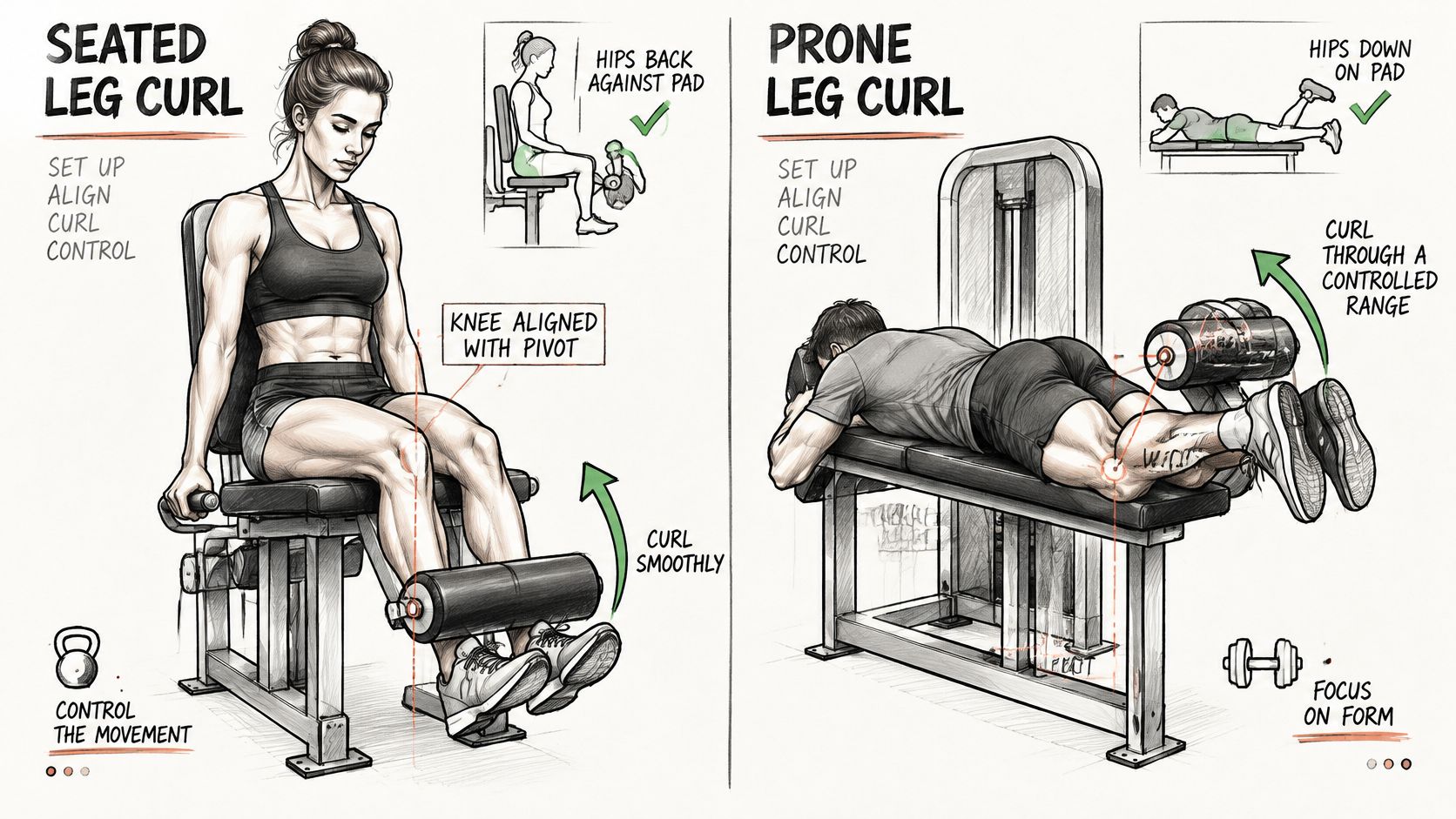
Do this the same way every session. Small setup drift is the fastest way to fake progress on a selectorized machine.
- Set the back pad and line up the knee. On a seated machine, position the pad so your hips stay flexed and your back stays supported. On a prone bench, get your hips flat. Then align the side of your knee joint with the machine's cam pivot. That alignment matters because a knee sitting ahead of or behind the pivot changes the resistance curve and can turn a smooth curl into a grind at one end and a free ride at the other.
- Bring the thigh pad down firmly. It should stop your thigh from lifting without crushing the back of your knee. If your legs can rise off the seat as you curl, the pad is too loose and your hips will start helping.
- Set the ankle roller just above your heels. Rest it on the lower Achilles area, not on the middle of your calves. Higher on the calf shortens the lever and invites swinging. Pick one foot position, neutral is fine, and keep it for good.
- Brace and start with the knee. Hold the handles, brace your trunk, and initiate each rep by bending the knee. Don't peel your hips off the pad or slide forward in the seat to get the weight moving.
- Curl through your deepest pain free flexion. Pull your heels toward your backside as far as the machine allows without your pelvis shifting. Pause briefly at the top instead of bouncing out of it.
- Lower for two to three seconds toward near full extension. This lowering phase is where the hamstrings lengthen under load, and it's the portion many people rush. Stop short of a slammed lockout and short of losing pelvic contact. You're chasing a genuine stretch, not a joint jolt.
- End the set when the range goes. If you must cut the range, bounce, or hitch your hips to finish a rep, rack the weight and take a lighter pin. That rep isn't evidence you got stronger.
- Rest and repeat the exact setup. Match the same seat holes and roller stops before the next set. Don't let a training partner's adjustments change your exercise between sets.
Why the Full Range Isn't Optional
Hamstring demand isn't flat across the rep. In a study comparing hamstring activation during injury prevention exercises, Nordic curl activation remained above 70% of maximal voluntary isometric contraction between approximately 60° and 40° of knee angle, then fell to about 27% at the end of the movement.
That study used the Nordic curl rather than a selectorized machine, but the lesson transfers directly. Different portions of knee flexion expose the hamstrings to different demands, so a partial rep shouldn't be logged as equivalent to a full one. A half rep isn't half the work, and it certainly isn't the lengthened stimulus you chose a seated machine to get. Machines also vary a lot in size and geometry between brands, which is another reason your personal settings matter more than any generic setup advice.
Watch the movement pattern here, then compare it against your own pelvis position on your next set.
One practical test before you add load. Film a set from the side and watch only your hips and lower back. If they move before your knees bend, or if your backside slides as the weight gets hard, the hamstrings are getting less of that load than you think. Fix the position first, then chase the pin. Leave a note of your seat hole somewhere you'll check next week, because you won't remember it.
Mistakes That Kill the Hamstring Stimulus
The set that looks heaviest is often the set that missed the hamstrings. Partial reps are the most expensive fault. Stopping well short of extension means the long muscle lengths that justify a seated curl barely get loaded, and you're left training the middle of the range at a weight chosen for a full rep.
Pelvic lift runs a close second. When your lower back peels off the pad on a lying curl, or your hips rise and slide on a seated one, you've turned a knee flexion exercise into a partial hip movement. Your glutes and spinal erectors take a share, the hamstrings shorten at the hip, and the stack keeps moving so it looks like progress.
Five Faults That Fake a Heavier Set
- Partial range at the bottom: The weight goes up, the stretch disappears, and the reason you picked the machine goes with it.
- Pelvis leaving the pad: The work shifts away from knee flexion the moment your hips start driving the rep.
- Knee misaligned with the pivot: The resistance curve changes, so the same pin feels brutal in one spot and weightless in another.
- Bouncing out of the bottom: Momentum carries you through the hardest portion, which is exactly the portion you need to own.
- Slamming the eccentric: Letting the stack drop throws away the controlled lengthening phase and adds joint stress for no extra stimulus.
Notice what these have in common. Every one of them lets you record a heavier or longer set while the hamstrings do less. That's why technique standards have to come before load decisions on this exercise. The machine removes balance from the equation, which is its great strength, but it also removes the obvious feedback you'd get from a barbell drifting out of position. You have to police the rep yourself.
The Ankle Position Distraction
Toe pointing debates eat up a lot of gym floor time for nothing. Research cited in a comparison of ankle positions during leg curl training found no significant differences in hamstring EMG, strength, or hypertrophy adaptations after 10 weeks, so dorsiflexing or plantar flexing the foot shouldn't be treated as a reliable overload strategy.
Fix your foot in whatever position feels stable and move on. What matters is that the position stays the same across sessions, along with machine setup, tempo, and range. Standardize those and your logged numbers mean something. That same source notes lying leg curls produced the greatest hamstring to quadriceps activation ratio among the exercises tested in a comparative EMG study, which is a genuine reason to keep them in a program, not a license to get sloppy on them.
A shorter rep with a heavier pin is a different exercise. It doesn't count as progress, no matter what the log says.
Apply that rule ruthlessly. If the pad loses contact with your body, end the set, drop one pin, and rebuild the full range before you even think about adding load. Record machine type, seat or hip angle setting, load, repetitions, and an RIR or RPE estimate for every working set. Without those fields, apparent progression may only reflect altered mechanics rather than increased hamstring capacity, and you'll spend a month celebrating a setup change.
Sets Reps and When to Add Weight
Start with the dose that produced measurable growth, then scale it to your week. A practical working weight is a load that gives you about 10 clean reps with 0 to 3 reps in reserve. That's your training weight, not a one rep max test. You should never need to find your true single on a leg curl machine to program it well.
For most lifters training beside squats or hinges, 3 to 5 hard sets, twice a week, for 8 to 12 reps is enough. Machine leg curls isolate knee flexion without the balance and trunk stabilization demands of free weight posterior chain work, so they create a strong local stimulus at a low systemic cost. That's precisely why they're valuable late in a session, and why piling on endless sets wastes the advantage. If you want the broader volume picture, this guide to how many sets build muscle lays out how to budget sets across a full week.
Machine Leg Curl Loading by Goal
| Goal | Frequency | Sets | Reps | Tempo | Stop point |
|---|---|---|---|---|---|
| Hypertrophy default | 2 days a week | 3-5 | 8-12 | 2-3 sec lower | 0-3 reps in reserve |
| MRI study dose | 2 days a week | 5 | 10 | Controlled full range | About 70% 1RM, all reps clean |
| Strength bias | 2 days a week | 3-4 | 5-8 | Controlled, no bounce | 1-3 reps in reserve |
| Optional failure | Last set only | 1 | Match the other sets | Full range held | 0 reps in reserve if the pelvis stays down |
Why Most Sets Stop Short of Failure
You don't need to fail every set to grow. The systematic review and meta analysis covering 15 studies found only a trivial hypertrophy advantage for training to set failure over non failure conditions, with an effect size of 0.19 and a 95% confidence interval from 0.00 to 0.37, and no moderating effect from volume load or relative load.
Read that carefully. Momentary failure hasn't been shown to produce superior hypertrophy compared with stopping short. So finish most sets 0 to 3 reps in reserve and reserve true failure for a selected final set, and only when your pelvis stays down and the range holds through the last rep. On a leg curl, failure usually arrives with cramping and form collapse rather than a clean stop, which makes grinding every set a poor trade. Stopping shy preserves performance in later sets and in whatever else you're training that day.
Progression rule: Add a rep before you add a plate. Machine stacks jump in big steps, and on an isolation lift that jump can be far larger than your actual strength gain that week.
When every prescribed rep stays clean at the same range and tempo, add one rep or the smallest load increase available. Lower for two to three seconds, pause briefly, and don't bounce. A one second pause at peak contraction or a slower lowering phase raises demand without touching the stack, which is useful when the next pin is out of reach.
Placement matters too. If your hamstrings are a priority and they're always fried by the time you reach curls, move them earlier in the session. If curl work is stealing from your hinge, drop a set rather than sandbagging both. Keep any faster, light load work in a separate log entry so your heavy load trend stays readable, because mixing intents in one exercise entry makes months of data hard to interpret.
What Curls Do and Do Not Cover
A machine curl trains knee flexion. It doesn't train the hamstrings as hip extensors, and it isn't an injury prevention program by itself. Keep that goal split clean from the start, because most disappointment with this exercise comes from asking it to do a job it was never built for.
Squats and deadlifts already load the hamstrings at the hip. Almost nothing in a normal leg day loads them as knee flexors, and that's the gap the leg curl fills. Use controlled full range curls to build knee flexor size and strength. Then pair them in the same week with a hip hinge or Romanian deadlift pattern if posterior chain size or sport performance matters to you. Neither movement fully covers the other, and pretending otherwise leaves half the muscle's job untrained.

The Injury Prevention Claim, With Its Limits
Hamstring function spans both knee and hip actions, while sprinting and change of direction demand force across varied joint angles at high speed. A slow, seated, single joint movement can't reproduce that. Evidence cited by the National Strength and Conditioning Association reports fewer hamstring strains when elite soccer players added lying leg curls, 3 of 15 players in the training group versus 10 of 15 controls.
Those numbers look dramatic, so state the limits plainly. It was an older, small team study. It supports keeping curls inside a broader plan that also includes range of motion work, progressive running, strengthening, and sport specific components. It does not prove the machine alone prevents strains, and it shouldn't be sold that way to an athlete returning from a tear.
Treat the machine curl as a hypertrophy isolation movement that can support a bigger plan. Not as the plan.
That framing also tells you how to progress it for athletic purposes. Build capacity with controlled full range work, monitor next day soreness separately from load, and don't let curl volume crowd out sprint exposure. If knee flexion soreness is changing your gait the next day, skip the station for a session and return at the same range on a lighter pin rather than shortening the movement to protect a number.
Variations Aren't Interchangeable
Seated, prone, and one leg setups aren't interchangeable progressions. Each changes hip angle, muscle length, and regional loading, so log a machine change as a new variation and progress the pin only inside one setup. Unilateral work has its own value for exposing side to side differences, and if your gym has no seated unit, the cable standing leg curl covers knee flexion one leg at a time with the hip near neutral.
Record variation, range of motion, tempo, unilateral work, RIR, and symptoms separately, then check whether load and reps progress without pain or excessive fatigue. That record is what separates a thoughtful return to training from guesswork. And if you're rehabbing an actual injury, none of this replaces individualized rehabilitation. The machine is a tool your clinician might use, not a substitute for their judgement.
Log the Same Curl and Add Load
The result that matters is the heaviest load you can curl for your target reps at the same seat setting, same range, and same reps in reserve. Everything else is noise dressed up as progress. If those three conditions drift, you're not comparing performances, you're comparing different exercises that happen to share a name.
Log these fields for every working set:
- Machine and variation: Seated or prone, plus the specific unit if your gym has two brands.
- Seat or hip setting: The hole number and roller stop, written once and reused.
- Load and reps: The pin and the reps you completed at full range.
- Tempo: Your lowering time, so a bounced set never gets logged as a personal record.
- RIR estimate: How many clean reps you had left, which tells you whether a load jump is earned.
Before you choose a weight, compare against last session's entry rather than going by feel. In Strive, every set shows the previous performance next to the input fields, including last weight and last reps, so the comparison is sitting in front of you while you decide. When auto progression is turned on, Strive proposes the next weights and reps after each workout, which removes the guesswork on busy days. RPE and RIR tracking, which logs proximity to failure on every set, is a Pro feature. That workflow is exactly what a workout log built for progressive overload should make effortless.
Your Four Week Seated Template
Save one seated template and run it unchanged. Four sets of 8 to 12 reps, two to three seconds down, twice a week for four weeks. Add load or reps only when every rep is full range and your hips stay quiet. In week one, find your settings at a light stack and record them. In week two, fix the range at the same weight and expect it to feel harder. In week three, push reps toward the top of the range at roughly two reps in reserve. In week four, move the pin one step and drop back toward the bottom of the rep range.
If the range shrinks at the new weight, don't take the jump. Repeat the same pin until the rep matches the one you logged. I'd rather see four weeks of identical, honest reps creeping upward than one heroic set that changed the exercise. Compare week four against week one on the same settings. If nothing moved, the fix is usually more weekly sets or better records, not a different machine.
Log your seated curl with its seat hole, tempo, and reps in reserve in Strive Workout Log, and you'll see last session's weight and reps beside every set so your next pin choice is a decision, not a guess. Build the four week template once, let auto progression propose your next loads, and keep your full history and charts free with no ads. Download it today and make your next leg day the first one you can compare.
Leave a Reply